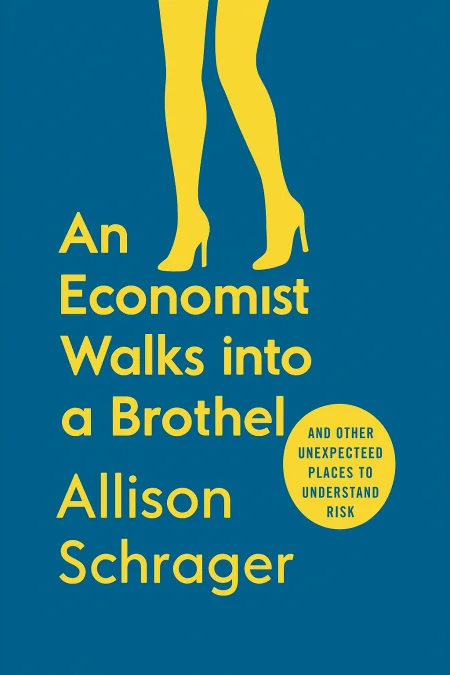
An Economist Walks into a Brothel
And Other Unexpected Places to Understand Risk
Book Edition Details
Summary
In a world where risk is the currency of life, Allison Schrager redefines the art of decision-making with her groundbreaking book, "An Economist Walks into a Brothel." Here, she unravels the hidden calculus behind every choice we make, from the mundane to the extraordinary. Schrager's journey takes us from the poker tables of Vegas to the battlefields of Iraq, each step illustrating a vivid tapestry of risk and reward. Through five transformative principles, she challenges us to master the balance between caution and audacity, turning the unpredictable into opportunity. Dive into the minds of professional risk-takers and discover how to steer life's uncertainties toward success. This isn't just a manual for survival—it's your blueprint for thriving in a world where every decision counts.
Introduction
Risk permeates every aspect of human existence, yet most people approach it with either paralyzed fear or reckless abandon. This fundamental misunderstanding stems from a critical gap in education: while we learn mathematics, history, and literature, few are ever taught the science of risk itself. The modern economy demands increasingly sophisticated risk navigation skills, as traditional safety nets disappear and individuals bear greater responsibility for their financial futures, career choices, and life decisions. The principles of financial economics offer a revolutionary framework for understanding risk that extends far beyond Wall Street. These tools, originally developed to price stocks and bonds, reveal universal patterns in how humans assess uncertainty, manage trade-offs, and optimize outcomes under pressure. By examining risk-taking in unexpected contexts - from Nevada brothels to celebrity photography, from horse breeding to military combat - we discover that successful risk management follows consistent principles whether the stakes involve millions of dollars or personal happiness. Rather than viewing risk as something to be avoided or embraced blindly, this analytical approach reveals risk as a measurable, manageable force that can be harnessed strategically. The goal is not to eliminate uncertainty, which is impossible, but to develop the intellectual tools necessary to take smarter risks and achieve better outcomes in an unpredictable world.
The Science of Risk: From Brothels to Battlefields
Risk management reaches its purest form in markets where the stakes are highest and the margins for error smallest. In Nevada's legal brothels, both sex workers and clients willingly pay enormous premiums to eliminate specific risks. Workers surrender fifty percent of their earnings to avoid the dangers of illegal work, while customers pay three times the street price for guaranteed safety and discretion. This extreme price differential reveals risk's fundamental economic principle: people will pay substantial amounts to convert uncertainty into certainty. The brothel market demonstrates how legitimate businesses create value not through the core service alone, but by managing the risks inherent in that service. Dennis Hof's innovation lay not in revolutionizing sex work, but in creating a controlled environment where both parties could pursue their goals without facing the typical dangers of violence, arrest, or exploitation. This risk reduction commanded premium pricing because both sides valued safety more than maximum profit. Financial markets operate on identical principles, though with different stakes and participants. Stock prices, bond yields, and insurance premiums all reflect society's collective assessment of various risks and the premium required to bear them. The tools developed to analyze financial risk - measuring volatility, calculating expected returns, and pricing uncertainty - apply universally because they capture fundamental truths about human decision-making under pressure. The key insight is that risk has a price, and that price can be calculated, compared, and optimized. Whether evaluating a career change, choosing a neighborhood, or planning retirement, the same analytical frameworks that govern financial markets provide clarity and structure for personal decision-making.
Human Irrationality: How Emotions Sabotage Risk Assessment
Rational risk analysis assumes people weigh potential outcomes by their probability and magnitude, but human psychology systematically distorts this process. Prospect theory reveals that people experience losses more intensely than equivalent gains, leading to predictable irrationality when facing uncertain outcomes. This loss aversion explains why poker players chase losses with increasingly desperate bets, why people buy lottery tickets despite terrible odds, and why investors hold losing stocks too long while selling winners too early. Professional risk-takers like poker champion Phil Hellmuth succeed not by eliminating these emotional biases, but by recognizing and compensating for them. Hellmuth's legendary tantrums actually mask sophisticated risk management: he limits his personal stakes, creates guaranteed payouts through side deals, and practices "broad framing" to avoid overreacting to short-term setbacks. His emotional volatility coexists with rigorous analytical discipline. The challenge intensifies when risk information is deliberately manipulated. Criminals consistently underestimate their chances of being caught, not due to superior planning but because they focus on immediate rewards while discounting future consequences. Similarly, consumers routinely misinterpret probability information depending on how it's presented, leading to poor decisions about everything from medical treatments to insurance purchases. Understanding these psychological tendencies provides a crucial advantage in risk assessment. Rather than fighting human nature, effective risk management acknowledges emotional responses while creating systems and rules that prevent them from deriving decisions. This might mean setting strict loss limits before entering risky situations, seeking out contrarian viewpoints to avoid overconfidence, or translating percentages into concrete frequencies that the human mind processes more accurately.
Risk Management Tools: Diversification, Hedging, and Insurance
Diversification represents the closest thing to a free lunch in risk management - spreading exposure across multiple uncorrelated assets reduces overall risk without sacrificing expected returns. Harry Markowitz's revolutionary insight was that investors could achieve superior outcomes by focusing on how different assets interact rather than simply picking individual winners. This principle explains why successful paparazzi form alliances to share tips and split earnings, despite constant temptation to cheat partners for exclusive photographs. The horse breeding industry illustrates diversification's power and the costs of ignoring it. Thoroughbred breeding has become increasingly inbred as commercial pressures favor horses that sell well at yearling auctions over those that actually win races. This concentration on a narrow genetic pool produces predictable sprinters but reduces the likelihood of versatile champions capable of winning major stakes races. Scientific analysis suggests that genetic diversification could improve racing outcomes while reducing costs, though changing market incentives remains challenging. Hedging and insurance offer alternative risk management approaches with different trade-offs. Hedging involves giving up potential gains to reduce potential losses - like betting against your favorite sports team to cushion disappointment or investing in bonds alongside stocks. Insurance transfers risk to specialists willing to bear it for a fee, preserving unlimited upside while eliminating catastrophic downside. The crucial insight is that these tools can be used to either reduce or amplify risk. David Bowie's securitization of his music royalties exemplified smart hedging - converting uncertain future income into immediate cash when industry disruption threatened traditional revenue models. Conversely, leverage allows investors to amplify both gains and losses, as demonstrated by Long-Term Capital Management's spectacular collapse despite Nobel Prize-winning founders and sophisticated models.
Uncertainty and Flexibility: When Risk Models Fail
Even the most sophisticated risk analysis cannot predict everything. Military operations exemplify this limitation most starkly - despite extensive planning and advanced technology, battlefield outcomes remain fundamentally unpredictable due to enemy responses, equipment failures, and countless unforeseen variables. Captain H.R. McMaster's victory at the Battle of 73 Easting succeeded not through perfect planning but through training that enabled rapid adaptation when circumstances deviated from expectations. The military's "vampire fallacy" - believing technology can eliminate risk from warfare - parallels similar delusions in financial markets and personal decision-making. The 2008 financial crisis, despite sophisticated risk models and derivatives, demonstrated that tools designed to reduce risk can create new vulnerabilities when used incorrectly or when fundamental assumptions prove wrong. Over-reliance on quantitative models can breed dangerous overconfidence. Effective uncertainty management requires maintaining flexibility alongside analytical rigor. This means empowering front-line decision-makers to adapt plans based on ground-truth information, avoiding excessive leverage that eliminates room for error, and building redundancy into critical systems. Colonel Meir Finkel's research identifies four essential elements: encouraging dissenting voices, recognizing that defensive measures invite countermeasures, facilitating rapid learning, and developing commanders capable of creative adaptation under pressure. The paradox is that good planning enables good improvisation. Thorough risk analysis educates decision-makers about likely scenarios and trade-offs, even when actual events unfold differently than anticipated. The process of thinking systematically about risks and responses builds the cognitive framework necessary for effective real-time adaptation. This suggests that uncertainty should not discourage analytical preparation but rather inform it, ensuring that risk management strategies maintain the flexibility required for successful navigation of genuinely unpredictable situations.
Summary
Risk mastery emerges not from eliminating uncertainty but from developing systematic approaches to navigate it strategically. The fundamental insight from financial economics - that risk has a price that can be measured, compared, and optimized - applies universally across human endeavors. Success comes from defining clear objectives, measuring risks accurately, diversifying appropriately, and maintaining flexibility for inevitable surprises. Whether managing a portfolio, choosing a career, or planning a life, these principles enable better decisions by transforming overwhelming uncertainty into manageable trade-offs. This framework empowers individuals to pursue ambitious goals while protecting against catastrophic losses, ultimately enabling both greater achievements and greater security in an inherently unpredictable world.
Related Books
Download PDF & EPUB
To save this Black List summary for later, download the free PDF and EPUB. You can print it out, or read offline at your convenience.
By Allison Schrager
