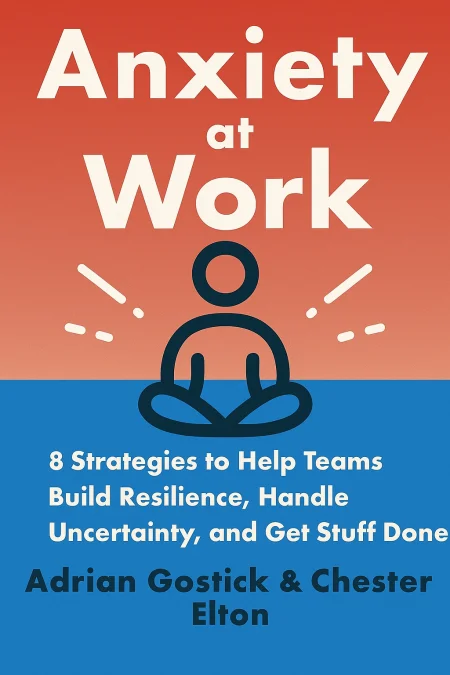
Anxiety at Work
8 Strategies to Help Teams Build Resilience, Handle Uncertainty, and Get Stuff Done
byAdrian Gostick, Chester Elton
Book Edition Details
Summary
Sunday evening dread and Monday morning jitters might sound familiar, but what if they didn’t have to be your reality? Welcome to a new era of workplace wellness with Adrian Gostick and Chester Elton’s revelatory guide, *Anxiety at Work*. This isn’t just another manual—it’s a lifeline for managers and employees alike, caught in the whirlwind of corporate pressure. From the boardroom to the breakroom, these celebrated executive coaches unveil eight transformative strategies that turn stress into serenity. Picture a work environment where anxiety is not just managed but genuinely diminished, fostering a culture of trust and collaboration. Whether you’re steering a team or navigating your career, this book offers the tools to recognize stress signals, engage in meaningful conversations, and create a calm, productive workplace. In a world where the stakes have never been higher, *Anxiety at Work* is your blueprint for thriving amidst the chaos.
Introduction
Sarah sat at her desk, fingers hovering over her keyboard as her heart raced. To anyone watching, she appeared to be the picture of composure—a high-performing marketing director who always met her deadlines and exceeded expectations. But beneath the surface, she was drowning. Every morning brought a fresh wave of dread, every meeting felt like a test she might fail, and every compliment from her boss only intensified her fear of being exposed as a fraud. Sarah's story is not unique; it's becoming the norm in today's hyperconnected, always-on work environment. What Sarah didn't know was that her manager, David, had noticed the subtle signs—the late-night emails, the perfectionist tendencies that sometimes slowed down projects, the way she seemed to retreat during team meetings. But like many well-meaning leaders, David wasn't sure how to help. He assumed that high performers like Sarah were naturally resilient and didn't need much support. This assumption, while common, can be devastating for employees who are struggling beneath a veneer of competence. The modern workplace has created a perfect storm for anxiety. Young professionals enter the workforce carrying unprecedented levels of stress from their educational years, only to find themselves in environments that often prioritize performance over well-being. Meanwhile, leaders—many of whom climbed the ranks during different times—find themselves unprepared to recognize and address the mental health challenges their teams face. This book reveals how the most successful leaders are learning to see beyond the surface, recognizing that creating a truly healthy workplace isn't just about employee satisfaction—it's about unlocking the full potential of every team member by addressing the hidden struggles that hold them back.
The Duck Syndrome: When High Performers Paddle Beneath the Surface
At Stanford University, students coined a term that perfectly captures what's happening in offices around the world: the duck syndrome. Like the graceful waterfowl gliding serenely across a pond, these students appeared to handle their demanding coursework with effortless ease. But beneath the waterline, they were paddling frantically, working themselves to exhaustion while maintaining a facade of calm competence. This metaphor has found new relevance in today's workplace, where some of our most talented employees are quietly struggling with overwhelming anxiety while projecting an image of unshakeable professionalism. Consider the experience of Chloe, a promising young professional who landed her dream job at a prestigious investment bank in Seattle. Fresh out of college with a near-perfect GPA, she had every reason to feel confident about her future. Her colleagues and manager saw exactly what they expected: a bright, capable employee who was clearly destined for success. But internally, Chloe was battling a constant stream of self-doubt and comparison. Every morning brought a crushing sense of dread, and every evening ended with her collapsing in exhaustion, having spent the day not just doing her job but also managing the intense anxiety that came with it. When she finally gathered the courage to mention to her manager that she felt overwhelmed, his dismissive response—"That's just how it is around here"—left her feeling more isolated than ever. The tragic end to Chloe's story came without warning. One day, she simply didn't show up to work. She never responded to calls or messages, never provided an explanation, and never returned to the office. She had "ghosted" her job, leaving behind a confused manager and a team that had no idea one of their star performers had been struggling so intensely. This phenomenon reveals a crucial truth about modern leadership: the employees who appear most capable of handling pressure may actually be the ones who need the most support. When leaders learn to recognize the signs of the duck syndrome and create environments where struggling employees feel safe to ask for help, they don't just prevent talented people from burning out—they unlock levels of engagement and performance that seemed impossible when those same employees were quietly drowning.
From Uncertainty to Clarity: Building Trust Through Transparent Leadership
When the COVID-19 pandemic forced FYidoctors to temporarily close all 250 of its optometry clinics across Canada, president Darcy Verhun faced a choice that would define his leadership. He could follow the traditional approach of carefully managing information flow, sharing updates only when absolutely necessary to avoid causing panic. Or he could do something radical: commit to complete transparency with his three thousand employees during one of the most uncertain periods in the company's history. Verhun chose transparency, instituting daily Zoom calls with the entire team to share everything he knew—and, crucially, everything he didn't know. These weren't polished corporate communications. They were raw, honest conversations where Verhun and his leadership team thought through problems in real time, admitted when they were unsure about the path forward, and invited questions from employees at every level. When team members asked difficult questions in the chat, executives would interrupt each other to tackle the issues on the fly. What began as a crisis management strategy evolved into something unexpected: employees started answering each other's questions faster than the leadership team could respond. The daily transparency had created such strong alignment around the company's values and decision-making principles that the entire organization was now thinking and problem-solving together. The results spoke for themselves. By midyear, as clinics reopened, FYidoctors reported its best monthly results and growth in the company's twelve-year history. The experience revealed a fundamental truth about managing anxiety in uncertain times: employees can handle almost any challenge when they understand what's happening and why decisions are being made the way they are. It's the information vacuum that creates anxiety, not the information itself. When leaders share both what they know and what they're still figuring out, they transform their teams from passive recipients of decisions into active participants in navigating challenges. This shift from secrecy to transparency doesn't just reduce anxiety—it harnesses the collective intelligence of the entire organization to find better solutions than any leader could develop alone.
Beyond Overload: Creating Sustainable Work Cultures That Thrive
The Navy SEALs represent the pinnacle of mental and physical toughness, yet their training reveals a surprising truth about handling overwhelming workloads. During the infamous "Hell Week," recruits must endure five days and nights of continuous training with only four hours of total sleep. Researchers studying who succeeds and who drops out discovered something counterintuitive: it wasn't the physically strongest or most mentally tough who made it through. Instead, success came down to a specific approach to managing overwhelming demands. The recruits who succeeded were called "Taskers"—they focused on completing one specific job at a time, then allowed themselves to rest before moving on to the next challenge. Those who failed were labeled "Optimizers"—they constantly looked ahead at all the tasks waiting for them, trying to mentally manage their entire workload simultaneously. The Optimizers wore themselves out with worry before their bodies even reached their limits. They never rested because their minds were always consumed with everything that lay ahead, creating a state of perpetual anxiety that ultimately led to failure. This military insight holds profound implications for modern workplace leadership. Too often, managers assume that their most capable employees can handle unlimited pressure, piling on responsibilities without considering the cumulative mental weight. Like the failed SEAL recruits, high-performing employees often become Optimizers by default, mentally carrying the burden of everything on their plate rather than focusing on one priority at a time. The most successful leaders learn to break down overwhelming projects into manageable chunks, help their teams prioritize effectively, and create space for mental recovery between intensive efforts. When employees can approach their work like successful SEALs—tackling one mission at a time with full focus, then genuinely recovering before the next challenge—they don't just survive high-pressure environments, they thrive in them while maintaining their mental health and long-term effectiveness.
The Power of Inclusion: Transforming Anxiety into Confidence
The story of Mitt Romney's early days at Bain Capital reads like a business school case study in how successful teams can nearly destroy themselves. The six founders of what would become a $100 billion investment firm were on the verge of walking away, torn apart by what Romney called "intractable conflicts." Personal animosity had reached such heights that productive collaboration seemed impossible. As a last resort, they agreed to attend a week-long retreat designed to either save their partnership or provide a dignified way to dissolve it. The week began catastrophically. In one exercise, each partner was asked to openly criticize what they would change about their colleagues, while the targets were forbidden from defending themselves. The session was supposed to last an hour but stretched through an entire evening and into the next morning, setting what Romney called "new records in inventive criticism." By the retreat's end, the group seemed more divided than ever. Then came a final exercise that changed everything: each partner was asked to list the five people they most respected and identify three characteristics they associated with each person. The results were stunning. Despite their fierce disagreements about strategy and personality conflicts that had nearly destroyed their partnership, all six partners had identified essentially the same core values: love, service, integrity, and faith. Every single partner had included Abraham Lincoln on their list of most admired individuals. The retreat facilitator helped them realize that their conflicts weren't about fundamentally different values—they were about different approaches to expressing shared ideals. With this foundation of common purpose revealed, the partners were able to rebuild their working relationship and collaborate productively for another decade. The experience demonstrates how inclusion isn't just about bringing different perspectives together—it's about helping people discover the shared humanity and common values that can transform anxiety-producing conflicts into productive collaboration.
Summary
The hidden struggle with workplace anxiety reveals itself not in dramatic breakdowns, but in the quiet desperation of talented people who suffer in silence while maintaining professional facades. Like Stanford's "duck syndrome," employees across industries are paddling frantically beneath the surface, exhausting themselves with the effort of appearing effortlessly competent. The most effective leaders learn to see past these carefully constructed performances to recognize when their people need support. The solution isn't complex therapy or expensive wellness programs—it's fundamentally about creating environments where authenticity is valued over perfection, where transparency replaces information hoarding, and where human connections matter as much as productivity metrics. When leaders share uncertainty rather than hiding it, break overwhelming workloads into manageable pieces, and help people discover shared values beneath surface-level conflicts, they don't just reduce anxiety—they unlock extraordinary levels of engagement and performance. The choice facing every leader is simple but profound: continue to accept the exhausting status quo where talented people burn out in silence, or begin building workplaces where the full spectrum of human experience is acknowledged and supported. The organizations that make this shift won't just have happier employees—they'll have a decisive competitive advantage in attracting, developing, and retaining the talent that drives success in an increasingly complex world. The time has come to punctuate the old story of workplace anxiety with something new: environments where people can bring their authentic selves to work and channel their energy toward shared success rather than hiding their struggles.
Related Books
Download PDF & EPUB
To save this Black List summary for later, download the free PDF and EPUB. You can print it out, or read offline at your convenience.
By Adrian Gostick
