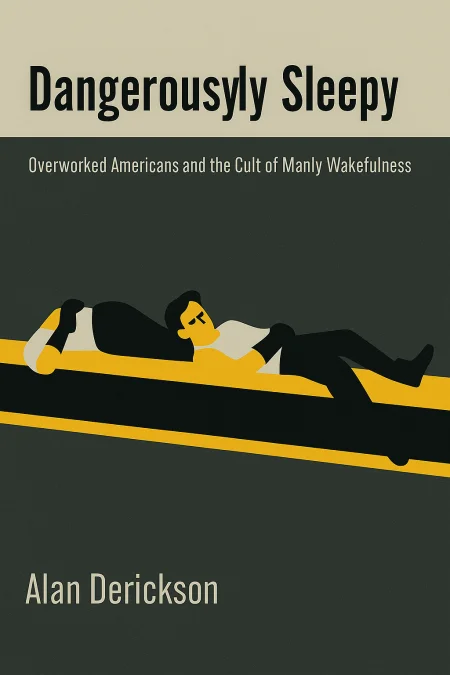
Dangerously Sleepy
Overworked Americans and the Cult of Manly Wakefulness
Book Edition Details
Summary
In a society where sleepless nights have become the badge of honor, "Dangerously Sleepy" uncovers the shadowy chronicles of sleep deprivation woven into the American work ethic. Health and labor historian Alan Derickson traces the relentless valorization of tireless labor from the dawn of the industrial age to our modern 24/7 grind. This gripping account delves into the iron wills of steelworkers, the ceaseless journeys of Pullman porters, and the road-bound odysseys of truckers, all underscored by a dangerous allure of wakefulness championed by icons like Edison and Trump. Yet, beneath the surface, the toll of these grueling hours is unmistakable, leading to a cascade of health crises. "Dangerously Sleepy" is a clarion call, challenging the glorification of exhaustion and urging a reawakening to the quiet power of rest.
Introduction
In the flickering gaslight of a Pittsburgh steel mill in 1919, workers stumbled through their shifts in a haze of exhaustion, some having labored continuously for twenty-four hours as they rotated between day and night crews. Across the country, Pullman porters maintained their dignified service aboard luxury trains while fighting to stay awake during grueling schedules that stretched over 400 hours per month. These scenes of systematic sleep deprivation reveal a hidden dimension of American industrial history that continues to shape our working lives today. This exploration uncovers how America developed a unique cultural relationship with sleeplessness, transforming what should be recognized as a basic human need into a luxury many workers could not afford. From Thomas Edison's boastful claims of needing only four hours of sleep to modern tech executives celebrating their sleepless dedication, American business culture has consistently equated rest with weakness and exhaustion with virtue. Yet behind this mythology lies a darker reality of workers pushed beyond human limits, suffering consequences that ripple through families and communities for generations. The story reveals three crucial insights about American labor history: how employers have systematically exploited workers' biological needs for competitive advantage, how scientific understanding of sleep evolved alongside worker resistance movements, and how regulatory battles over working hours reflected deeper conflicts about human dignity versus economic efficiency. This history speaks to anyone seeking to understand the roots of modern workplace exhaustion, the evolution of labor rights, and the ongoing tension between human needs and industrial demands in our 24/7 economy.
The Edison Doctrine: Industrialization and Sleep as Weakness (1880s-1920s)
The late nineteenth century witnessed the emergence of a distinctly American ideology that celebrated sleeplessness as a mark of superior character and competitive advantage. Thomas Edison, the era's most celebrated inventor, deliberately crafted a public persona around his alleged ability to function on just three to four hours of sleep per night. His famous declaration that "sleep is a criminal waste of time" became a rallying cry for ambitious Americans, transforming sleep deprivation from a hardship into a badge of honor that suggested true innovators could transcend basic human limitations through sheer willpower. This cultural mythology found its most brutal expression in the steel mills of Pittsburgh, where workers endured the notorious twelve-hour day, seven days a week, punctuated by the dreaded "long turn" - a twenty-four-hour shift that occurred whenever day and night crews switched schedules. These exhausted men, many recent immigrants seeking their piece of the American dream, lived in overcrowded boarding houses where multiple shifts of workers shared beds in rotation, creating the infamous "hotbed" system where mattresses never grew cold. The cacophony of industrial life - constant noise from nearby mills, irregular schedules, physical exhaustion - created what reformers called "broken sleep" that left entire communities in perpetual fatigue. The human cost extended far beyond individual suffering, as steel families struggled with breadwinners who worked themselves into premature aging and early death. Wives managed boarding houses to supplement meager incomes, children grew up barely knowing fathers who disappeared into the mills for days at a time, and entire neighborhoods organized their rhythms around the relentless demands of continuous production. The connection between worker exhaustion and industrial accidents became undeniable, yet employers resisted any limits on their authority to extract maximum productivity from human bodies. This period established the template for American industrial exploitation that would persist throughout the twentieth century, where the rhetoric of individual achievement and masculine vigor masked systematic denial of basic human needs. The Edison doctrine provided intellectual cover for employers who demanded impossible schedules, transforming what should have been recognized as exploitation into a test of character and ambition that would echo through subsequent generations of American workers.
New Deal Hours and Organized Labor's Sleep Victories (1930s-1950s)
The economic catastrophe of the Great Depression created unprecedented opportunities for challenging the industrial sleep regime, as policymakers sought to redistribute available work while addressing the most egregious forms of worker exploitation. The National Recovery Administration briefly established industry-wide codes that limited working hours and banned night work for women in certain industries, while the emerging federal regulation of transportation workers recognized that sleepiness posed unacceptable dangers to public safety. More significantly, the dramatic expansion of union power during this era gave workers new tools to fight collectively for their right to rest and human dignity. The Brotherhood of Sleeping Car Porters, led by A. Philip Randolph, made sleep deprivation a central organizing issue in their groundbreaking campaign for recognition and respect. These African American workers, among the most visible service employees in the nation, faced the impossible demand to remain alert and courteous while working schedules that could stretch over 400 hours per month, often catching brief naps on uncomfortable stools in cramped quarters between passenger requests. Their situation was complicated by racial discrimination that denied them access to decent lodging in many cities, forcing them to sleep in segregated facilities or in the railroad cars themselves. The porters' eventual victory in 1937, securing the first union contract for African American railroad workers, demonstrated that even the most marginalized workers could organize successfully around fundamental human needs. Their campaign reframed sleep not as personal weakness but as a prerequisite for providing quality service, connecting worker welfare with passenger safety and satisfaction. This strategic approach would influence subsequent labor organizing by showing how appeals to human dignity could be combined with practical arguments about productivity and public welfare. The steelworkers finally achieved their long-sought victory against the twelve-hour day in 1923, not through government regulation but through a combination of public pressure, expert testimony, and employer recognition that exhausted workers were actually less productive than rested ones. This triumph demonstrated that seemingly intractable systems of exploitation could be dismantled when economic logic aligned with humanitarian concerns, establishing a model for future campaigns that would emphasize the business case for humane working conditions alongside moral arguments about worker dignity.
Deregulation's Toll: The Return of Systematic Sleep Deprivation (1960s-Present)
The post-war decades brought new challenges to worker sleep as the economy shifted toward service industries operating around the clock, while deregulation movements systematically dismantled the modest protections won in earlier eras. The rise of the 24/7 economy, driven by consumer demands for constant availability and global competition requiring coordination across time zones, created unprecedented pressures for workplace flexibility that inevitably came at workers' expense. The long-haul trucking industry became the laboratory for this new form of exploitation, where independent owner-operators competed by sacrificing sleep and safety in pursuit of economic survival. The deregulation of trucking in 1980 unleashed market forces that rewarded the most desperate drivers, creating a race to the bottom where staying awake for days at a time became a competitive advantage rather than a dangerous aberration. Owner-operators, driven by equipment payments and fierce competition, routinely violated federal hours-of-service regulations, keeping false logbooks and driving until they literally fell asleep at the wheel. The widespread use of amphetamines among truckers became an open secret, with drivers relying on "bennies" and other stimulants to maintain impossible schedules that regulatory authorities treated as matters of individual choice rather than systematic exploitation. Meanwhile, the medical profession was beginning to understand sleep deprivation as a serious health issue rather than merely a character flaw. The identification of shift work sleep disorder as a legitimate medical condition in 1980 provided scientific validation for what workers had long experienced, while research linking sleep loss to cardiovascular disease, diabetes, and other chronic conditions revealed the true costs of America's sleepless work culture. Yet this growing scientific knowledge had little impact on policy, as the dominant political ideology of the era viewed any regulation of working time as unacceptable interference with market freedom. The persistence of sleep-depriving work schedules into the twenty-first century, despite overwhelming scientific evidence of their harmful effects, reflects the triumph of the flexibility regime over worker protection. From Amazon warehouse workers monitored by algorithms that track their every movement to healthcare providers working dangerous shifts during the COVID-19 pandemic, millions of Americans continue to suffer the consequences of schedules designed around operational efficiency rather than human needs, revealing how the Edison doctrine has evolved but never disappeared from American workplace culture.
Summary
The century-long struggle over sleep in American workplaces reveals a fundamental tension between human biological needs and economic systems designed to extract maximum productivity without regard for worker welfare. From the steel mills of the Progressive Era to the gig economy of today, employers have consistently found ways to treat sleep as an expendable luxury rather than a basic requirement for human health and dignity. This pattern reflects deeper contradictions in American capitalism, where the rhetoric of individual achievement and entrepreneurial freedom often masks systematic exploitation that destroys workers' bodies and communities. The historical record demonstrates that meaningful change occurs only when multiple forces align: scientific evidence of harm, organized worker resistance, public pressure, and economic incentives for employers to modify their practices. The steelworkers' victory against the twelve-hour day, the Pullman porters' success in limiting their monthly hours, and various transportation workers' campaigns for reasonable schedules show that even the most entrenched systems of exploitation can be challenged when workers unite around fundamental human needs. However, the persistence of dangerous schedules despite decades of research reveals how economic pressures can override both regulatory safeguards and scientific knowledge. Today's workers and advocates can draw crucial lessons from this history. Sleep deprivation must be understood not as individual failing but as systematic exploitation requiring collective solutions that combine moral arguments about human dignity with practical evidence about productivity and safety costs. The fight for reasonable working hours remains as urgent today as it was a century ago, demanding the same combination of scientific rigor, moral clarity, and organized resistance that has driven progress throughout American labor history. Only by recognizing sleep as a fundamental right rather than a competitive weakness can we build workplaces that prioritize human sustainability alongside economic efficiency.
Related Books
Download PDF & EPUB
To save this Black List summary for later, download the free PDF and EPUB. You can print it out, or read offline at your convenience.
By Alan Derickson
