
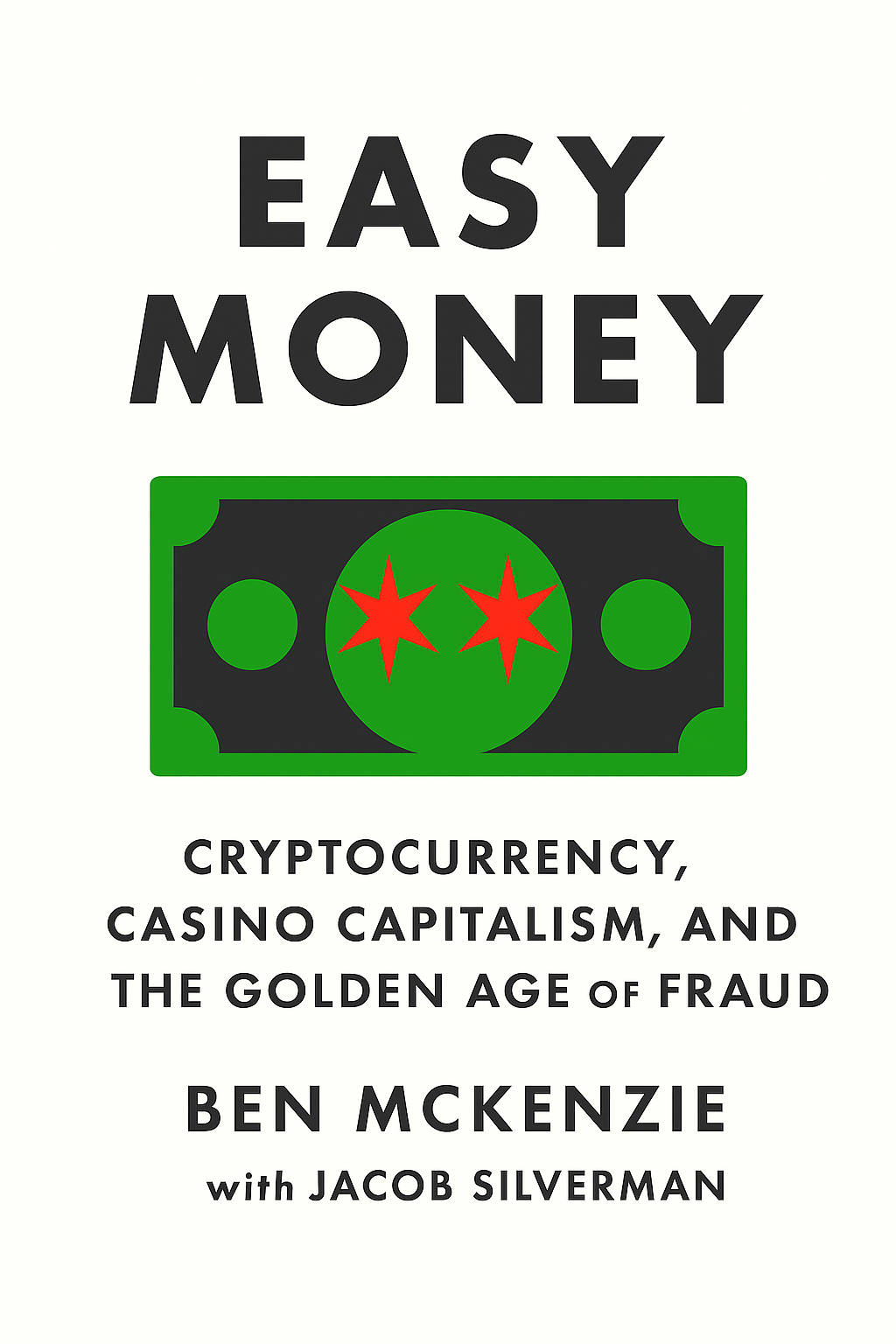
Easy Money
Cryptocurrency, Casino Capitalism, and the Golden Age of Fraud
byBen McKenzie, Jacob Silverman
Book Edition Details
Summary
In the tumultuous world of cryptocurrency, chaos reigns supreme, and Ben McKenzie—an unexpected skeptic and erstwhile TV star—dives headfirst into its stormy waters. “Easy Money” is a gripping exposé, unraveling the dizzying rise and calamitous fall of digital currency through McKenzie's eyes. Armed with skepticism and a journalist's curiosity, he teams up with Jacob Silverman to lift the veil on this enigmatic empire. From the glossy facade of digital coins to the gritty tales of everyday investors and the audacious architects of this financial phenomenon, the book paints a vivid tapestry of hubris and hope. This meticulously reported narrative challenges what we think we know about blockchain’s promise, revealing the shadows lurking behind its bright promises.
Introduction
The intersection of technological innovation and financial speculation has created one of the most sophisticated deception schemes in economic history. What emerged from the ashes of the 2008 financial crisis as a promise of decentralized monetary freedom transformed into a centralized system of wealth extraction that exploited millions of ordinary investors while enriching a small group of insiders. The cryptocurrency phenomenon reveals how complex technology can be weaponized to obscure fundamental economic relationships, creating new forms of systemic risk while concentrating power in unaccountable offshore entities. This investigation exposes the mechanisms by which digital innovation enabled unprecedented financial fraud, operating at scales that dwarf traditional Ponzi schemes while maintaining the veneer of revolutionary technology. The analysis traces the flow of money through blockchain networks, corporate structures, and political influence campaigns to reveal how an industry promising to eliminate trusted intermediaries instead created new ones with even less oversight than traditional financial institutions. The forensic examination demonstrates that cryptocurrency's technological complexity served primarily as a smokescreen for age-old financial manipulation, repackaged with Silicon Valley rhetoric about disruption and democratization. The systematic nature of this deception extends beyond individual bad actors to encompass regulatory capture, celebrity manipulation, and the exploitation of behavioral psychology on an industrial scale. Understanding these patterns becomes crucial for recognizing how speculative bubbles exploit technological uncertainty and regulatory gaps to perpetuate sophisticated forms of financial predation disguised as innovation.
Technological Complexity as Financial Fraud: The Crypto Ponzi Architecture
Cryptocurrency's fundamental structure mirrors classic Ponzi schemes with mathematical precision, despite its technological sophistication. The industry's core promise that digital tokens could simultaneously serve as revolutionary technology and profitable investments created an inherent contradiction requiring constant influxes of new money to maintain the illusion of value creation. Unlike traditional Ponzi schemes that fabricate investment strategies, crypto operations utilized complex blockchain mechanisms to obscure their true nature while achieving identical wealth transfers from later participants to earlier ones. The mathematical impossibility of crypto's promises becomes evident when examining basic industry economics. With no underlying productive assets or cash flows, cryptocurrency values depended entirely on speculation and market manipulation. Internal communications from major exchange operators revealed that only 10-15 percent of crypto's nominal value represented actual money that could be withdrawn, exposing the fundamental fraud where most crypto wealth existed solely on paper, backed by circular trading between affiliated entities rather than genuine market demand. Stablecoins emerged as crucial infrastructure enabling this deception, promising dollar-backed stability while operating as fractional reserve systems with minimal oversight. These digital tokens functioned as poker chips in crypto casinos, allowing exchanges to create artificial liquidity and manipulate prices across thousands of different cryptocurrencies. The largest stablecoin operators maintained opaque banking relationships and refused independent audits, indicating that even the supposedly stable foundation of crypto markets rested on questionable reserves. The technological complexity of blockchain systems provided perfect cover for fraudulent operations. Smart contracts and decentralized finance protocols created layers of abstraction that made it nearly impossible for ordinary investors to understand fund destinations or return generation mechanisms. This complexity served to intimidate potential critics while creating an aura of sophisticated innovation around fundamentally simple wealth extraction schemes.
Manufacturing Consent: Celebrity Marketing and Systematic Market Manipulation
The crypto industry's marketing apparatus represented a sophisticated manipulation campaign that weaponized celebrity influence and social media algorithms to drive retail investment into fundamentally worthless assets. Major exchanges paid tens of millions to sports stars, actors, and influencers who promoted cryptocurrency investments without disclosing speculative risks or their financial relationships with crypto companies. This celebrity endorsement infrastructure created artificial credibility for an industry lacking legitimate use cases or sustainable business models. Market manipulation occurred through coordinated mechanisms that would constitute securities fraud in regulated markets. Exchanges engaged in wash trading, artificially inflating volumes by buying and selling tokens between their own accounts to create false impressions of market activity and liquidity. Major trading firms exploited privileged access to manipulate prices during critical moments, extracting profits from retail traders who lacked information about these coordinated moves. The concentration of crypto ownership among a small number of whale accounts enabled systematic price manipulation across entire markets. The deception infrastructure extended to crypto media and conference circuits, where industry insiders created echo chambers reinforcing bullish narratives while suppressing critical analysis. Crypto publications received funding from companies they covered, creating conflicts of interest that prevented honest reporting about industry problems. Major conferences became elaborate marketing events where speakers promoted their own tokens while presenting themselves as neutral blockchain technology experts. Social media platforms amplified manipulation campaigns through algorithmic systems rewarding engagement over accuracy. Crypto promoters exploited psychological triggers like fear of missing out and social proof to drive speculative behavior, creating viral marketing campaigns reaching millions of potential investors. The gamification of trading through mobile apps transformed investment decisions into addictive behaviors, particularly targeting young men with promises of easy wealth and financial independence.
Regulatory Capture and Political Protection: How Crypto Bought Government Silence
The cryptocurrency industry's political influence campaign represented one of the most successful regulatory capture efforts in recent history, systematically compromising oversight mechanisms through strategic donations, lobbying, and revolving door employment between government and industry. Crypto executives donated over one hundred million dollars to political campaigns while simultaneously arguing their industry was too innovative for existing financial regulations. This coordinated effort created protective political environments allowing fraudulent schemes to operate with minimal government interference. The revolving door between crypto companies and regulatory agencies created inherent conflicts undermining effective oversight. Former regulators joined crypto firms as highly paid executives and lobbyists, while crypto industry veterans moved into key government positions where they shaped policy favoring former employers. This personnel exchange ensured regulatory agencies lacked both expertise and political will to address crypto's systemic problems, even as evidence of widespread fraud accumulated. Congressional hearings and regulatory proceedings became theater rather than meaningful oversight, with crypto executives using technical complexity to confuse lawmakers and avoid substantive questions about business practices. Industry representatives successfully framed regulatory discussions around innovation and competitiveness rather than consumer protection and fraud prevention. This rhetorical strategy convinced politicians that restricting crypto would disadvantage America in global technology competition, despite lacking evidence for crypto's productive economic value. The industry's political strategy deliberately targeted both parties to ensure bipartisan protection. Democratic politicians received donations framed around progressive values like financial inclusion, while Republicans were courted with libertarian arguments about innovation and free markets. This dual approach created political consensus that crypto deserved special legal treatment, even as traditional financial regulations would have immediately identified most crypto business models as fraudulent securities offerings.
Human Cost and Economic Devastation: The Real-World Impact of Digital Deception
The human toll of cryptocurrency's collapse extended far beyond abstract market losses, destroying financial security for millions of ordinary people who trusted industry promises of revolutionary technology and guaranteed returns. Retirement savings, college funds, and emergency reserves vanished when crypto exchanges froze withdrawals or declared bankruptcy, leaving customers without recourse or hope of recovery. The industry's targeting of financially vulnerable populations, including communities of color, young adults, and those excluded from traditional banking, amplified the social damage of its eventual collapse. Individual victim stories reveal psychological manipulation tactics used to extract money from those who could least afford losses. Elderly investors were convinced to move retirement funds into high-yield crypto lending platforms operating as obvious Ponzi schemes. Young adults took out loans and maxed credit cards to buy digital tokens promoted by social media influencers. Families lost homes and businesses when crypto investments they believed were safe turned out to be complete frauds operated by criminals in offshore jurisdictions. The international dimension of crypto fraud created additional barriers to justice and recovery for victims. Most major crypto companies operated from countries with weak financial regulations and limited cooperation with law enforcement, making it nearly impossible to recover stolen funds or prosecute perpetrators. When exchanges collapsed, customer funds often disappeared into complex corporate structures designed to shield assets from creditors and legal authorities. The broader economic impact rippled through communities targeted by industry marketing campaigns. Local businesses accepting cryptocurrency payments found themselves holding worthless tokens. Real estate markets in crypto-heavy areas experienced additional volatility as speculative wealth evaporated. The psychological trauma of financial loss combined with shame of deception created lasting damage extending well beyond immediate monetary losses, affecting families and communities for years after initial fraud exposure.
Summary
The cryptocurrency industry's rise and fall demonstrates how technological complexity can be weaponized to perpetrate financial fraud at unprecedented scale, exploiting regulatory gaps and public trust to extract billions from ordinary investors while enriching a small group of insiders. The systematic nature of crypto's deception, from manipulated markets to captured regulators to sophisticated marketing campaigns, reveals the inadequacy of existing frameworks for protecting consumers from technologically sophisticated financial predators. The collapse of major crypto companies exposed the industry's fundamental hollowness, but not before millions lost money they could not afford to lose, highlighting the urgent need for regulatory systems capable of distinguishing between genuine innovation and elaborate fraud schemes designed to exploit public fascination with emerging technology.
Related Books
Download PDF & EPUB
To save this Black List summary for later, download the free PDF and EPUB. You can print it out, or read offline at your convenience.
By Ben McKenzie
