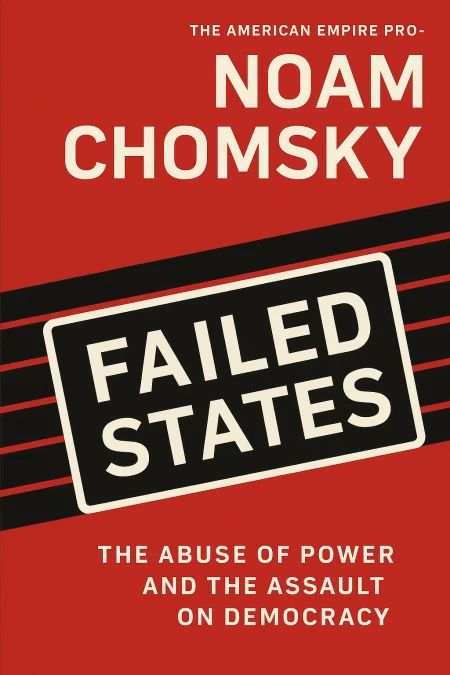
Failed States
The Abuse of Power and the Assault on Democracy
Book Edition Details
Summary
With a piercing gaze fixed on the world's most formidable superpower, Noam Chomsky's "Failed States" dismantles the facade of American democracy. Stripping away the veneer of liberty, Chomsky lays bare a nation whose democratic ideals are crumbling under the weight of its own contradictions. The United States, he argues, mirrors the very "failed states" it chastises, caught in a web of self-interest and unchecked power. Through incisive analysis, Chomsky exposes the perilous consequences of U.S. policies that disregard both domestic welfare and global harmony, spotlighting the ominous escalation towards militarization and nuclear threats. This unflinching critique challenges readers to reconsider America's role on the world stage, questioning the legitimacy of its self-proclaimed status as the bastion of democracy. "Failed States" is a clarion call, urging a reevaluation of a system veering dangerously off course.
Introduction
The traditional understanding of failed states focuses on distant nations plagued by civil war, corruption, and institutional collapse. This analysis challenges that comfortable assumption by applying the same diagnostic criteria to the world's most powerful democracy. The investigation reveals a troubling paradox: while condemning other nations for their failures to uphold democratic norms and international law, the United States exhibits many characteristics typically associated with state failure, including systematic exemption from legal constraints, inability to protect citizens from preventable threats, and governance structures increasingly divorced from popular will. The methodology employed here involves rigorous comparative analysis, measuring American policies against the same standards applied to nations labeled as threats to international order. This approach reveals patterns that transcend partisan politics, suggesting deeper structural problems within contemporary democratic institutions. The examination proceeds through multiple dimensions of governance failure, from nuclear brinksmanship that endangers global survival to systematic violations of international legal frameworks that undermine the foundations of peaceful coexistence. The framework illuminates how democratic rhetoric can mask fundamentally anti-democratic practices, creating a dangerous gap between formal institutions and substantive governance. This disconnect threatens not only American democracy but the broader international order, as other nations observe and potentially emulate patterns of behavior that prioritize power over principle. Understanding these dynamics becomes essential for anyone seeking to comprehend how democratic institutions can be systematically undermined while maintaining their formal appearance.
The Outlaw State: US Exemption from International Law
International law represents humanity's attempt to establish universal principles that constrain the behavior of all nations regardless of their power. The foundational premise requires that legal standards apply equally to all actors, creating predictable rules that enable peaceful coexistence and cooperation. However, American policy operates on the explicit assumption that international law constrains other nations while leaving the United States free to act according to its own interpretation of necessity and strategic interest. This exemption manifests across multiple domains with remarkable consistency. The rejection of International Criminal Court jurisdiction, withdrawal from arms control treaties signed by virtually all other nations, and explicit assertion of rights denied to others reveal a systematic pattern of self-exemption from universal principles. When international institutions issue rulings that conflict with American preferences, their authority is simply dismissed or ignored, regardless of legal merit or international consensus. The consequences extend far beyond immediate policy disagreements to threaten the entire framework of international cooperation. By demonstrating that international law applies only to weaker nations, this behavior encourages other powerful states to follow suit and undermines the rules-based order that emerged from the catastrophes of the twentieth century. The resulting system increasingly resembles pure power politics, where might makes right and smaller nations have no recourse against the predations of the strong. Perhaps most troubling is how this exemption has become so normalized within domestic political discourse that it rarely generates serious debate. The assumption that America stands above international law has transformed from a controversial position requiring justification into an unquestioned premise underlying foreign policy discussions. This normalization represents a fundamental departure from the principles that originally guided American engagement with the world and signals a dangerous drift toward the arbitrary exercise of power unconstrained by legal or moral limitations.
Democracy Promotion as Imperial Strategy: The Continuity Thesis
The rhetoric of democracy promotion has become the primary justification for American interventions abroad, yet systematic examination reveals a striking disconnect between democratic ideals and actual policy implementation. Support for democracy correlates not with democratic practices or popular sovereignty but with alignment with American strategic and economic interests. This pattern persists across different administrations and reflects structural imperatives that transcend partisan political preferences. Historical analysis demonstrates consistent support for authoritarian regimes when they serve American interests, while democratically elected governments face subversion or overthrow when they pursue independent policies. From the overthrow of democratic governments in Chile, Iran, and Guatemala to contemporary interventions in Haiti, Venezuela, and Iraq, the same principles apply: democracy is acceptable only within limits that preserve fundamental power relationships favorable to American interests. The mechanisms of selective democracy promotion operate through multiple channels that shape political outcomes while maintaining plausible deniability. Economic aid flows disproportionately to compliant regimes regardless of their democratic credentials, while economic warfare targets governments that pursue independent development strategies. Military assistance and training programs strengthen security forces that often serve primarily to suppress domestic opposition rather than external threats. Most revealing is the speed with which democratic rhetoric disappears when genuine popular movements emerge that might challenge American interests. The rapid withdrawal of support for democratically elected governments that choose policies incompatible with American preferences demonstrates that democracy promotion serves primarily as a tool of imperial management rather than a genuine commitment to popular sovereignty and self-determination.
The Democratic Deficit at Home: Corporate Control vs Popular Will
The gap between popular preferences and actual policy outcomes in American domestic politics has reached proportions that fundamentally challenge basic assumptions about democratic governance. Systematic polling data reveals that on issue after issue, substantial majorities support policies that receive no serious consideration from political institutions, while policies opposed by most citizens are routinely implemented without meaningful debate or opposition. This democratic deficit operates through sophisticated mechanisms that have transformed electoral democracy into a largely theatrical exercise. The role of concentrated wealth in shaping political discourse through campaign contributions, lobbying, and media ownership has created barriers that prevent popular preferences from translating into policy outcomes. Elections have become marketing exercises designed to manipulate voter behavior rather than provide meaningful choices about policy direction. Corporate power has achieved unprecedented political influence through legal doctrines that grant corporations rights exceeding those of actual persons while requiring them by law to prioritize profit maximization over all other considerations. These immortal entities with vast resources and pathological motivations now dominate political decision-making processes, creating a system where government serves concentrated private power rather than the general welfare. The result represents a fundamental inversion of democratic principles, where formal democratic institutions provide legitimacy for a system that systematically excludes popular participation from meaningful policy decisions. The maintenance of electoral rituals and democratic rhetoric obscures but cannot eliminate the reality that popular sovereignty has been largely eliminated from American political life, replaced by a form of managed democracy that serves elite interests while marginalizing the needs and preferences of ordinary citizens.
Case Studies: Middle East Policy and the Rhetoric-Reality Gap
Middle East policy provides particularly stark illustrations of how democratic rhetoric serves to obscure imperial objectives that systematically undermine the democratic principles it claims to promote. The region's strategic importance, derived primarily from its vast energy resources and geographical position, has led to consistent support for authoritarian regimes that serve American interests while opposing democratic movements that might threaten those arrangements. The Israeli-Palestinian conflict exemplifies these contradictions most clearly. Despite overwhelming international consensus supporting Palestinian rights and a negotiated two-state solution, American policy has consistently enabled Israeli expansion and the systematic violation of Palestinian rights through diplomatic protection, military aid, and economic support. This support continues despite clear violations of international law and American domestic legislation, revealing how strategic considerations override both legal obligations and stated democratic principles. The invasion and occupation of Iraq represents perhaps the most dramatic example of how democratic rhetoric can justify actions that systematically destroy democratic possibilities. The dismantling of Iraqi state institutions, the installation of a sectarian political system, and the broader destabilization of the region were all carried out under the banner of democracy promotion. The gap between stated objectives and actual outcomes reveals the true priorities driving policy decisions. Regional allies like Saudi Arabia, Egypt, and other authoritarian regimes receive massive military and economic support precisely because they suppress democratic movements that might threaten American control over regional resources and strategic positions. When genuine democratic movements emerge, as during various Arab Spring uprisings, American support quickly evaporates if these movements threaten to produce outcomes incompatible with imperial objectives, demonstrating that democracy promotion serves primarily as ideological cover for traditional power politics rather than genuine support for popular sovereignty.
Summary
The systematic examination of American behavior both internationally and domestically reveals a profound crisis of legitimacy that transcends partisan political divisions and reflects deeper structural problems with contemporary governance arrangements. The evidence demonstrates that the greatest threat to democratic governance comes not from external enemies or failed states abroad, but from the concentration of power within ostensibly democratic societies that has hollowed out democratic institutions while maintaining their formal appearance. The gap between democratic rhetoric and authoritarian practice has reached proportions that threaten both domestic stability and international order, as the language of democracy increasingly serves to justify fundamentally anti-democratic practices that serve narrow elite interests rather than popular will. Understanding these patterns represents a crucial step toward recognizing how democratic institutions can be systematically undermined while preserving their legitimizing function, and why genuine democratic renewal requires confronting the concentration of private power that has captured public institutions and transformed them into mechanisms for elite control rather than popular governance.
Related Books
Download PDF & EPUB
To save this Black List summary for later, download the free PDF and EPUB. You can print it out, or read offline at your convenience.
By Noam Chomsky
