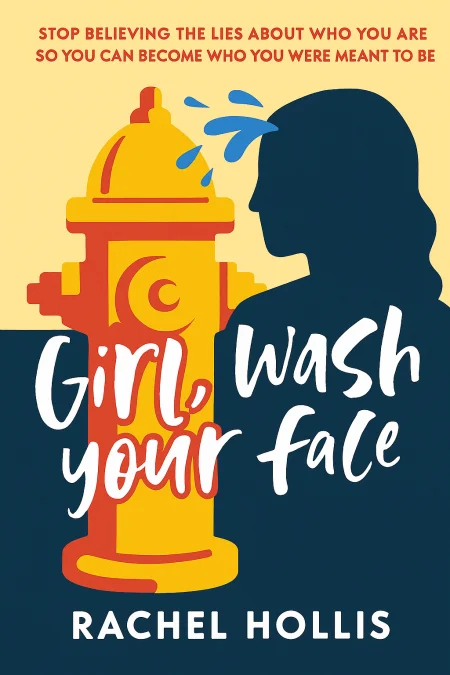
Girl, Wash Your Face
Stop Believing the Lies About Who You Are So You Can Become Who You Were Meant to Be
Book Edition Details
Summary
Rachel Hollis weaves a bold tapestry of truth and laughter, unraveling the myths that bind us in her debut, "Girl, Wash Your Face." With a voice that resonates like a trusted confidante, Hollis reveals the personal battles and quirky anecdotes that pepper her journey, from craving Hollywood romance to navigating parenthood's peculiar challenges. Each chapter dismantles a falsehood that once dimmed her spirit, inviting readers to discard self-doubt and embrace their agency. This is more than a book; it's a call to arms, urging women to reignite their dreams and seize their happiness with unyielding resolve. Hollis’s candid narrative offers both solace and a spark, reminding us that life's joy is a fierce, personal pursuit.
Introduction
Sarah stared at her reflection in the bathroom mirror at 3 AM, her eyes red from crying. Another evening had ended with her snapping at her children, then retreating to bed with a glass of wine and a heavy heart full of shame. "I'm such a terrible mother," she whispered to herself, the same refrain that had played in her head for months. What Sarah didn't realize was that this crushing self-judgment wasn't truth—it was one of many lies she'd unconsciously accepted about herself, lies that were slowly suffocating her authentic spirit. We all carry invisible scripts written by past wounds, societal expectations, and fear-based thinking. These internal narratives whisper that we're not good enough, that we need to be perfect to be loved, or that our dreams are too big for someone like us. They convince us that happiness lies just around the corner—in the next promotion, the perfect relationship, or when we finally lose those last ten pounds. But what if these voices aren't protecting us? What if they're actually the prison bars keeping us from the vibrant, authentic life we were meant to live? This journey isn't about perfection or having all the answers. It's about recognizing the lies that have shaped our choices, understanding how they took root, and discovering the courage to rewrite our stories. Through honest examination of our deepest struggles and fears, we can break free from the patterns that no longer serve us and step into the fullness of who we were created to be.
The Weight of Perfectionism: When Self-Worth Becomes Performance
The first time her face went completely numb, she was nineteen years old, working tirelessly at her dream job while juggling a failing long-distance relationship. Stress consumed her days and nights, but she pushed through, believing that if she just worked harder, achieved more, everything would fall into place. Then one morning, she couldn't move the left side of her face. Bell's palsy, the doctor explained—a condition often triggered by extreme stress and exhaustion. But even lying in a hospital bed with facial paralysis, her first thought wasn't about rest or recovery. It was about the work she was missing, the goals she wasn't achieving, the ways she was failing to prove her worth. Years later, similar episodes would follow whenever stress peaked in her life. Each time, her body was screaming what her mind refused to acknowledge: the relentless pursuit of external validation was slowly destroying her from within. She had learned early that love came with conditions. Achievement brought praise, success earned attention, but simply being herself—flawed, uncertain, ordinary—felt insufficient. This pattern had been carved deep in childhood, when a parent's approval seemed to depend entirely on performance. Good grades, perfect behavior, constant productivity became the currency she used to purchase acceptance, first from family, then from the world. The cruel irony of perfectionism is that it promises control while delivering chaos. The harder we chase flawless performance, the more we lose touch with our authentic selves. We become actors in our own lives, so focused on hitting our marks that we forget why we stepped onto the stage in the first place. True peace comes not from achieving perfection, but from accepting our beautifully imperfect humanity and recognizing that our worth was never meant to be earned.
Toxic Relationships and the Journey to Self-Respect
At nineteen, she met him and knew instantly she would marry him. He was older, sophisticated, everything her inexperienced heart thought it wanted. What followed was a year of emotional whiplash that would teach her the difference between love and desperation, between being chosen and choosing herself. He kept her at arm's length while pulling her close enough to keep hope alive, treating her like a secret during the day and a convenience at night. She accepted crumbs of affection because she didn't know she deserved a feast. When friends ignored her at parties, when he flirted with other women in front of her, when he introduced her only as "the nineteen-year-old," she swallowed her dignity and smiled. She had never learned that love without respect isn't love at all—it's just emotional starvation dressed up in romantic clothing. The night everything changed, she was sitting on her bright pink comforter, begging him not to leave her. But something shifted in that moment of complete humiliation. A voice inside her whispered the truth she'd been avoiding: this wasn't what love looked like. Real love wouldn't require her to shrink herself to fit someone else's convenience. Real love wouldn't leave her questioning her worth every single day. That night, she made the hardest choice of her young life—she chose herself. When he called the next day with his usual mixed signals, she said the words that would change everything: "I don't deserve to be treated like this." It was the first time she had ever stood up for herself in that relationship, and ironically, it was the moment he realized he was losing her. But by then, she had already found something more valuable than his attention—her own self-respect. The relationships we accept teach us what we believe we deserve. When we settle for less than love that honors our whole being, we're not just compromising our happiness—we're betraying our souls. Sometimes the most courageous act of love is walking away from someone who can't see our worth, trusting that somewhere in the future, someone will celebrate the very things that others took for granted.
From Workaholic to Whole: Learning to Rest and Receive Love
The vertigo hit during one of the busiest seasons of her career. The room would spin violently whenever she stood up, forcing her to grip furniture just to walk across the room. Doctor after doctor couldn't explain it, prescribing allergy medication for what they assumed was seasonal vertigo. For over a year, she adapted to the dizziness, taking extra pills and working longer hours to compensate for her decreased productivity. It wasn't until she visited a homeopathic doctor that someone finally asked the right questions. Not about her physical symptoms, but about her stress levels, her work schedule, her emotional state. As he listened to her describe sixty-hour work weeks and the constant pressure to prove herself, he suddenly interrupted: "Your vertigo is your body's response to emotional overload. Go home and do nothing." The prescription horrified her more than any medicine could. Do nothing? The idea made her physically sick. She had built her identity around productivity, around being indispensable, around achieving more and more until someone finally said she was enough. But her body was staging a rebellion, demanding the rest her mind refused to grant. She was drowning in her own success, mistaking motion for progress, achievement for fulfillment. Learning to rest felt like learning a foreign language. At first, sitting still for even an hour created overwhelming anxiety. But slowly, she began to understand that her worth wasn't tied to her output. She was valuable not because of what she produced, but simply because she existed. The driven little girl who had learned to earn love through performance was finally learning to receive it freely. True strength isn't found in relentless doing, but in the wisdom to know when to stop. When we mistake our worth for our work, we rob ourselves of the very thing we're working toward—a life worth living. Rest isn't the absence of productivity; it's the presence of peace, the sacred space where our souls remember who we are beyond what we do.
Summary
These stories reveal a profound truth that echoes through every human heart: the lies we tell ourselves aren't random—they're survival strategies that once helped us navigate difficult situations but have now become the very chains that bind us. Whether it's the perfectionist who believes love must be earned, the people-pleaser who accepts crumbs instead of genuine connection, or the workaholic who equates worth with productivity, these patterns share a common thread—they all stem from forgetting our inherent value. The path to authentic living isn't about perfection or having all the answers; it's about developing the courage to question the stories we've accepted as truth. When we examine these lies with compassion rather than judgment, we discover that beneath each limiting belief lies a beautiful, worthy human being who simply forgot their own magnificence. The woman who stands up for herself in a toxic relationship isn't just changing her circumstances—she's reclaiming her birthright of dignity. The achiever who learns to rest isn't giving up on success—she's discovering that she was already enough before she accomplished anything at all. Your life doesn't have to be a performance, and your love doesn't have to be earned. The very fact that you're here, reading these words, reaching for something better, is proof that you're already worthy of the authentic, joy-filled existence you're seeking. The lies may have shaped your past, but they don't have to write your future. Today, you can choose truth, choose yourself, and choose to believe that you are exactly who you were meant to be—beautifully, imperfectly, authentically human.
Related Books
Download PDF & EPUB
To save this Black List summary for later, download the free PDF and EPUB. You can print it out, or read offline at your convenience.
By Rachel Hollis
