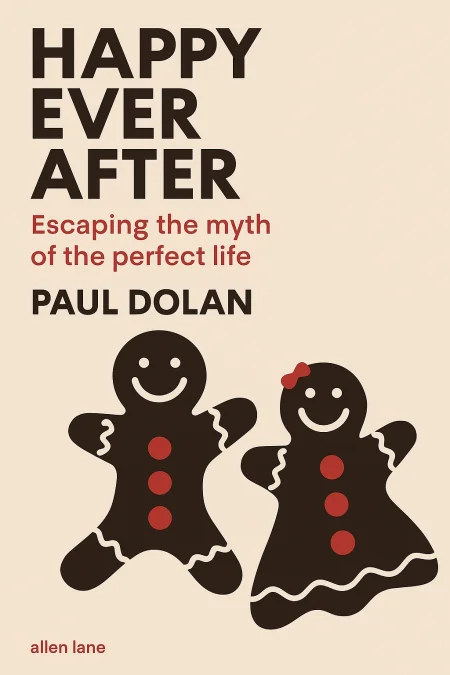
Happy Ever After
Escaping The Myth of The Perfect Life
Book Edition Details
Summary
Whispers of society paint happiness as a checklist: education, success, marriage, children. But what if the true secret to joy is hidden beyond these familiar tales? In "Happy Ever After," acclaimed happiness guru Professor Paul Dolan shatters the glass of conventional wisdom with startling research and riveting insights. He challenges us to defy societal scripts and craft a life brimming with genuine fulfillment. Dolan's compelling narrative urges a reawakening—an invitation to find liberation from inherited expectations and embrace a mosaic of meaningful experiences that enrich not only our own lives but foster greater empathy towards others. Happiness, Dolan posits, is not a destination dictated by others; it's a personal journey crafted by our own choices and values.
Introduction
Modern society has constructed elaborate narratives about what constitutes a successful, fulfilling life. These social stories permeate every aspect of our existence, from career ambitions to relationship choices, creating invisible frameworks that guide our decisions and shape our judgments of others. The fundamental premise examined here challenges the assumption that following these widely accepted life scripts necessarily leads to happiness or well-being. The investigation employs a consequentialist lens, prioritizing actual outcomes over adherence to prescribed social norms. By examining empirical evidence from psychology, economics, and sociology, a systematic critique emerges of three dominant meta-narratives that govern contemporary life: the pursuit of ever-greater achievement (Reaching), conformity to relationship expectations (Related), and adherence to moral and behavioral standards (Responsible). This analysis reveals how these narratives often function as traps, creating suffering rather than alleviating it. The evidence suggests that many widely cherished beliefs about success, relationships, and responsibility rest on shaky empirical foundations. The exploration invites readers to question their assumptions about what makes life worth living, offering a framework for evaluating life choices based on actual experience rather than social expectation. The ultimate goal is liberation from the tyranny of one-size-fits-all prescriptions for human flourishing.
The Narrative Trap: How Social Stories Control Our Lives
Social narratives operate as powerful, often invisible forces that shape individual behavior and collective judgment. These stories function through three key mechanisms: they provide behavioral regularities that simplify complex decisions, create a sense of moral obligation about how life should be lived, and establish social sanctions for those who deviate from prescribed paths. The concept of narrative traps emerges when these social stories become so dominant that they override personal experience and individual well-being. People find themselves pursuing goals not because these goals bring happiness, but because society has designated them as markers of a life well-lived. The trap lies in the disconnect between what the narrative promises and what it actually delivers in terms of human flourishing. The power of these narratives is reinforced by social dominance orientation and class structures. Those with greater social and economic power tend to create and enforce stories that legitimize existing hierarchies. Working-class individuals often face particular challenges when their authentic selves conflict with middle-class professional expectations, creating internal tension between personal identity and social advancement. Recognition of narrative traps offers the possibility of choice. Once individuals understand how social stories influence their decisions, they can begin to evaluate whether adherence to these narratives genuinely serves their well-being or merely satisfies external expectations. This awareness creates space for more authentic decision-making based on personal experience rather than social prescription.
Reaching for More: The Futility of Endless Pursuit
The Reaching meta-narrative encompasses three powerful social imperatives: the accumulation of wealth, the achievement of professional success, and the pursuit of educational credentials. Each of these domains operates on the assumption that more is always better, creating an endless treadmill of aspiration that rarely delivers the promised satisfaction. Evidence from happiness research reveals a fundamental flaw in the wealth narrative. Beyond meeting basic needs, additional income provides diminishing returns to well-being. Data from the American Time Use Survey demonstrates that people earning between $50,000 and $75,000 report higher levels of daily happiness and meaning than those earning over $100,000. The wealthiest group experiences the least sense of purpose in their daily activities, suggesting that excessive focus on financial accumulation may actually undermine life satisfaction. Professional success narratives create similar problems. While employment generally benefits well-being, the relentless pursuit of status and recognition often leads to longer working hours, increased stress, and reduced time for activities that generate genuine happiness. Research shows that people in high-status professions like law report lower levels of job satisfaction compared to those in supposedly "lesser" occupations like floristry, where daily activities provide more immediate pleasure and purpose. Educational achievement, similarly, shows weak associations with actual well-being once basic literacy is achieved. University graduates are not significantly happier than those with secondary education, and in some measures of daily experience, they report lower levels of satisfaction. The social pressure to pursue ever-higher credentials often comes at considerable psychological and financial cost, with questionable returns in terms of life satisfaction.
Related Expectations: Questioning Love, Marriage and Family Myths
The Related meta-narrative centers on three fundamental assumptions about human relationships: that marriage represents the pinnacle of emotional fulfillment, that monogamy is the natural and optimal relationship structure, and that having children is essential for a complete life. Each of these beliefs creates powerful social pressures while lacking strong empirical support for universal application. Marriage, despite its cultural valorization, shows surprisingly modest effects on actual well-being. Analysis of experience-based measures reveals that married people report higher happiness only when their spouses are present during interviews, suggesting that positive reports may reflect social desirability rather than genuine satisfaction. Single people often demonstrate stronger social networks and greater community involvement than their married counterparts, challenging assumptions about social isolation. Monogamy presents itself as a biological and moral imperative, yet evidence suggests considerable variability in human sexual orientation toward exclusivity. Research indicates that roughly equal proportions of men and women may be naturally inclined toward monogamous versus non-monogamous relationship styles. The rigid enforcement of monogamy creates unnecessary suffering when relationships fail to meet unrealistic expectations of exclusive lifetime partnership. Parenthood, while personally meaningful for many, does not universally enhance well-being. Longitudinal studies show that parents experience decreased life satisfaction, increased stress, and reduced relationship quality, particularly in the years immediately following childbirth. The environmental impact of reproduction and the alternative contributions possible through childless lives suggest that the imperative to procreate may be socially and ecologically counterproductive.
Responsible Living: Rethinking Altruism, Health and Free Will
The Responsible meta-narrative imposes three key expectations: that moral action requires pure altruistic motivation, that individuals have an obligation to maximize their physical health and longevity, and that people possess substantial free will and should be judged accordingly. These assumptions, while intuitively appealing, create harmful consequences when rigidly applied. Pure altruism, the idea that good acts are only truly moral when performed without self-interest, actually discourages prosocial behavior. Research demonstrates that people who receive personal satisfaction from helping others maintain their charitable activities longer than those motivated solely by abstract principles. The demonization of self-interested altruism reduces overall charitable giving and volunteering, ultimately harming the very beneficiaries that pure altruism claims to prioritize. Health imperatives create their own forms of suffering. The social narrative demands that individuals maximize their physical health and lifespan regardless of other considerations. This leads to harsh judgment of those who make different trade-offs between health and other values, excessive spending on end-of-life care that prolongs suffering, and inadequate attention to mental health relative to physical conditions. The assumption that longer life is always better ignores the quality of experience and individual preferences about meaningful existence. The belief in free will, while personally motivating, becomes problematic when applied to social judgment. Genetic influences, environmental factors, contextual priming, and random circumstances account for far more variation in human behavior than conscious choice. The persistence of free will narratives perpetuates unjust inequalities by suggesting that life outcomes result from personal merit rather than systemic advantages and disadvantages.
Summary
The central insight emerging from this systematic examination is that social narratives, while serving some organizational functions, frequently become obstacles to human flourishing when they override individual experience and diverse paths to well-being. The evidence consistently demonstrates that rigid adherence to prescribed life scripts often produces the opposite of their intended effects: the relentless pursuit of wealth, status, and credentials diminishes rather than enhances daily satisfaction; conformity to relationship norms creates suffering for those whose authentic selves require different arrangements; and moral imperatives based on pure altruism, health maximization, and individual responsibility generate harm through unrealistic expectations and harsh social judgment. The path forward requires replacing these one-size-fits-all prescriptions with a more empirical approach that prioritizes actual outcomes over theoretical ideals, allowing individuals to craft lives based on their genuine experiences of meaning and satisfaction rather than societal expectations of what should bring happiness.
Related Books
Download PDF & EPUB
To save this Black List summary for later, download the free PDF and EPUB. You can print it out, or read offline at your convenience.
By Paul Dolan
