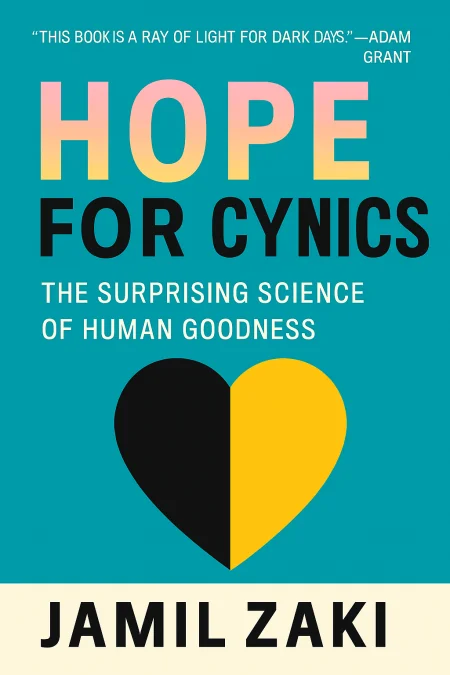
Hope for Cynics
The Surprising Science of Human Goodness
Book Edition Details
Summary
In a society shadowed by suspicion and division, where trust in humanity seems a relic of the past, Dr. Jamil Zaki offers a radical perspective shift. With a deft blend of scientific insight and compelling narratives, "Hope For Cynics" challenges the pervasive belief that human virtue is eroding. Zaki unearths an antidote to our growing cynicism: hopeful skepticism. This nuanced approach doesn't call for blind optimism but encourages a critical eye tempered with belief in the inherent goodness of others. By recognizing the underestimated kindness and generosity that exist around us, Zaki reveals how our perceptions shape reality, urging readers to recalibrate their worldview. It's a call to action for those weary of pessimism—a guide to nurturing a more compassionate world by first changing how we see it.
Introduction
Cynicism has become the dominant worldview of our time, convincing millions that people are fundamentally selfish, institutions are corrupt, and positive change is impossible. This pervasive mistrust appears justified by endless headlines of scandal and betrayal, yet it extracts a devastating toll on individuals and society alike. Cynical people suffer higher rates of depression, earn less money, and die younger than their trusting counterparts. Nations plagued by widespread cynicism struggle with economic stagnation, political dysfunction, and social fragmentation. The scientific evidence reveals a profound paradox: cynicism masquerades as wisdom while consistently leading us astray. Research across psychology, neuroscience, and behavioral economics demonstrates that cynics are actually worse at detecting lies, less cognitively sharp, and more prone to conspiracy thinking than their hopeful peers. Most surprisingly, the fundamental premise underlying cynical thinking proves false. Human beings are demonstrably more honest, generous, and trustworthy than cynics believe. This systematic underestimation of human goodness creates self-fulfilling prophecies where mistrust breeds the very selfishness cynics claim to detect. The path forward requires embracing what can be called "hopeful skepticism" - maintaining rigorous standards for evidence while remaining open to humanity's potential for growth and cooperation. This approach combines the cynic's healthy questioning with the optimist's faith in possibility, creating a more accurate and ultimately more powerful way of navigating social relationships and driving positive change.
The Hidden Costs of Cynicism
Cynicism extracts a price that extends far beyond individual unhappiness into the fundamental structures of society. Research tracking thousands of people over decades reveals that cynical individuals face measurably worse life outcomes across every domain scientists can measure. They experience higher rates of cardiovascular disease, clinical depression, and premature death. Their marriages fail more frequently, their careers stagnate, and they earn significantly less money over their lifetimes compared to more trusting individuals. The mechanism behind these negative outcomes becomes clear when examining cynicism's effect on social connections. Cynical people seek support from others less frequently, negotiate as though everyone is trying to cheat them, and respond to kindness with suspicion about ulterior motives. This defensive posture creates a self-reinforcing cycle where cynics behave in ways that actually elicit the selfish responses they expect from others. At the societal level, cynicism functions as a corrosive force that weakens the social bonds essential for community resilience and economic prosperity. High-trust societies consistently outperform their cynical counterparts on measures ranging from GDP growth to public health outcomes. When disaster strikes, communities with strong social connections mobilize quickly to help members recover, while cynical populations fragment and struggle. The COVID-19 pandemic provided a stark illustration of this dynamic, as nations with higher baseline trust achieved better vaccination rates and lower infection rates. The tragedy lies in cynicism's self-defeating nature. By expecting the worst from others, cynics create conditions that bring out humanity's darker impulses, then point to the resulting dysfunction as evidence of their worldview's accuracy. This creates what researchers call "negative feedback loops" where mistrust begets more mistrust, gradually eroding the social capital that makes civilization possible.
Hope as Scientific Wisdom
Contrary to cynicism's reputation as sophisticated realism, scientific evidence reveals it to be a form of systematic error in human judgment. Large-scale studies involving hundreds of thousands of participants across dozens of countries demonstrate that cynical individuals consistently perform worse on cognitive assessments, including tests of reasoning, problem-solving, and mathematical ability. Perhaps most ironically, cynics prove less skilled at the very task they claim to excel at: detecting deception and dishonesty in others. The "cynical genius illusion" emerges from our cultural tendency to associate negativity with intelligence and positivity with naivety. When people are asked to appear as competent as possible, they instinctively adopt more cynical language and attitudes, believing this signals intellectual sophistication. However, experimental evidence consistently contradicts this intuition. Participants who approach social situations with trust and openness gather more accurate information about others' intentions and capabilities than those who begin with suspicion. Hope, properly understood, represents a more scientifically grounded approach to uncertainty than cynicism. Unlike optimism, which assumes positive outcomes regardless of evidence, hope acknowledges problems while maintaining that improvement remains possible through human effort. This perspective aligns with core principles of scientific thinking: forming hypotheses, gathering evidence, and updating beliefs based on new information rather than clinging to predetermined conclusions. The superiority of hopeful thinking becomes apparent when examining how different mindsets affect learning and adaptation. Cynical individuals tend to interpret ambiguous social information through a negative lens, missing opportunities to form beneficial relationships and collaborate on shared goals. Hopeful skeptics, by contrast, approach social situations with curiosity rather than predetermined judgments, allowing them to discover the cooperative potential that cynics overlook. This difference in approach leads to measurably better outcomes in negotiations, leadership effectiveness, and personal relationships.
Building Cultures of Trust
The workplace provides a particularly vivid laboratory for observing how cynical versus trusting leadership approaches shape human behavior and organizational performance. Companies that operate on the assumption that employees are fundamentally lazy and dishonest typically implement extensive surveillance systems, rigid hierarchies, and competitive reward structures designed to prevent cheating and motivate performance through fear. Research consistently demonstrates that these "command and control" environments produce the very problems they aim to prevent: lower productivity, higher turnover, increased workplace conflict, and actual dishonest behavior. Microsoft's transformation under CEO Satya Nadella illustrates the dramatic possibilities when organizations shift from cynical to trusting management philosophies. The company's previous culture, characterized by forced rankings that pitted employees against each other and Byzantine approval processes that assumed incompetence, had led to technological stagnation and talent flight. Nadella's leadership team dismantled these systems in favor of collaborative evaluation methods, increased autonomy, and explicit trust in employee judgment. The results included not only improved morale and retention but also breakthrough innovations and massive increases in market value. Educational settings reveal similar patterns when comparing punishment-focused versus trust-based approaches to student behavior. Schools that assume students are inherently disruptive typically invest heavily in surveillance, zero-tolerance disciplinary policies, and punitive consequences designed to deter misbehavior. These environments consistently produce higher rates of student disengagement, academic underperformance, and actual behavioral problems. Conversely, schools that approach student discipline through restorative justice principles, assuming that young people want to do well when properly supported, achieve better outcomes across all measures of student success. The key insight emerging from organizational psychology research involves understanding how environmental factors shape individual behavior. People are not fixed entities with predetermined moral characteristics but rather adaptive beings who respond to the expectations and structures around them. Cynical systems that assume the worst of people create conditions that bring out selfish and defensive behaviors. Trusting environments that expect cooperation and growth provide the psychological safety necessary for individuals to live up to their better impulses.
The Future of Collective Action
History's most significant social transformations have emerged not from cynical resignation but from the marriage of moral outrage with practical hope. The combination of anger at injustice and belief in the possibility of improvement creates what researchers identify as the optimal emotional conditions for sustained collective action. Cynicism, despite its ability to accurately diagnose social problems, ultimately serves the status quo by convincing people that systemic change is impossible and individual efforts are futile. Contemporary movements for democratic reform, environmental protection, and social justice demonstrate hope's practical power in driving real-world change. Activists who maintain faith in humanity's capacity for growth and cooperation prove more effective at building coalitions, sustaining long-term campaigns, and achieving policy victories than those motivated purely by opposition to current conditions. The difference lies not in the accuracy of their problem diagnosis but in their willingness to envision and work toward better alternatives. The science of social change reveals that transformative movements require reaching a critical mass of committed participants, typically around 25 percent of a given population. Cynical worldviews make reaching this threshold more difficult by encouraging isolation and discouraging civic engagement. Hopeful approaches, by contrast, help people recognize that they are not alone in wanting change and that coordinated action can overcome even entrenched interests. Climate activism provides a particularly clear example of how cynical versus hopeful framings affect movement effectiveness. "Doomerism" that portrays environmental destruction as inevitable tends to produce paralysis and disengagement, even among people who are deeply concerned about ecological issues. Approaches that acknowledge climate threats while highlighting successful interventions and technological solutions tend to motivate sustained engagement and behavioral change. The key lies in balancing honest assessment of challenges with realistic pathways for addressing them, avoiding both false optimism and paralyzing despair.
Summary
The scientific evidence presents a clear verdict: cynicism masquerades as wisdom while consistently leading individuals and societies toward worse outcomes across every measurable domain. Research across psychology, economics, and organizational behavior demonstrates that trust, properly calibrated through skeptical inquiry, provides a more accurate and effective approach to navigating social relationships and driving positive change. Hopeful skepticism emerges as the optimal synthesis, combining rigorous standards for evidence with openness to human potential and possibility. This approach proves especially crucial in addressing collective challenges that require sustained cooperation, from workplace productivity to democratic governance to environmental protection. Readers seeking to understand how mistrust shapes modern life and how evidence-based hope can create better outcomes will find in these pages both a rigorous diagnosis of cynicism's costs and a practical roadmap for building more trusting and effective communities.
Related Books
Download PDF & EPUB
To save this Black List summary for later, download the free PDF and EPUB. You can print it out, or read offline at your convenience.

By Jamil Zaki
