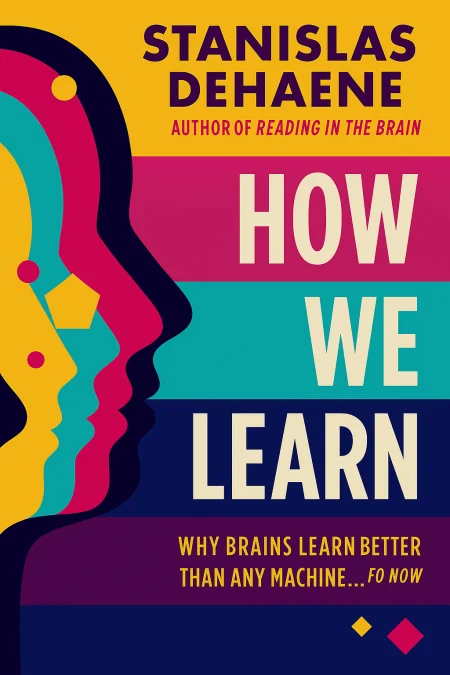
How We Learn
Why Brains Learn Better Than Any Machine . . . for Now
Book Edition Details
Summary
In the silent symphony of synapses and neurons, the human brain orchestrates a masterpiece of learning unmatched by any machine. Stanislas Dehaene's "How We Learn" unfurls the intricate tapestry of cognitive prowess, revealing the secrets that propel our thirst for knowledge. As our digital creations strive to emulate this natural wonder, Dehaene delves into the mysterious alchemy of brain functions, from reprogramming itself to absorbing new information. Through the lens of cutting-edge science, he juxtaposes human cognition with artificial intelligence, offering profound insights that could revolutionize education at every level. Discover how these revelations can transform learning into a lifelong adventure, tapping into the immense potential residing within us all.
Introduction
Imagine watching a two-year-old effortlessly absorb a new language while you struggle to remember basic vocabulary from your high school Spanish class. Or consider how a child can master the rules of grammar without ever studying them, while sophisticated computer programs require millions of examples to achieve similar fluency. These everyday observations point to one of the most remarkable phenomena in nature: the human brain's extraordinary capacity for learning. Far from being passive sponges that simply absorb information, our minds operate as sophisticated prediction machines, constantly building and refining internal models of the world around us. Recent breakthroughs in neuroscience have revealed that learning isn't the mysterious process we once thought it to be. Instead, it follows discoverable principles and mechanisms that can be understood, measured, and optimized. The brain employs elegant algorithms that would impress any computer scientist, using attention to filter relevant information, active engagement to test hypotheses, feedback to correct errors, and sleep to consolidate memories. Perhaps most surprisingly, babies don't enter the world as blank slates but arrive equipped with sophisticated knowledge about physics, mathematics, and social relationships. Understanding these hidden algorithms of learning doesn't just satisfy our curiosity about how minds work—it offers practical insights for revolutionizing education, accelerating skill acquisition, and unlocking human potential at any age.
Born Scientists: The Remarkable Knowledge Babies Bring to Life
The idea that babies are born as empty vessels waiting to be filled with knowledge represents one of science's most persistent myths. Modern research reveals a startling truth: newborns arrive in the world as sophisticated scientists, equipped with powerful theories about how reality operates and the statistical tools to test these theories. Within hours of birth, babies demonstrate understanding of fundamental physical principles that would challenge even advanced artificial intelligence systems. Consider the remarkable experiments that reveal infant knowledge. Show a four-month-old baby a ball rolling behind a screen, and they expect it to emerge on the other side. If it doesn't appear, or if a different colored ball emerges, babies stare longer in apparent surprise—demonstrating they understand object permanence and identity. Even more impressive, babies grasp basic arithmetic. When researchers show infants one doll, hide it behind a screen, then visibly add a second doll, babies expect to see two dolls when the screen is removed. If only one doll appears, they look longer with what can only be described as mathematical confusion. This innate knowledge extends far beyond physics and numbers into the realm of social intelligence. Babies are born with an intuitive understanding of intentionality—the idea that people's actions are driven by goals and beliefs. When they observe someone struggling to reach an object, babies understand this represents a frustrated intention and will often try to help. They can distinguish between accidental and purposeful actions, showing surprise when people behave in ways that don't align with apparent goals. Most remarkably, babies demonstrate sophisticated statistical reasoning, calculating probabilities and making inferences that would impress professional mathematicians. These abilities don't emerge through learning—they're built into the brain's architecture through millions of years of evolution. Rather than starting from scratch, human learning builds upon these rich foundations of core knowledge. This understanding transforms how we think about education and development. The most effective teaching doesn't ignore these innate capacities but builds upon them, connecting new concepts to the deep intuitions that babies bring to their exploration of the world.
Neural Plasticity: How Experience Rewires Our Brain Circuits
While babies arrive with remarkable built-in knowledge, their brains also possess an extraordinary capacity for change that allows them to adapt to virtually any environment on Earth. This neural plasticity operates through the fundamental currency of brain computation: synapses, the microscopic connections between neurons that strengthen, weaken, or form anew based on experience. Every time we learn something, whether it's a new word, a motor skill, or a mathematical concept, our brain physically rewires itself according to a simple but powerful rule: neurons that fire together, wire together. The scale of this plasticity during childhood is breathtaking. A two-year-old's brain contains nearly twice as many synaptic connections as an adult brain, representing a period of exuberant neural growth followed by selective pruning. The brain essentially overproduces connections and then eliminates those that prove unnecessary, keeping only the circuits that demonstrate their value through repeated use. This process creates sensitive periods—windows of time when particular types of learning occur with remarkable ease and efficiency. The power and limitations of early plasticity reveal themselves in dramatic case studies. Children who lose an entire brain hemisphere due to injury or disease can often develop surprisingly normal abilities, with the remaining half taking over functions typically handled by the missing tissue. Babies born blind can repurpose their visual cortex for processing sound and touch, developing enhanced auditory abilities that exceed those of sighted individuals. Yet this same plasticity has boundaries—children who don't hear language during critical early years may never fully master grammar, and those deprived of proper visual input can develop permanent vision problems even if their eyes are later corrected. Understanding neural plasticity reveals why early experiences matter so profoundly for human development. The brain's remarkable capacity for change means that enriching environments can enhance learning potential, while impoverished or harmful conditions can create lasting deficits. This knowledge empowers us to create optimal conditions for learning throughout life, recognizing that while plasticity decreases with age, the adult brain retains significant capacity for growth and adaptation when provided with appropriate challenges and support.
The Four Pillars: Attention, Engagement, Feedback, and Sleep
Successful learning rests upon four fundamental mechanisms that work together like architectural pillars supporting a grand structure. Understanding these pillars reveals why some educational approaches succeed brilliantly while others fail despite good intentions, and provides a scientific foundation for optimizing learning at any age. The first pillar, attention, serves as the brain's spotlight, determining which information receives the deep processing necessary for memory formation. Without focused attention, even the most brilliant teaching falls on deaf ears because relevant signals get lost in the noise of competing inputs. Modern neuroscience reveals that attention isn't simply about trying harder to concentrate—it involves sophisticated neural mechanisms that amplify important information while actively suppressing distractions. When we focus on something, the corresponding brain regions literally increase their activity while competing areas are dampened, creating the neural conditions necessary for effective learning. Active engagement forms the second pillar, transforming learners from passive recipients into curious scientists who generate and test their own hypotheses. The brain learns best when it's making predictions about the world and discovering whether those predictions prove accurate. This principle explains why children learn through play—their seemingly random activities are actually sophisticated experiments designed to understand how reality operates. The brain's reward systems encourage this exploration by releasing dopamine when we encounter something novel or surprising, creating the motivation to continue investigating and learning. Error feedback constitutes the third pillar, providing the mechanism by which our brains detect when predictions go wrong and adjust their internal models accordingly. Every time reality violates our expectations, error signals cascade through neural networks, strengthening some connections while weakening others to improve future predictions. This process requires a delicate balance—enough challenge to generate useful errors, but not so much difficulty that learners become overwhelmed and abandon their efforts. The fourth pillar, sleep, serves as the brain's master consolidation system, transforming temporary memories into permanent knowledge through sophisticated replay mechanisms. During sleep, our brains don't simply rest—they actively rehearse the day's experiences at accelerated speeds, transferring information from temporary storage areas to long-term memory networks. Students who sleep after studying consistently outperform those who stay awake, demonstrating that learning continues long after conscious effort ends. Understanding these four pillars provides a scientific roadmap for creating educational experiences that work with, rather than against, the brain's natural learning algorithms.
Summary
The most profound revelation from modern learning science is that our brains operate as sophisticated prediction machines, equipped from birth with powerful algorithms for understanding the world and remarkable capacity for adaptation throughout life. Rather than passive vessels waiting to be filled with information, we are active scientists constantly building and refining internal models of reality through the coordinated action of attention, engagement, feedback, and consolidation. This understanding fundamentally challenges traditional educational approaches that ignore how the brain actually learns, pointing toward more effective methods that harness our natural learning mechanisms. As we continue to decode the algorithms underlying human intelligence, we face fascinating questions about the future of education and human potential: How might we redesign schools to better align with these four pillars of learning? What new possibilities emerge when we recognize that every child arrives as a born scientist, ready to explore and understand their world through the most sophisticated learning system nature has ever created?
Related Books
Download PDF & EPUB
To save this Black List summary for later, download the free PDF and EPUB. You can print it out, or read offline at your convenience.
By Stanislas Dehaene
