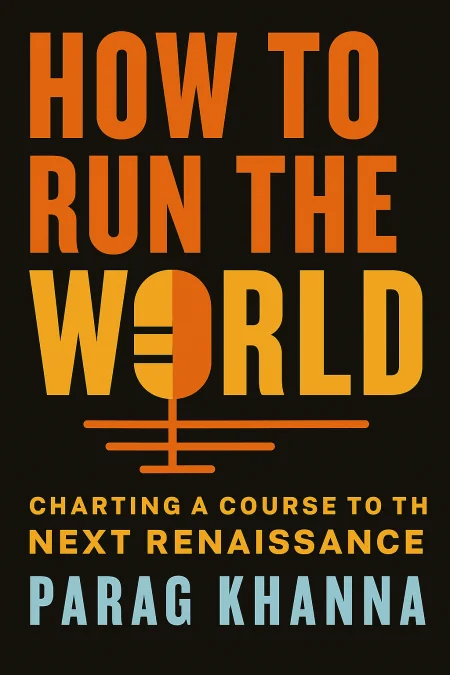
How to Run the World
Charting a Course to the Next Renaissance
Book Edition Details
Summary
In a world teetering on the brink of chaos, Parag Khanna's "How to Run the World" envisions a new dawn of diplomacy that transcends traditional boundaries. Picture a modern era reminiscent of the tumultuous Middle Ages, where empires, corporations, and communities clash and converge. Khanna, an adventurer-scholar of unmatched insight, proposes a revolutionary concept: mega-diplomacy. This innovative approach calls for a grand coalition of diverse actors—from tech-savvy visionaries to philanthropic powerhouses—uniting to address the planet's gravest challenges. Through vivid narratives and real-world examples, Khanna illustrates how these eclectic alliances can weave a resilient fabric of global cooperation, ushering in an era of enlightenment and balance. "How to Run the World" is not just a guide; it's a bold blueprint for crafting a future where collaboration triumphs over division.
Introduction
Picture this: In the marble halls of the United Nations, diplomats in crisp suits debate Syria while their smartphones buzz with updates from corporate boardrooms in Shanghai and NGO field offices in Somalia. Meanwhile, a tech billionaire announces a climate initiative that dwarfs most government budgets, and a viral social media campaign reshapes public opinion faster than any state propaganda ever could. This is not your grandfather's diplomacy—this is the new medieval world order, where power flows through networks as complex as those of the original Middle Ages. We live in an era that mirrors the political fragmentation of medieval Europe, where emperors, merchants, bishops, and guilds all wielded influence in overlapping spheres. Today's equivalent cast includes nation-states, multinational corporations, international organizations, NGOs, terrorist networks, and super-empowered individuals. Just as medieval merchants could bypass kings through trade routes, modern actors routinely circumvent traditional diplomatic channels. Understanding this transformation is crucial for anyone seeking to navigate our interconnected yet fragmented world—whether you're a policy maker, business leader, activist, or simply a global citizen trying to make sense of our chaotic times.
The New Middle Ages: Power Fragmentation in the 21st Century
The Westphalian system of sovereign nation-states, born from the ashes of the Thirty Years' War in 1648, is quietly crumbling. Like the Holy Roman Empire's nominal authority over feuding duchies and city-states, today's international system presents a facade of order while real power operates through a maze of competing networks. The parallels are striking: medieval Europe had no single authority capable of governing its diverse territories, just as today's world lacks any institution powerful enough to manage global challenges alone. This new medievalism emerged most visibly after the Cold War's end, when the bipolar certainty of American-Soviet competition gave way to a multipolar confusion. Failed states became breeding grounds for non-state actors, much like the ungoverned spaces between medieval kingdoms harbored bandits and mercenaries. Meanwhile, economic globalization empowered corporations to operate across borders with an autonomy that medieval guilds could only dream of. The 2008 financial crisis revealed how interconnected yet ungoverned these networks had become—a global system without a global sovereign. Unlike the original Middle Ages, however, today's fragmentation is accelerated by technology and occurs on a planetary scale. Information flows instantly across networks that ignore traditional boundaries, creating virtual communities that often command more loyalty than physical nations. A cyber-attack can cripple infrastructure faster than any medieval siege, while social movements can mobilize globally in hours rather than decades. The result is a world where influence is distributed among countless actors, none of whom can control the whole system, but each of whom can significantly disrupt it. This fragmentation isn't necessarily chaos—it's complexity. Medieval Europe, for all its political messiness, generated the Renaissance, the Reformation, and eventually the modern state system. Today's neo-medieval world might similarly be transitioning toward new forms of governance better suited to our interconnected age. The question isn't how to restore the old order, but how to navigate the new one intelligently.
The Rise of Non-State Diplomats: Corporations, NGOs and New Networks
While traditional ambassadors still exchange credentials and attend state dinners, the real diplomatic action increasingly happens elsewhere. In Silicon Valley boardrooms, NGO headquarters in Geneva, and corporate offices in Mumbai, a new class of diplomatic actors shapes global affairs without wearing any nation's flag. These are the mega-diplomats of our era: tech CEOs who negotiate with governments, humanitarian leaders who broker peace deals, and corporate executives who effectively govern failed states through their operations. Consider how Bill Gates has become perhaps the world's most influential health diplomat, wielding a foundation budget that exceeds many countries' entire health ministries. His partnerships with pharmaceutical companies have accelerated vaccine development more effectively than traditional international health organizations. Similarly, George Soros's Open Society Foundations have influenced democratic transitions across Eastern Europe and beyond, operating with an agility that formal diplomacy cannot match. These actors succeed where governments fail because they can act quickly, transcend borders effortlessly, and combine resources in novel ways. Corporations, too, have evolved into diplomatic entities by necessity. When Royal Dutch Shell operates in Nigeria, it must navigate not just market forces but tribal politics, environmental activism, and international law. The company's decisions about oil extraction carry diplomatic weight—they can stabilize or destabilize regions, influence global energy prices, and shape environmental policy worldwide. Like medieval merchant houses that maintained their own armies and diplomatic corps, modern multinationals often possess capabilities that rival or exceed those of the states where they operate. The digital revolution has democratized diplomatic access even further. A single tweet can now influence foreign policy debates, while crowdsourced campaigns can pressure corporations to change practices faster than any government regulation. Organizations like Avaaz mobilize millions of global citizens around causes ranging from climate change to human rights, creating a form of digital diplomacy that bypasses traditional state-to-state channels entirely. These new networks represent the future of international relations—fluid, fast-moving, and fundamentally different from the rigid hierarchies of the past.
Failed States and New Colonialism: Managing Global Chaos
In the medieval world, when central authority collapsed, local strongmen, religious orders, and merchant guilds stepped in to provide governance. Today's failed states witness a strikingly similar phenomenon. Somalia has no functioning government, yet Somali entrepreneurs run sophisticated remittance networks that connect diaspora communities worldwide. In Afghanistan, international NGOs deliver services that the Kabul government cannot provide, while private military contractors maintain security that national forces cannot guarantee. This is the new colonialism—not the exploitative imperialism of the past, but a complex web of external actors providing governance where states cannot. Unlike their predecessors, these new colonialists generally aim to strengthen rather than weaken local capacity. The Gates Foundation works to eliminate diseases, not spread them. Corporate investments in African infrastructure, whatever their profit motives, build roads and power plants that improve lives. International NGOs train local staff and transfer skills rather than simply extracting resources. The new colonialism emerges from practical necessity rather than imperial ambition. When Ebola threatened West Africa in 2014, it was international medical NGOs, not regional governments, that provided the primary response. When climate change displaces Pacific Island populations, it will be international organizations and donor countries that manage the crisis. These interventions happen not because external actors seek control, but because local governance structures cannot handle transnational challenges alone. Yet this system remains fundamentally unstable. External actors may provide services more efficiently than weak governments, but they cannot provide legitimacy. Local populations may welcome foreign investment and aid, but they also resent their dependence on outside powers. The challenge is developing hybrid governance models that combine external resources with local legitimacy—creating systems that can eventually become self-sustaining while managing immediate crises effectively.
Towards the Next Renaissance: Building Sustainable Global Governance
History suggests that periods of political fragmentation and complexity often precede remarkable creative breakthroughs. The chaos of late medieval Europe generated the Renaissance; the disorder of early modern religious wars eventually produced the Westphalian system; the catastrophe of two world wars led to the United Nations and European Union. Our current neo-medieval moment may likewise be pregnant with possibilities for new forms of global governance better adapted to our interconnected world. The key insight from successful historical transitions is that sustainable governance must emerge organically from existing networks rather than being imposed from above. The European Union succeeded not by replacing nation-states but by creating new layers of governance that complemented existing structures. Medieval universities preserved knowledge through dark ages by operating across political boundaries. Today's most promising governance innovations similarly work with and around existing institutions rather than trying to replace them wholesale. Technology offers unprecedented opportunities for this kind of networked governance. Blockchain systems could enable new forms of international law enforcement; artificial intelligence could help coordinate responses to global challenges; social media could facilitate genuine democratic participation across borders. The tools exist to create governance systems that are both more democratic and more effective than traditional state-centered approaches. The question is whether we can develop the institutional creativity to use them wisely. The path toward this new Renaissance runs through what we might call "mega-diplomacy"—the integration of governmental, corporate, and civil society actors in flexible coalitions focused on specific challenges. Climate change requires energy companies, environmental NGOs, and multiple governments working together. Pandemic response needs pharmaceutical corporations, international health organizations, and national public health systems coordinating in real-time. Financial stability depends on central banks, commercial banks, and international regulatory bodies sharing information and aligning policies.
Summary
The great paradox of our time is that we live in the most connected world in human history, yet we lack the governance structures to manage that connectivity effectively. Like medieval Europe before the rise of modern states, our world is characterized by overlapping authorities, competing loyalties, and fragmented power. But history teaches us that such periods of complexity often precede remarkable innovations in human organization. The rise of non-state actors—from tech billionaires to international NGOs to multinational corporations—represents both a challenge and an opportunity. These actors can respond to global problems with speed and resources that traditional diplomacy cannot match, but they also operate outside democratic accountability and may pursue narrow interests rather than common goods. The task ahead is learning to harness their capabilities while ensuring they serve broader human purposes. Three principles can guide us toward more effective global governance. First, we must embrace institutional diversity rather than seeking one-size-fits-all solutions—different challenges require different combinations of actors and approaches. Second, we need to prioritize effectiveness over legitimacy in crisis situations while building legitimate institutions for long-term governance. Finally, we must remember that sustainable change requires local ownership—external actors can provide resources and expertise, but lasting solutions must emerge from the communities they're meant to serve. The next Renaissance awaits those bold enough to experiment with new forms of human cooperation while wise enough to learn from history's hard-won lessons.
Related Books
Download PDF & EPUB
To save this Black List summary for later, download the free PDF and EPUB. You can print it out, or read offline at your convenience.
By Parag Khanna
