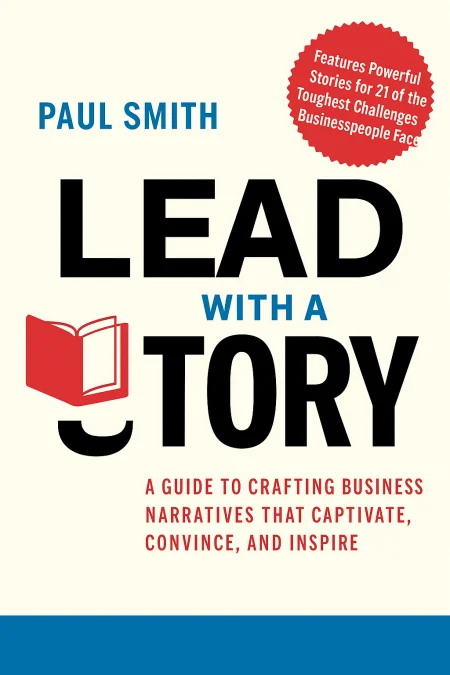
Lead with a Story
A Guide to Crafting Business Narratives that Captivate, Convince and Inspire
Book Edition Details
Summary
In a world where the currency of leadership is storytelling, "Lead with a Story" emerges as a beacon for those eager to transform mundane business exchanges into unforgettable narratives. Imagine a boardroom where bullet points give way to tales that inspire, captivate, and drive action. Dive into this treasure trove of ready-to-use stories and expert guidance, designed to elevate your communication from the ordinary to the extraordinary. Whether you're defining a company's culture or rallying a team around a shared vision, this book reveals how storytelling can be your most potent tool. With vivid examples from industry giants like Nike and Procter & Gamble, discover how stories not only inform but ignite. For leaders ready to make their mark, this isn't just a book—it's a revolution in how we connect and lead.
Introduction
Picture yourself in a familiar scene: you're sitting in a conference room watching yet another PowerPoint presentation filled with charts, bullet points, and statistics. Your mind begins to wander, your phone becomes mysteriously more interesting, and you realize you've absorbed virtually nothing despite the presenter's obvious preparation. Now imagine a different scenario: the same presenter begins with a compelling story about a real person facing a genuine challenge. Suddenly, you're leaning forward, engaged, and actually remembering what's being said long after the meeting ends. This fundamental shift from data-driven presentations to story-powered leadership represents one of the most significant transformations in how successful organizations communicate and inspire action. Stories possess the unique ability to bypass our analytical defenses and speak directly to our emotions, making complex ideas memorable and motivating people to act in ways that spreadsheets and logical arguments simply cannot achieve. When leaders master the art of business storytelling, they discover they can accomplish what no amount of statistics or rational persuasion can deliver: they can truly move people toward meaningful change. Through this exploration of narrative leadership, you'll discover how to craft compelling stories that capture attention in any business setting, learn to use specific story structures that make your messages stick long after conversations end, and develop the confidence to replace dry presentations with engaging narratives that inspire genuine transformation. The most successful leaders understand that while data informs decisions, stories transform hearts and minds.
When Stories Speak Louder Than Statistics
When A.G. Lafley, former CEO of Procter & Gamble, walked into his weekly Executive Global Leadership Council meeting, he made a choice that would forever change how one presenter understood leadership communication. The nervous executive had arrived thirty minutes early, meticulously setting up audio-visual equipment and preparing slides for what he hoped would be a flawless presentation to the CEO. His charts were perfect, his data was comprehensive, and his arguments were logically bulletproof. But as the meeting began, Lafley did something completely unexpected. He positioned himself directly underneath the projection screen with his back to it, never once turning around to look at the carefully prepared slides. For twenty agonizing minutes, the presenter watched in growing confusion as the CEO remained focused entirely on him, engaging in direct conversation while completely ignoring the visual presentation that had consumed weeks of preparation. Despite this apparent inattention to the slides, Lafley not only understood everything being discussed but enthusiastically agreed to the recommendation being made. When the meeting ended, the lesson became crystal clear: if you have something truly important to say, it will come out of your mouth through authentic conversation, not from a screen filled with bullet points. The CEO knew that slides existed more for the presenter's comfort than for genuine communication. This revelation illuminates a fundamental truth about human connection in leadership. In our data-saturated business environment, executives are drowning in charts, graphs, and statistical analyses. What they're truly hungry for is authentic human connection and compelling narratives that bring meaning to the numbers. Stories provide the essential context that transforms abstract concepts into relatable experiences that stick in memory and drive action. The most effective leaders understand that storytelling isn't merely a nice-to-have communication skill, it's an essential leadership tool that separates good managers from transformational leaders. Stories are remembered twenty times longer than facts alone, they appeal to all types of learners simultaneously, and they create the emotional connections that actually drive human behavior and organizational change.
Building Culture Through Crisis and Character
The revolution erupted across Egypt on January 25, 2011, as millions of protesters flooded the streets of Cairo demanding immediate political change. Among those caught in the escalating chaos was Rasoul Madadi, a Procter & Gamble expatriate from Cincinnati, who found himself trapped at Cairo airport with his wife and six-year-old son, desperately trying to escape the violence that was consuming the city around them. The airport had become a nightmare of overcrowding, with flights being canceled hourly and panic setting in as food and water supplies dwindled. Families were sleeping on floors, credit cards were being declined, and many travelers were receiving no response whatsoever from their companies back home. But Rasoul remained calmer than most passengers around him, and for a very specific reason that would become legendary within his organization. While other desperate travelers frantically tried to contact their companies for help, many hearing only voicemail messages or bureaucratic delays, Rasoul's phone was buzzing with proactive support from colleagues around the world. His plant manager called to say, "Take care of your family first. Do what is best for you and your safety; I approve whatever you need to do." A UK human resources manager reached out immediately: "Get on the first flight you can find. We will take care of everything else, including all the logistics and expenses." Colleagues from multiple countries began coordinating complex travel arrangements, secured backup tickets on different airlines, arranged for emergency funds when his credit card reached its limit, and even worked with immigration authorities when visa complications arose. After five canceled flights and countless obstacles, Rasoul and his family finally boarded one of the first commercial flights to leave Cairo, but their support network continued working until they were safely home. This story reveals the profound difference between companies that merely say their employees are their most valuable asset and those that prove it through decisive action during moments of crisis. True organizational culture isn't defined by mission statements hanging on office walls or values printed in employee handbooks, it's revealed in those critical moments when principles are tested under extreme pressure and leaders must choose between convenience and character. When leaders share stories like Rasoul's experience throughout their organizations, they're not just recounting interesting events, they're establishing the behavioral expectations and cultural norms that will guide countless future decisions when no policy manual can provide adequate guidance.
Inspiring Action Through Authentic Vulnerability
The 1968 Mexico City Olympics presented brutal conditions that would test every marathon runner's limits. At over 7,400 feet in altitude, the thin mountain air contained 23 percent less oxygen than at sea level, causing seventeen of the seventy-four competitors to abandon the race entirely. John Stephen Akhwari of Tanzania was absolutely determined not to be among those who quit, even after a devastating fall during the race that badly cut his right leg and dislocated his knee. Against urgent medical advice from Olympic physicians, Akhwari stood up from the pavement, blood streaming down his leg, and continued down the road far behind the other runners who had long since disappeared from view. More than an hour after Ethiopian runner Mamo Walde had crossed the finish line in first place and received his gold medal, the Olympic stadium had nearly emptied of spectators. The sun had set over Mexico City, and only a few thousand people remained in their seats when suddenly a police escort appeared at the stadium entrance. Following the motorcycles came a limping figure with bloodied bandages dangling from his leg, moving forward with obvious pain but unmistakable determination. As John Stephen Akhwari entered the track, the diminished crowd erupted in spontaneous awe and disbelief. He hobbled around the entire 400-meter track as spectators rose to their feet, and crossed the finish line at 3:25:27, finishing dead last among all competitors but finishing nonetheless. When reporters rushed to ask why he had continued running in such terrible condition when he had no chance of winning any medal, Akhwari's response was simple yet profound: "My country didn't send me 5,000 miles to start this race. They sent me 5,000 miles to finish it." His words captured something essential about commitment and perseverance that resonated far beyond the world of athletics and has inspired leaders for decades. This story has become legendary in boardrooms and team meetings around the world because it speaks directly to a universal challenge every leader faces: keeping people focused and motivated when they're encountering significant difficulties, distractions, or the temptation to quit before completing important work. Whether someone is struggling with a difficult project, counting down days to a new assignment, or simply losing energy on a long-term initiative, Akhwari's example provides a powerful mental model for the difference between people who start things and those who finish them.
Crafting Narratives That Create Lasting Change
The transformation of Nokia from a 19th-century paper mill to a global technology giant illustrates the essential structure that makes business stories both memorable and actionable. In 1865, Fredrik Idestam established his company on the banks of the Tammerkoski River in Finland, focusing on producing high-quality paper products for the growing European market. For decades, the company thrived in traditional manufacturing, gradually expanding into rubber products, cables, and various industrial materials. By the early 20th century, Nokia had become a successful regional conglomerate, but nothing suggested it would become a household name worldwide. The company seemed destined to remain a solid but unremarkable industrial manufacturer, competing in mature markets with established competitors. Then the telecommunications revolution began, and Nokia faced a choice that would define its future: continue operating in familiar industries or bet everything on an emerging technology that most people couldn't even envision. In the 1980s and 1990s, Nokia made a series of bold strategic decisions that seemed almost reckless at the time. They systematically sold off their traditional businesses, including the paper mills that had sustained the company for over a century, and invested everything in mobile phone technology. This wasn't a gradual transition or a hedge-your-bets diversification strategy, it was an all-in commitment to a future that existed more in imagination than in current market reality. The result transformed not just Nokia, but entire industries and billions of human lives. Nokia became the world's largest mobile phone manufacturer, defining how people communicate across the globe and establishing Finland as a technology powerhouse. But the story's real power for leaders lies in its lesson about organizational courage: the most successful companies and teams must be willing to abandon their past success to embrace future opportunities, even when that future feels uncertain and risky. This narrative structure demonstrates why certain business stories stick in memory while others are immediately forgotten. The most effective stories begin with relatable context, build tension through challenges and difficult decisions, reveal surprising outcomes, and conclude with lessons that apply directly to current leadership challenges. When you master this structure, you can transform any business experience into a compelling narrative that changes how people think and act.
Summary
The ultimate insight is elegantly simple: while data informs decisions, stories inspire action and create the emotional connections that drive lasting organizational transformation. Begin building your storytelling leadership toolkit by collecting three types of narratives: success stories that demonstrate your values in action during challenging situations, failure stories that show learning and resilience when things go wrong, and vision stories that help people see themselves succeeding in a better future. Practice telling these stories conversationally rather than formally, focusing on concrete details and emotional truth rather than abstract concepts or corporate jargon. Remember that the most powerful business stories often emerge from unexpected moments of crisis or challenge, when people's true character and your organization's real values are revealed under pressure. Keep your narratives concise but complete, ensuring they have clear beginnings that establish context, middles that show conflict or difficult decisions, and endings that deliver both resolution and actionable lessons. Most importantly, don't just collect stories for special occasions, use them regularly in meetings, presentations, and one-on-one conversations to replace dry bullet points with compelling human experiences that people will remember, believe, and act upon long after your conversation ends.
Related Books
Download PDF & EPUB
To save this Black List summary for later, download the free PDF and EPUB. You can print it out, or read offline at your convenience.
By Paul Smith
