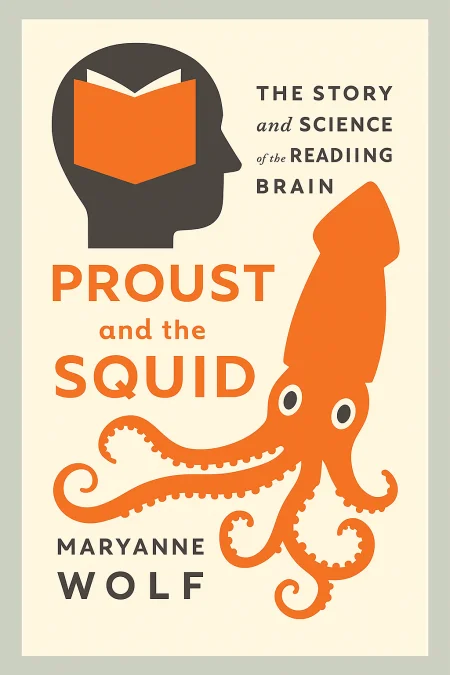
Proust and the Squid
The Story and Science of the Reading Brain
Book Edition Details
Summary
In the dazzling tapestry of human history, the art of reading is a recent, yet profound, marvel. Maryanne Wolf, a luminary in cognitive neuroscience, delves into this intellectual odyssey in "Proust and the Squid." With fervor and insight, she unravels the brain's metamorphosis from deciphering ancient cuneiform tablets to navigating today's digital prose. Wolf illuminates the evolutionary dance between our brains and the written word, revealing both the triumphs and trials—like dyslexia—that accompany this cerebral journey. From a child's first encounter with "Goodnight Moon" to the nuanced musings of Proust, Wolf invites us to ponder the transformative power of reading. This book is not just a chronicle of literacy's past but a clarion call to its future, reminding us that our very essence is intertwined with the words we cherish.
Introduction
Every time you glance at these words and effortlessly transform squiggles on a page into meaning, your brain performs what might be the most remarkable feat in human cognitive evolution. Reading seems so natural that we rarely pause to consider its profound unnaturalness. Unlike walking or speaking, which our brains evolved to do over millions of years, reading is a recent cultural invention that has existed for merely 5,000 years. Yet this brief moment in evolutionary time has fundamentally rewired our neural architecture and transformed how we think, remember, and understand the world. The human brain was never designed to read. There are no reading genes, no reading centers hardwired into our neural circuitry. Instead, each time a child learns to read, their brain must perform an extraordinary act of biological recycling, connecting ancient systems for vision and speech in entirely new ways. This neuroplastic miracle doesn't just enable literacy; it creates new forms of consciousness, new ways of processing information, and new capacities for abstract thought that have shaped the trajectory of human civilization. From the first clay tokens in ancient Mesopotamia to the digital screens of today, the story of reading reveals how cultural inventions can literally reshape the organ that creates them, offering profound insights into the future of human intelligence in our rapidly evolving technological landscape.
The Brain's Reading Revolution: From Ancient Symbols to Neural Networks
The story of reading begins not with books or even alphabets, but with small clay tokens no larger than quarters, scattered across ancient Mesopotamian settlements over 8,000 years ago. These humble objects represent humanity's first breakthrough into symbolic representation, the revolutionary idea that marks on clay could represent sheep, grain, or wine without those objects being physically present. This cognitive leap required our ancestors' brains to forge entirely new neural pathways, connecting visual processing areas with conceptual and linguistic regions in ways that had never existed before. What makes this transformation remarkable is how the brain accomplished it through neuronal recycling. Ancient visual circuits originally designed to distinguish predators from prey, or tools from rocks, were repurposed to recognize the subtle differences between symbolic marks. The brain's extraordinary plasticity allowed specialized groups of neurons to become pattern recognition experts, creating representations that could be retrieved automatically. This same process occurs today when a child learns to distinguish between 'b' and 'd', requiring visual areas to develop exquisite sensitivity to directional features that matter enormously in reading but are irrelevant in the natural world. From these token-reading brains emerged increasingly sophisticated writing systems. The Sumerians developed cuneiform, the Egyptians created hieroglyphs, and the Chinese invented logographic characters, each demanding different neural adaptations. Sumerian readers needed circuits that could handle both pictographic symbols and abstract sound representations. Chinese readers developed enhanced visual-spatial processing and bilateral brain activation to manage thousands of characters. Each writing system essentially created its own version of the reading brain, demonstrating how cultural inventions can drive neural evolution. The culmination of this journey was the Greek alphabet, which required perhaps the most sophisticated linguistic insight in human history: the recognition that all spoken words consist of a finite set of individual sounds that can be represented by letters. This alphabetic principle created unprecedented neural efficiency, allowing readers to decode any word in their language with just 26 symbols. The Greek innovation freed cognitive resources for higher-order thinking, setting the stage for the philosophical and scientific achievements that would define Western civilization and demonstrating how technological advances in communication directly enable advances in human thought.
Learning to Read: How Children's Brains Develop Literacy Circuits
Learning to read recapitulates the entire history of writing in compressed time. What took our species thousands of years to discover, each child must master in roughly 2,000 days. This developmental journey begins not with formal instruction but in the loving embrace of a caregiver reading aloud, where children first associate the magic of stories with the comfort of being cherished. These early experiences create the emotional foundation for literacy, establishing reading as a source of pleasure rather than merely an academic skill. The pre-reading years are crucial for building the cognitive architecture that will support literacy. Children must develop phonological awareness, learning that words are composed of individual sounds that can be manipulated and combined. They need semantic development, accumulating the thousands of word meanings that will fuel reading comprehension. Syntactic growth allows them to understand increasingly complex sentence structures, while morphological awareness helps them recognize how words are built from meaningful parts. Perhaps most importantly, they must master the seemingly simple task of naming letters rapidly and automatically, a skill that predicts reading success better than almost any other measure. The transition from pre-reader to fluent reader unfolds through predictable stages, each requiring different neural configurations. Novice readers laboriously sound out individual letters, their brains working overtime to connect visual symbols with speech sounds. Decoding readers begin to recognize common letter patterns and sight words, allowing smoother reading but still requiring significant cognitive effort. The breakthrough comes with fluent comprehension, when decoding becomes so automatic that cognitive resources are freed for understanding meaning, making inferences, and connecting texts to personal experience. Expert readers represent the pinnacle of this developmental journey, capable of processing words in mere milliseconds while simultaneously engaging in complex interpretive thinking. Their brains have become marvels of efficiency, with specialized neural circuits handling everything from visual pattern recognition to semantic processing to syntactic analysis. Yet this expertise comes with a hidden cost: the more automatic reading becomes, the less conscious we are of the intricate neural symphony occurring with every word. Understanding this developmental progression reveals why reading difficulties can emerge at different stages and why intervention must be tailored to each child's specific neural and cognitive profile.
When Reading Goes Wrong: Understanding Dyslexia and Brain Differences
Dyslexia offers a unique window into the reading brain precisely because it reveals what happens when the typical neural circuits fail to develop properly. Far from being a simple "reading disorder," dyslexia represents a fundamental difference in brain organization that affects how visual, auditory, and linguistic systems connect and communicate. These differences often manifest as difficulties with phonological processing, the ability to hear and manipulate the individual sounds within words, making it challenging to master the alphabetic principle that underlies reading in most languages. The traditional view of dyslexia as a deficit is being revolutionized by research showing that many individuals with reading difficulties possess enhanced right-hemisphere processing capabilities. While the left hemisphere typically dominates language functions with its precision and speed, the right hemisphere excels at pattern recognition, spatial processing, and creative thinking. Brain imaging studies suggest that some people with dyslexia may rely more heavily on right-hemisphere circuits for reading, creating a different but not necessarily inferior neural architecture. This alternative organization may explain why many individuals with dyslexia excel in fields requiring visual-spatial skills, pattern recognition, and creative problem-solving. The genetic foundations of dyslexia are complex, involving multiple genes that influence the development of brain regions crucial for reading. Rather than a single "dyslexia gene," researchers have identified several genetic variations that affect neuronal migration during brain development, potentially leading to differences in how reading circuits are wired. These genetic influences help explain why dyslexia runs in families and why it manifests differently across languages and writing systems. In transparent orthographies like Spanish or German, dyslexia may primarily affect reading fluency, while in complex systems like English, it more often impacts decoding accuracy. Understanding dyslexia has profound implications for education and society. Early identification through measures of phonological awareness and rapid naming can predict reading difficulties before they become entrenched, allowing for timely intervention. Effective remediation programs address multiple components of reading simultaneously, from phoneme awareness to vocabulary development to reading fluency. Perhaps most importantly, recognizing dyslexia as a different form of brain organization rather than a deficiency can help preserve the self-esteem and unique talents of struggling readers while ensuring they receive the support needed to become literate citizens in an increasingly text-dependent world.
Digital Reading: How Technology is Reshaping Our Neural Pathways
The reading brain that took millennia to evolve and years to develop in each individual now faces its most dramatic transformation since the invention of the alphabet. Digital technologies are reshaping how we access, process, and interact with text in ways that may fundamentally alter the neural circuits underlying literacy. The shift from linear, deep reading of books to the rapid scanning of hyperlinked, multimedia content represents a new evolutionary pressure on the reading brain, one whose consequences we are only beginning to understand. Screen-based reading appears to engage different cognitive processes than traditional print reading. The constant availability of hyperlinks encourages associative rather than linear thinking, while multimedia presentations may reduce the need for the imaginative construction of meaning that characterizes deep reading. The brain's remarkable plasticity means it will adapt to these new demands, potentially developing enhanced skills in information integration, multitasking, and rapid decision-making about relevance and credibility. However, these gains may come at the cost of the sustained attention, critical analysis, and reflective thinking that print-based literacy has traditionally fostered. The implications for developing readers are particularly profound. Children growing up in digital environments may develop reading brains optimized for information foraging rather than deep comprehension. Their neural circuits may become expert at quickly scanning and categorizing information but less skilled at the patient, recursive thinking required for complex problem-solving and creative insight. The challenge for educators is to preserve the cognitive benefits of traditional literacy while helping students develop the new literacies required for digital citizenship. Yet this transition also offers unprecedented opportunities. Digital technologies can provide personalized instruction tailored to individual learning profiles, potentially helping students with dyslexia and other reading differences in ways never before possible. Virtual reality and augmented reality may create immersive reading experiences that engage multiple senses and learning modalities. Artificial intelligence could serve as reading companions, offering real-time support for comprehension and vocabulary development. The key is ensuring that these technological advances enhance rather than replace the fundamental cognitive capacities that make reading a transformative human experience, preserving our ability to think deeply, empathize broadly, and imagine boldly in an age of exponential change.
Summary
The most profound insight from studying the reading brain is that our capacity to transform arbitrary visual symbols into meaning, emotion, and wisdom represents both humanity's greatest intellectual achievement and its most vulnerable cultural creation. Reading literally rewires our brains, creating new neural pathways that enable forms of thinking impossible in purely oral cultures, yet this transformation must be painstakingly recreated in each generation through careful instruction and practice. The story of literacy reveals the extraordinary plasticity of human consciousness and our species' unique ability to transcend biological limitations through cultural innovation. As we stand at the threshold of a new era in human communication, the lessons from reading's past become crucial for navigating its future. The same neural plasticity that allowed our ancestors to transform from token-readers to alphabet-users will enable us to adapt to digital technologies, but the direction of that adaptation is not predetermined. We face critical choices about what cognitive capacities to preserve and what new skills to cultivate. Will we maintain the deep, reflective thinking that print literacy fostered while developing the rapid information processing that digital media demands? Can we preserve the empathy and imagination that emerge from sustained engagement with complex narratives while embracing the collaborative and multimedia literacies of the digital age? The answers to these questions will determine not just how future generations read, but how they think, feel, and understand their place in an increasingly complex world.
Related Books
Download PDF & EPUB
To save this Black List summary for later, download the free PDF and EPUB. You can print it out, or read offline at your convenience.
By Maryanne Wolf
