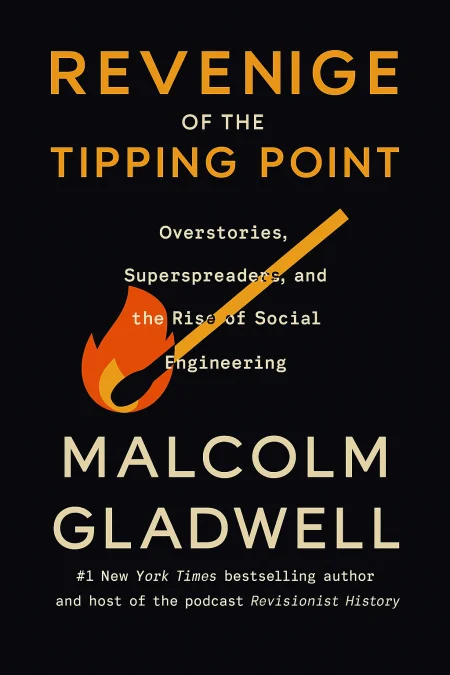
Revenge of the Tipping Point
Overstories, Superspreaders, and the Rise of Social Engineering
Book Edition Details
Summary
Malcolm Gladwell invites readers into an intriguing labyrinth of social dynamics with "Revenge of the Tipping Point," a compelling exploration of the unseen forces that shape our world. Twenty-five years after his groundbreaking debut, Gladwell returns to dissect the darker side of social contagions with a fresh lens. Why does Miami pulsate with a unique energy? What can a cheetah's plight reveal about our parenting methods? Through gripping narratives and unexpected insights, Gladwell navigates the enigmatic interplay of culture, sports, and social engineering. From revisiting forgotten experiments to unraveling the layers of current epidemics like COVID and the opioid crisis, this book challenges perceptions and offers a thought-provoking guide to understanding the viral phenomena that define our times. Prepare to see the world anew through the eyes of one of the most incisive thinkers of our era.
Introduction
In the early hours of a February morning in 2020, executives from a biotechnology company gathered at a Boston hotel for what seemed like a routine leadership retreat. Within days, this single event would spark a chain reaction affecting hundreds of thousands of people across the globe. Yet the most remarkable aspect wasn't the virus itself, but how predictably it followed patterns that have shaped human behavior for millennia. From the Los Angeles bank robbery epidemic of the 1990s to the surprising transformation of American attitudes toward gay marriage, from the calculated admissions strategies of elite universities to the devastating opioid crisis that claimed hundreds of thousands of lives, our world is shaped by hidden forces operating according to discoverable rules. These forces don't respect the boundaries we imagine exist between medicine, education, crime, and culture. Instead, they reveal a startling truth: the epidemics that define our era are not random acts of nature, but engineered phenomena that follow predictable patterns. Understanding these patterns requires us to look beyond surface explanations and examine the deeper architecture of how ideas, behaviors, and crises spread through populations. This exploration reveals both the vulnerability of our institutions and the extraordinary power that comes from understanding the hidden mechanisms that drive social change.
The Architecture of Contagion: Overstories and Hidden Rules
The concept of an "overstory" emerges from forest ecology, describing the uppermost canopy that shapes everything below. In human societies, overstories are the cultural narratives and institutional frameworks that hover above our daily lives, casting invisible shadows that determine how epidemics unfold. These aren't merely abstract ideas, but powerful forces with concrete consequences. Consider the case of Miami, where three traumatic events in 1980 transformed a sleepy Southern city into something entirely different. The influx of Cuban refugees through the Mariel boatlift, the explosion of cocaine trafficking, and devastating race riots didn't just change Miami's demographics or economy. They shattered the institutional authority that had anchored the city for generations, creating an overstory where traditional rules no longer applied. Decades later, this transformation manifested in Miami becoming the Medicare fraud capital of America, where criminals operated with a brazenness that would be unthinkable elsewhere. The power of overstories lies not in their visibility, but in their subtlety. Most residents of Miami couldn't articulate how their city's unique history shaped contemporary behavior, yet the evidence was everywhere. In office buildings where supposed medical practices consisted of empty rooms with unplugged phones, in the casual acceptance of corruption that permeated daily life, and in the extraordinary concentration of Medicare fraud that made Miami an outlier among American cities. These invisible narratives operate across all scales of human organization. In the affluent suburban community of Poplar Grove, an overstory of extreme achievement pressure created conditions that seemed perfect from the outside but proved devastating from within. The community's unwavering focus on academic and athletic excellence produced impressive statistics and college acceptance rates, but it also eliminated the diversity of identity that typically allows communities to resist contagion. When tragedy struck, it spread through a population that had no cultural antibodies against it.
The Magic Third: Engineering Social Tipping Points
Numbers matter in ways that most people never consider. Research across fields as diverse as corporate governance, elementary education, and social revolution reveals a remarkable consistency: somewhere between 25 and 33 percent lies a magical threshold where the dynamics of groups fundamentally transform. This "Magic Third" represents one of the most powerful tools for understanding and manipulating social change. The phenomenon first gained attention through studies of corporate boards, where researchers discovered that having one or two women among nine directors created token dynamics that actually reinforced male dominance. But when three or more women joined a board, something shifted dramatically. Suddenly, women could be themselves rather than representatives of their entire gender. They asked harder questions, challenged assumptions, and changed the culture of decision-making. The difference between two and three women wasn't just arithmetic, it was qualitative transformation. This pattern repeats across contexts with striking consistency. In classrooms where minority students comprised less than 25 percent of the population, achievement gaps persisted and even widened over time. But in classrooms where minority representation exceeded this threshold, gaps disappeared entirely. The students hadn't changed, but the social dynamics that shaped their experience had been fundamentally altered. Understanding these thresholds creates both opportunities and dilemmas. The residents of the Lawrence Tract in 1950s Palo Alto deliberately engineered their neighborhood to maintain exact racial proportions, never allowing any group to exceed the Magic Third. They succeeded in creating a stable integrated community, but only through painful sacrifices that revealed the moral complexities of social engineering. Harvard University appears to have mastered these dynamics through its athletic recruitment programs. By carefully maintaining group proportions that keep any single demographic from reaching the tipping point, the institution preserves a particular vision of diversity while ensuring that certain groups remain perpetually in the majority. The addition of women's rugby to Harvard's athletic offerings in 2013 wasn't about sports, it was about demographics, providing another mechanism for fine-tuning the composition of each incoming class through the backdoor of athletic recruitment.
Superspreaders and the Law of the Very Few
The conventional wisdom about epidemics assumes relatively uniform transmission, with each infected person passing a disease to roughly the same number of others. Reality tells a very different story. Whether examining bank robberies in 1990s Los Angeles, COVID transmission in hotel conference rooms, or opioid prescriptions across American states, the pattern remains consistent: a tiny fraction of actors drives the vast majority of activity. The bank robber known as Casper didn't personally rob 175 banks in four years. Instead, he perfected a system of recruiting and organizing teams of young people to execute robberies while he managed operations from a safe distance. This wasn't just criminal innovation, it was an early example of what economists now recognize as a fundamental asymmetry in how epidemics spread. A handful of superspreaders can generate cascading effects that overwhelm the combined impact of thousands of ordinary participants. During the COVID pandemic, researchers discovered that some individuals naturally produce orders of magnitude more aerosol particles than others when they breathe, talk, or sing. These biological differences, invisible to the naked eye, determined which gatherings became superspreader events and which remained contained. The Biogen conference in Boston that eventually infected over 300,000 people likely began with a single attendee whose unique physiological characteristics turned what should have been a minor exposure into a global catastrophe. The pharmaceutical industry learned to exploit these patterns with devastating effectiveness. When McKinsey consultants analyzed OxyContin prescribing patterns, they discovered that just 358 doctors wrote nearly as many prescriptions as 99,825 of their colleagues combined. Rather than trying to convince the medical profession as a whole, Purdue Pharma focused its marketing firepower on this tiny group of "Super Core" prescribers, many of whom displayed an unusual susceptibility to sales pressure and a troubling indifference to patient welfare. This concentration creates both vulnerability and opportunity. By identifying superspreaders, whether they're spreading disease, crime, or dangerous behaviors, societies can potentially intervene with surgical precision rather than broad population-level measures. However, acting on this knowledge raises profound ethical questions about surveillance, discrimination, and individual liberty that we're only beginning to grapple with.
The Opioid Crisis: A Case Study in Epidemic Engineering
The opioid epidemic that has claimed hundreds of thousands of American lives wasn't an accident of geography, economics, or medical necessity. It was the predictable result of deliberate choices made by specific actors who understood exactly how epidemics work and used that knowledge to devastating effect. Tracing the crisis reveals how overstories, group proportions, and superspreaders combined to create one of the most destructive public health disasters in modern history. The story begins in 1939 with Paul Madden, a puritanical drug warrior in California who created a simple bureaucratic requirement: doctors prescribing opioids had to use special triplicate prescription pads, with carbon copies sent to state authorities. This seemingly minor administrative burden created a powerful overstory that made physicians pause and consider the implications of prescribing powerful painkillers. Over decades, this "Madden overstory" spread to a handful of states and proved remarkably durable. When Purdue Pharma prepared to launch OxyContin in the 1990s, market research revealed the power of these competing overstories. Focus groups in triplicate states showed doctors who were deeply reluctant to prescribe powerful opioids for non-cancer pain. In non-triplicate states, physicians were far more receptive. Rather than attempting a national rollout, Purdue strategically targeted its marketing to avoid the Madden states entirely. The result was dramatic geographic variation in opioid prescribing that persists to this day. McKinsey's involvement transformed the crisis from a supply-side problem into a demand-side catastrophe. By identifying the tiny fraction of doctors responsible for the majority of prescriptions, the consulting firm helped Purdue focus its resources on the most susceptible targets. These "Super Core" prescribers weren't representative of the medical profession, they were outliers who craved attention from sales representatives and showed unusual indifference to mounting evidence of their drugs' dangers. The final act came when Purdue reformulated OxyContin to make it harder to abuse, inadvertently shifting the group proportions of the crisis. Users who had been purchasing pills from doctors suddenly switched to heroin from dealers, transforming a regulated pharmaceutical epidemic into an unregulated street-drug catastrophe. The result was a dramatic increase in overdose deaths that continues to this day, demonstrating how attempts to solve epidemics without understanding their underlying dynamics can make problems catastrophically worse.
Summary
The epidemics that shape our world are not mysterious forces beyond human understanding or control. They follow discoverable patterns involving overstories that shape cultural narratives, tipping points that determine when minorities become majorities, and superspreaders who drive disproportionate amounts of transmission. Understanding these patterns reveals both the hidden architecture of social change and the extraordinary responsibility that comes with such knowledge. The most troubling lesson from these case studies is how easily epidemic dynamics can be weaponized by those who understand them. Whether it's pharmaceutical companies exploiting superspreaders, universities manipulating group proportions, or institutions allowing destructive overstories to persist unchallenged, the tools of epidemic analysis are already being used in ways that serve narrow interests rather than broader social good. The passive voice that characterizes so many discussions of social problems obscures the active choices that create and sustain them. Yet these same tools offer unprecedented opportunities for positive intervention. Communities can deliberately cultivate overstories that promote resilience rather than vulnerability. Institutions can engineer group proportions that support rather than undermine their stated values. Public health officials can develop superspreader strategies that enhance rather than exploit human networks. The question isn't whether we'll use these tools, but whether we'll use them consciously and ethically rather than allowing others to deploy them in secret for their own purposes. The epidemics of the future will be shaped by those who best understand the hidden forces revealed in these stories.
Related Books
Download PDF & EPUB
To save this Black List summary for later, download the free PDF and EPUB. You can print it out, or read offline at your convenience.
By Malcolm Gladwell
