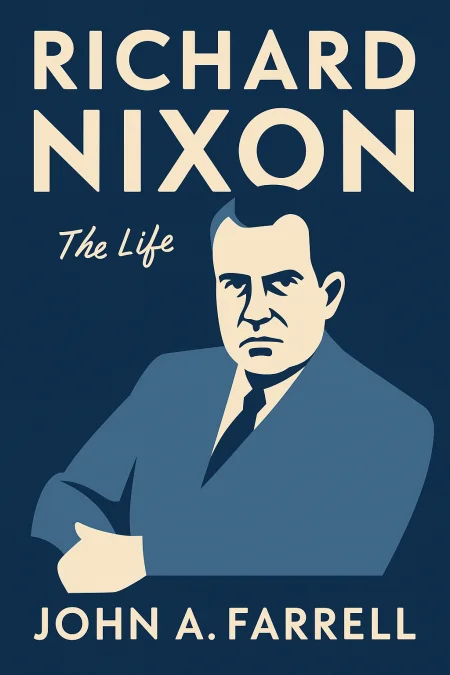
Richard Nixon
The Life
Book Edition Details
Summary
In the labyrinth of American politics, few figures cast as complex a shadow as Richard Nixon. John A. Farrell’s masterful biography unravels the enigmatic journey of a man whose ambitions ignited both his rapid ascent and notorious downfall. From the fervor of a young Navy lieutenant to the corridors of power, Nixon's story is one of stark contrasts. His early idealism swiftly surrendered to a brand of unapologetic tenacity, propelling him to the Senate, the vice presidency, and ultimately, the Oval Office. Yet, beneath the veneer of power, Farrell reveals a legacy steeped in division and dissent. Nixon's pioneering foreign policy maneuvers, including the pivotal opening to China, are juxtaposed against the domestic turmoil of Watergate, marking him as both a visionary and a cautionary tale. This biography promises a gripping exploration of America’s darkest leader, offering a portrait as multifaceted as the man himself.
Introduction
On a humid August morning in 1974, Richard Nixon became the first American president to resign from office, his political career seemingly destroyed by the Watergate scandal that had consumed his administration. Yet this dramatic moment of disgrace was merely the final act in one of the most extraordinary and contradictory lives in American political history. Nixon's journey from a struggling grocer's son in Depression-era California to the pinnacle of global power embodies both the promise and the perils of unbridled political ambition. Few figures in American history have achieved such remarkable heights while simultaneously orchestrating their own spectacular downfall. Nixon's presidency witnessed groundbreaking diplomatic achievements that reshaped the global order, including the historic opening to China and détente with the Soviet Union, yet these triumphs were overshadowed by his systematic abuse of presidential power and contempt for constitutional limits. His story reveals the dangerous intersection of brilliance and paranoia, of visionary leadership and self-destructive behavior that would forever change how Americans viewed their highest office. Through Nixon's tumultuous life, we witness the evolution of modern American politics from the idealistic post-war era through the cynical decades that followed. His experiences offer profound insights into the nature of political ambition, the corrosive effects of power unchecked by moral restraint, and the eternal struggle between public achievement and private demons. From his relentless pursuit of respectability to his ultimate quest for historical redemption, Nixon's complex legacy provides enduring lessons about leadership, character, and the price of compromising one's principles in the pursuit of greatness.
From Humble Beginnings to Political Stardom
Richard Milhous Nixon entered the world on January 9, 1913, in a modest house his father built in Yorba Linda, California, where lemon groves stretched toward distant mountains under the relentless California sun. The second of five sons born to Frank and Hannah Nixon, young Richard grew up in a household marked by financial struggle, personal tragedy, and the austere discipline of Quaker faith. His father Frank was a restless man who tried his hand at various occupations, from streetcar conductor to lemon farmer to grocer, never quite finding the success that seemed to elude him at every turn. The Nixon family's struggles deepened when tragedy struck repeatedly. Richard's younger brother Arthur died of meningitis at age seven, and his beloved older brother Harold succumbed to tuberculosis after a long, expensive battle that drained the family's meager resources. These early experiences of loss and financial hardship forged Nixon's iron determination to succeed where his father had failed. He threw himself into his studies with remarkable intensity, earning top grades while working long hours in the family grocery store, learning to read people's motivations and weaknesses through countless interactions with customers. Nixon's entry into politics came through a fateful letter in 1946, when local Republican leaders invited the young Navy veteran to challenge popular Democratic incumbent Jerry Voorhis for Congress. The campaign revealed Nixon's natural political instincts and his willingness to employ aggressive tactics, as he skillfully exploited Cold War anxieties about Communist infiltration to defeat his opponent. His victory launched him into the national spotlight and established the pattern that would define his career: brilliant strategic thinking married to questionable ethical choices. His rapid ascent continued with his role in the Alger Hiss case, where his dogged pursuit of the accused State Department official made him a hero to conservatives and a villain to liberals. The methodical investigation that exposed Hiss as a Soviet spy demonstrated Nixon's prosecutorial skills and his talent for political theater. By 1952, at age thirty-nine, Nixon had secured the Republican vice-presidential nomination, surviving the "Checkers" scandal through a masterful television performance that saved his political career and revealed his intuitive understanding of the new medium's transformative power.
The Vice Presidency and Years in Exile
Nixon's eight years as Vice President under Dwight Eisenhower provided him with invaluable experience in foreign affairs and domestic politics, yet the relationship between the war hero president and his ambitious deputy remained complex and often strained. Eisenhower valued Nixon's political skills and knowledge of Congress but never fully embraced him as a trusted confidant, preferring the company of successful businessmen and military officers to that of professional politicians. This ambivalent relationship left deep psychological scars that would influence Nixon's behavior for decades, teaching him that even those who claimed to be allies could not be fully trusted. Nixon's role in the Eisenhower administration was largely defined by his willingness to serve as the political hatchet man, allowing the president to remain above partisan battles while Nixon engaged in the rough-and-tumble of political combat. His extensive travels during this period, including confrontations with hostile crowds in South America and his famous "Kitchen Debate" with Soviet Premier Nikita Khrushchev, enhanced his reputation as a serious student of foreign policy and demonstrated his ability to project American strength on the world stage. The narrow defeat to John F. Kennedy in 1960 represented the first major setback in Nixon's seemingly charmed political life, leaving him convinced that the election had been stolen through fraud in Illinois and Texas. This belief reinforced his conviction that politics was fundamentally a dirty business where only the ruthless survived. The subsequent loss in the 1962 California gubernatorial race appeared to end his political career entirely, leading to his bitter declaration that the press wouldn't have Nixon to kick around anymore. The wilderness years from 1962 to 1968 proved crucial to Nixon's ultimate resurrection. Moving to New York to practice law allowed him to rebuild his finances and cultivate relationships with business leaders and foreign dignitaries, while giving him time to study his previous failures and develop new strategies for political comeback. He observed how the civil rights movement, the Vietnam War, and cultural upheaval were fracturing the Democratic coalition, creating opportunities for a Republican candidate who could appeal to what he would call the "Silent Majority" - disaffected middle-class voters feeling abandoned by both parties and threatened by rapid social change.
Presidential Triumphs and the Watergate Downfall
Nixon's return to the presidency in 1969 marked the beginning of one of the most consequential and contradictory administrations in American history. Inheriting a nation torn apart by the Vietnam War and domestic upheaval, he achieved remarkable policy successes that seemed to validate his long journey back to power. His opening to China represented one of the most dramatic diplomatic breakthroughs of the twentieth century, fundamentally altering the global balance of power and demonstrating his capacity for bold, visionary leadership that transcended conventional Cold War thinking. Simultaneously, Nixon's domestic policies revealed a pragmatic leader willing to challenge conservative orthodoxy when circumstances demanded it. His administration created the Environmental Protection Agency, expanded civil rights enforcement, and implemented comprehensive affirmative action programs. The policy of détente with the Soviet Union, culminating in the SALT I arms control agreement, showed his understanding that America's position in the world was changing and that new approaches were needed to maintain its influence and security in an increasingly multipolar world. However, beneath these public successes lay the seeds of Nixon's ultimate destruction. His deep-seated insecurities and paranoid tendencies, exacerbated by the pressures of the Vietnam War and domestic unrest, led him to authorize increasingly questionable activities designed to gather intelligence on political opponents and suppress dissent. The creation of the "Plumbers" unit to stop leaks, the compilation of enemies lists, and the use of government agencies to harass critics revealed a president who had lost sight of constitutional boundaries and democratic norms. The Watergate break-in on June 17, 1972, initially seemed like a minor incident that would have little impact on Nixon's overwhelming reelection victory. However, the president's decision to participate in covering up the crime transformed a third-rate burglary into a constitutional crisis that would ultimately destroy his presidency. The subsequent investigation revealed a systematic pattern of abuse of power, obstruction of justice, and contempt for democratic institutions that shocked the American people. When the Supreme Court forced him to release tape recordings that proved his involvement in the cover-up, Nixon faced certain impeachment and conviction, leading to his unprecedented resignation on August 9, 1974.
Resignation, Rehabilitation, and Historical Legacy
Nixon's final years were marked by a determined campaign to rehabilitate his reputation and secure his place in history, demonstrating the same relentless persistence that had characterized his entire political career. From his exile in San Clemente, California, he wrote memoirs, granted interviews, and gradually reentered public life through his continued expertise in foreign affairs. His 1977 interviews with David Frost provided a form of public confession, as Nixon acknowledged that his actions had been wrong and that he had let down the American people, though he stopped short of admitting criminal behavior. The former president's rehabilitation was aided by his valuable insights into international relations and his relationships with world leaders around the globe. He made numerous trips to China and Russia, meeting with heads of state and offering advice to his successors from both political parties. His analysis of geopolitical trends remained sharp and prescient, and his books on foreign policy were widely read by scholars and policymakers seeking to understand the complexities of global diplomacy in the post-Cold War era. Nixon's post-presidential years were also marked by personal tragedy and quiet triumph. The death of his beloved wife Pat in 1993 devastated him, but he found solace in his daughters and grandchildren while continuing his prolific writing and speaking career. He moved from California to New Jersey, where he lived quietly while working tirelessly to shape how history would remember his presidency. His funeral in 1994 was attended by presidents and world leaders, a testament to his remarkable journey from disgrace to a form of grudging respect. The arc of Nixon's post-presidential rehabilitation demonstrated both his extraordinary resilience and his fundamental limitations as a leader and human being. While he never fully acknowledged the extent of his wrongdoing or accepted complete responsibility for the constitutional crisis his actions had created, his persistence in the face of public humiliation was remarkable. His contributions to foreign policy thinking remained valuable long after his resignation, and his warnings about the dangers of political polarization and the abuse of presidential power proved prophetic in subsequent decades.
Summary
Richard Nixon's extraordinary life stands as both an inspiration and a cautionary tale about the possibilities and perils of American political ambition, demonstrating how the same qualities that enable remarkable achievement can become the instruments of spectacular self-destruction when unchecked by moral restraint and respect for democratic institutions. His journey from poverty to power, from triumph to disgrace, and from exile to partial redemption reveals the complex interplay between personal character and public responsibility that defines democratic leadership in its highest and lowest forms. The enduring lessons of Nixon's career remind us that talent, intelligence, and determination, while necessary for great leadership, are ultimately insufficient without the ethical foundation and constitutional humility required of those who seek to serve in a democracy. His story challenges us to examine our own relationship with power and ambition, to consider how personal insecurities and resentments can corrupt even the most capable leaders, and to remain vigilant against the temptation to place expediency above principle in the pursuit of political success. For students of politics, history, and human nature, Nixon's complex legacy offers invaluable insights into the eternal struggle between our aspirations and our limitations, reminding us that character ultimately determines destiny regardless of circumstances or capabilities.
Related Books
Download PDF & EPUB
To save this Black List summary for later, download the free PDF and EPUB. You can print it out, or read offline at your convenience.
By John A. Farrell
