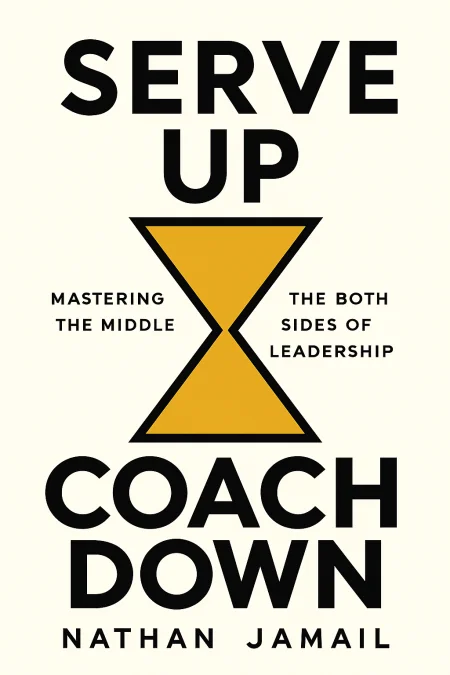
Serve Up, Coach Down
Mastering the Middle and Both Sides of Leadership
Book Edition Details
Summary
In the complex dance of corporate hierarchy, middle managers often find themselves as the unsung heroes who bridge the gap between strategic vision and day-to-day execution. "Serve Up, Coach Down" is a revolutionary leadership manual that redefines what it means to thrive in this pivotal role. It challenges the status quo by empowering these leaders not merely to manage but to inspire—cultivating an environment where innovation flourishes and productivity soars. Instead of acting as mere conduits, these leaders become the architects of success, coaching their teams to greatness while strategically advocating upwards. This guide is a beacon for those ready to master the delicate art of balancing authority with empathy, ensuring that both their superiors and subordinates are aligned towards a shared vision of excellence.
Introduction
In today's complex organizational landscape, millions of professionals find themselves in a peculiar position of power and paradox. They lead teams while simultaneously reporting to superiors, wielding influence while remaining accountable to others. This middle ground of leadership has long been misunderstood as a position of weakness, yet it represents one of the most critical and powerful roles in modern business. The challenge lies not in the position itself, but in how leaders approach their dual responsibilities. Traditional servant leadership models have inadvertently created confusion about the direction of service and support. The conventional wisdom suggests leaders should serve downward to their teams while defending upward to their bosses. However, this approach often leads to protective behaviors that actually limit team growth and organizational effectiveness. What emerges from examining successful middle leadership is a counterintuitive but powerful framework that reverses this conventional flow. The most effective leaders in the middle serve upward to their superiors while coaching downward to their teams, creating a dynamic that empowers everyone involved and drives exceptional results.
The Serve Up Mindset: Supporting Leaders Above
The serve up mindset fundamentally reframes how middle leaders view their relationship with superiors and organizational direction. Rather than seeing bosses as obstacles to navigate or defend against, this approach treats them as partners whose success directly enables team achievement. Serving up means embracing the principle that making your boss look good is not weakness or manipulation, but strategic leadership that benefits everyone in the organization. This mindset operates on three core premises that challenge conventional thinking. First, leaders above you possess broader visibility and information that informs their decisions, even when those decisions seem unclear from your vantage point. Second, your primary value lies not in being right about organizational direction, but in executing that direction with excellence and commitment. Third, resistance to leadership decisions, even well-intentioned resistance, often creates more problems than it solves and diminishes your influence over time. The distinction between serving up and sucking up lies in authenticity and motivation. Serving up stems from genuine respect for organizational goals and a commitment to collective success. It involves asking clarifying questions to understand direction rather than challenging it, providing honest feedback when requested, and never undermining leadership decisions in front of your team. Consider a regional manager who receives news of a company restructuring that will eliminate positions. Rather than immediately defending his team or expressing doubts about the decision, he focuses on understanding the implementation timeline and requirements, then works with his team to execute the transition effectively. Practicing the serve up mindset requires abandoning the comfortable position of being the middleman who buffers bad news or unpopular decisions. Instead, you become the leader who owns every organizational direction as if you had made the decision yourself. This ownership creates clarity for your team and demonstrates the kind of commitment that senior leadership values and rewards. When you consistently serve up, you build trust that leads to greater autonomy and influence over time.
The Coach Down Approach: Developing Teams Below
Coaching down represents a fundamental shift from managing people to developing them, moving beyond task assignment to capability building. Unlike traditional management approaches that focus on correcting problems after they occur, coaching down emphasizes preparation, skill development, and proactive performance enhancement. This approach treats every team member as having untapped potential that can be unlocked through deliberate development efforts. The coaching framework consists of four essential components that work together to create high-intensity rather than high-tension environments. Regular practice sessions allow teams to rehearse important skills in low-stakes settings, building confidence and competence before real-world application. Scrimmaging takes practice further by simulating challenging scenarios and difficult conversations, preparing team members for various outcomes. One-on-one meetings provide personalized development opportunities and accountability check-ins. Finally, floor time ensures leaders stay connected to the actual work being performed and can provide real-time guidance. The power of coaching down becomes evident when comparing high-intensity and high-tension environments. High-tension environments feature high expectations and demanding accountability without adequate support or development. Team members feel stressed, defensive, and focused on avoiding mistakes rather than pursuing excellence. High-intensity environments combine those same high expectations with coaching support, creating conditions where people feel challenged but prepared. The energy is positive, mistakes become learning opportunities, and team members actively seek greater responsibility. Consider a sales team leader who notices declining performance in client presentations. Rather than simply demanding better results or providing generic training, she implements a coaching approach. She observes actual client meetings, identifies specific improvement areas, and then creates practice sessions where team members rehearse presentations and receive feedback. She brings in challenging colleagues to play difficult clients during scrimmages, preparing her team for various scenarios. The result is not just improved presentation skills, but increased confidence and a team culture that embraces continuous improvement.
Leading Through Change and Uncertainty
Leading through change and uncertainty demands a fundamental shift in focus from the "what" and "why" of change to the "how" of implementation. While traditional change management approaches often get bogged down in explaining rationale and building consensus, effective middle leaders recognize that uncertainty is permanent and must be navigated through action rather than analysis. The key lies in becoming "how people" who assume positive intent from leadership and focus entirely on execution excellence. This approach requires abandoning the comfortable role of change skeptic or devil's advocate. Instead of questioning whether changes are necessary or wise, effective middle leaders immediately shift to understanding implementation requirements and preparing their teams for success. They recognize that their perspective, while valuable, is necessarily limited compared to senior leadership's broader view. Rather than demanding proof that changes will work, they commit to making changes work through superior execution. The serve up and coach down mindset proves especially valuable during organizational transitions such as new leadership appointments or structural reorganizations. When a new boss arrives, traditional middle managers often adopt a wait-and-see approach, protecting their teams from potential disruption while evaluating the new leader's competence. However, leaders with a serve up mindset immediately begin building the new relationship, sharing their commitment to organizational success and demonstrating their value through consistent execution. Imagine a manufacturing division that must centralize previously localized services. Traditional managers might spend weeks documenting why local control is superior and building cases for maintaining the status quo. A leader with the right mindset instead focuses on understanding the centralization timeline, identifying potential implementation challenges, and preparing the team to excel within the new structure. This approach not only ensures smoother transitions but positions the leader as someone who can be counted on during difficult periods, ultimately increasing their influence and job security.
Maintaining Power and Accountability in Middle Leadership
The final element of effective middle leadership involves understanding that power comes not from position or title, but from consistent demonstration of value through results and relationships. Many middle leaders inadvertently surrender their power by positioning themselves as victims of organizational decisions or by lowering expectations to avoid conflict. True power in the middle comes from embracing full ownership of both successes and failures while maintaining unwavering commitment to organizational goals. Power preservation requires careful balance between loyalty and accountability, particularly when dealing with long-tenured team members who may feel entitled to reduced expectations. The principle that "everyone is important, but no one is required" guides decision-making about team composition and performance standards. This means showing genuine appreciation for contributions while never accepting mediocrity based on past performance or organizational tenure. Leaders must coach people up or coach them out, ensuring every team member contributes at their highest potential. The relationship between goals and power demonstrates why effective leaders never lower expectations to match results. Instead, they raise efforts to match expectations, creating cultures of continuous improvement and high performance. When teams consistently achieve challenging goals, they develop confidence and momentum that becomes self-reinforcing. Leaders who protect teams from stretch goals actually limit their growth potential and organizational impact. Maintaining power also requires welcoming oversight and collaboration rather than defending territory. Secure leaders invite their bosses into meetings and team interactions, viewing such involvement as coaching opportunities rather than threats to authority. They build benches continuously, always recruiting and developing talent that could potentially replace current team members. This approach creates healthy competition and ensures organizational resilience while demonstrating the leader's confidence in their own value.
Summary
Mastering leadership from the middle requires embracing the counterintuitive truth that serving upward while coaching downward creates more power and influence than traditional approaches that reverse this flow. This framework transforms middle management from a position of compromise and limitation into one of exceptional impact and organizational value. By owning every organizational direction while demanding excellence from every team member, middle leaders become the crucial link that translates vision into results. The ultimate measure of this approach lies not in comfort or popularity, but in the consistent achievement of results that benefit everyone in the organization and create sustainable cultures of high performance and continuous growth.
Related Books
Download PDF & EPUB
To save this Black List summary for later, download the free PDF and EPUB. You can print it out, or read offline at your convenience.

By Nathan Jamail
