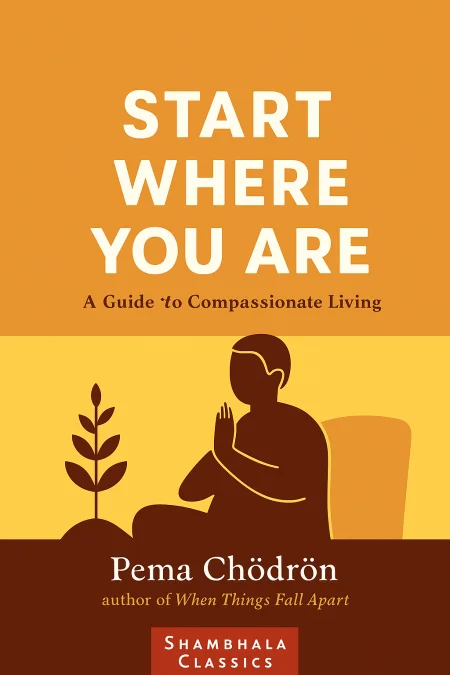
Start Where You Are
A Guide to Compassionate Living
Book Edition Details
Summary
Nestled within the pages of "Start Where You Are" lies a profound invitation to embrace life's raw edges with courage and grace. Pema Chödrön, with her signature blend of humor and wisdom, distills ancient Tibetan Buddhist teachings into an accessible guide for modern seekers. These fifty-nine poignant maxims—like "Always meditate on whatever provokes resentment"—become tools for transformation, urging us to meet our fears head-on and discover the joy hidden within our struggles. This isn't just a book; it's a gentle nudge toward awakening a heart full of compassion and a mind at peace. Through meditation and mindful reflection, Chödrön lights the path to inner resilience and serenity, encouraging us to find strength in vulnerability and happiness in the present moment.
Introduction
Life has a way of presenting us with moments that feel overwhelming, when our carefully constructed plans crumble and we find ourselves face-to-face with raw, uncomfortable emotions. Whether it's anger bubbling up during a difficult conversation, grief that seems to have no end, or fear that paralyzes us in the face of uncertainty, these experiences often leave us feeling stuck and searching for escape. Yet what if these very moments of difficulty contain the seeds of our greatest growth? What if the path to genuine compassion and awakening doesn't require us to fix ourselves first, but invites us to work with exactly what we have, right now, in this very moment? This revolutionary approach suggests that our messy, imperfect lives aren't obstacles to overcome, but the raw material from which wisdom and kindness naturally emerge. The journey toward a more compassionate way of living begins not with perfection, but with the courage to meet ourselves exactly where we are.
Awakening the Heart Through Meditation Practice
The foundation of compassionate living rests not in complex philosophical understanding, but in the simple yet profound practice of making friends with our own mind. At its essence, meditation is about developing an unconditional relationship with ourselves, learning to sit with whatever arises without immediately trying to fix, change, or escape it. This isn't about achieving some blissful state of permanent calm, but about cultivating the basic sanity and gentleness needed to remain present with life as it unfolds. Consider the story of a student who approached meditation with the determination of a warrior going to battle. Every time a thought arose during sitting practice, she would attack it with fierce concentration, believing that good meditation meant having no thoughts at all. Day after day, she left her cushion feeling defeated, convinced she was the worst meditator in the world. Her teacher suggested a radical shift: instead of fighting her thoughts, what if she could greet them like unexpected guests? Not invited guests she was thrilled to see, but not enemies to be destroyed either. Just visitors passing through. This simple reframe transformed her entire practice. She learned to notice when her mind wandered off into planning or remembering, gently label it "thinking," and return to her breath without drama or self-judgment. The thoughts didn't stop coming, but something fundamental shifted in her relationship to them. She discovered that beneath all the mental chatter was a natural awareness that was spacious, warm, and inherently peaceful. The technique itself is elegantly simple: sit upright with your eyes slightly open, rest your attention lightly on the out-breath, and when you notice your mind has wandered into thought, simply say "thinking" and return to the breath. The key is the quality of gentleness you bring to this process. Each time you catch your mind wandering and come back to the present moment, you're strengthening your capacity for loving-kindness toward yourself. This isn't a mechanical exercise but a practice of coming home to your own basic goodness, again and again. The meditation cushion becomes a laboratory for learning how to be fully present with whatever life brings, training ground for the kind of open-hearted awareness that can transform any situation into an opportunity for awakening.
Transforming Pain into the Path of Wisdom
Rather than viewing painful emotions and difficult circumstances as signs that something has gone wrong, we can learn to see them as doorways to deeper understanding and genuine compassion. This radical shift in perspective transforms obstacles into opportunities, turning our most challenging experiences into the very fuel for awakening. The key lies not in eliminating pain, but in changing our relationship to it entirely. Milarepa, the great Tibetan yogi, returned to his cave one evening to find it filled with demons. These weren't ordinary intruders but manifestations of his own unresolved fears, anger, and confusion. Initially, he tried to get rid of them through conventional means. He taught them dharma from his elevated seat, speaking about compassion and enlightenment, but the demons remained unmoved. Growing frustrated, he charged at them with aggression, but they only laughed at his futile attempts. Finally, exhausted and defeated, Milarepa simply sat down and said, "I'm not going away and it looks like you're not either, so let's just live here together." In that moment of surrender, all but one demon disappeared. Facing the most vicious one remaining, Milarepa took an even more radical step. He walked directly toward the demon and placed his head in its mouth, saying, "Just eat me up if you want to." With this ultimate act of non-resistance, the final demon vanished completely. Milarepa discovered the profound truth that when resistance is gone, so are the demons. This story illustrates the practice of tonglen, or "taking and giving," which involves breathing in pain and sending out relief. When you encounter suffering, whether your own or others', instead of pushing it away, you breathe it in fully, making space for it in your heart. Then you breathe out whatever might help: peace, comfort, or simply loving presence. Begin with your own pain, then extend this practice to include others who are experiencing similar suffering. This isn't masochistic self-punishment but a way of developing the courage to remain present with reality rather than constantly seeking escape. Through tonglen, you discover that your heart is far more resilient than you imagined, capable of holding both pain and joy without being destroyed by either.
Cultivating Compassion for Self and Others
True compassion begins with the radical notion that we must start exactly where we are, with all our flaws, fears, and imperfections intact. This isn't about becoming someone different or better before we're worthy of love, but about recognizing that our current messy, complicated human existence is the perfect starting point for awakening our hearts. The path forward isn't about self-improvement but about self-acceptance, which paradoxically becomes the foundation for genuine transformation. A meditation instructor discovered this truth while working with students. When someone would arrive for a session feeling angry, depressed, or completely hopeless about their practice, she noticed her tendency to want to cheer them up or offer solutions. One day, a student came in describing himself as "the most violent, jealous, worthless person on the planet," convinced he should quit meditation altogether. Instead of trying to convince him otherwise, the instructor simply said, "That sounds like an excellent place to start. You've got all the raw materials you need right here." This response surprised both of them, but it opened up something genuine in their conversation. The student began to explore his difficult emotions not as problems to be solved but as information about the human condition. His jealousy became a window into understanding how others feel when consumed by envy. His anger revealed the universal experience of feeling misunderstood and unheard. Rather than being obstacles to compassion, these very emotions became bridges of connection to all beings who share similar struggles. The practice is beautifully straightforward: whatever you're experiencing right now, whether pleasant or unpleasant, use it as your starting point for connecting with others. If you're feeling lonely, recognize that countless people are feeling lonely at this very moment. Breathe in that shared loneliness and breathe out connection and understanding. If you're feeling joy, share that joy by sending it out to others who need upliftment. This simple exchange dissolves the artificial barriers between self and other, revealing the fundamental interconnectedness that is always present. Start each day by making friends with yourself exactly as you are. Notice your thoughts and emotions without trying to change them immediately. Practice speaking to yourself with the same kindness you'd offer a good friend going through a difficult time. This isn't about indulging in self-pity or avoiding responsibility, but about creating the inner environment of acceptance that allows genuine growth to unfold naturally.
Summary
The journey toward compassionate living doesn't require us to become perfect before we begin, but invites us to embrace the messy, imperfect reality of our current experience as the perfect place to start. Through gentle meditation practice, we learn to make friends with our own minds, discovering that beneath all our mental chatter lies an inherent wisdom and goodness that can never be damaged or destroyed. By transforming our relationship to pain and difficulty, we find that our greatest challenges become our most powerful teachers, showing us how to remain present and open-hearted even in the midst of life's storms. As the text reminds us, "Whether you're feeling angry, poverty-stricken, or depressed, the practices described here were designed for you, because they will encourage you to use all the unwanted things in your life as the means for awakening compassion for yourself and others." Begin today by taking one difficult emotion or challenging situation you're facing, and instead of trying to escape or fix it, breathe into it with curiosity and kindness, allowing it to become your doorway into deeper understanding and genuine compassion for all beings who share in the beautiful struggle of being human.
Related Books
Download PDF & EPUB
To save this Black List summary for later, download the free PDF and EPUB. You can print it out, or read offline at your convenience.
By Pema Chödrön
