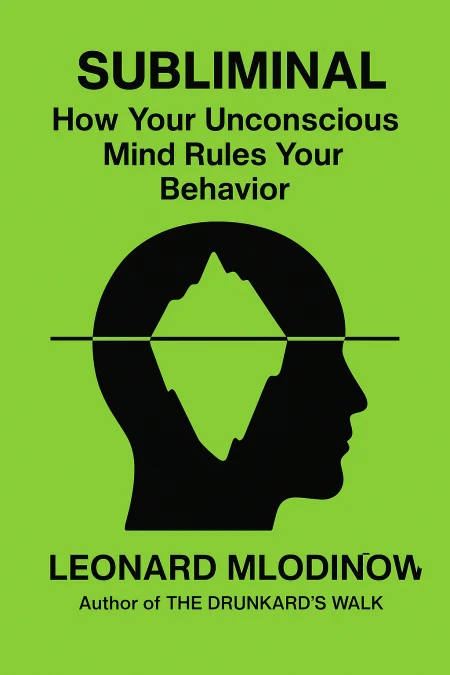
Subliminal
How Your Unconscious Mind Rules Your Behavior
Book Edition Details
Summary
Deep beneath the surface of our thoughts lies an elusive force, shaping every decision, every memory, and every relationship—it's the realm of the unconscious. In "Subliminal," Leonard Mlodinow invites you to peek under the hood of your mind, unraveling the mysterious, often misunderstood machinery that drives human behavior. With his signature blend of wit and crystal-clear explanations, Mlodinow delves into the unseen influences that govern how we perceive the world, from our choice in partners to the stocks we invest in, and even the memories we hold dear. This exploration of the hidden mind offers a revolutionary perspective on why we do what we do, challenging everything we thought we knew about free will and self-awareness. Prepare to have your worldview turned inside out as you discover the silent puppet master pulling the strings behind your every move.
Introduction
Imagine walking into a room and instantly feeling that something is "off" about a person you've just met, but you can't quite put your finger on why. Or consider how you might confidently recall a childhood memory in vivid detail, only to discover later that key elements never actually happened. These everyday mysteries point to one of the most fascinating discoveries in modern psychology: much of what drives our thoughts, feelings, and behaviors happens below the threshold of our awareness, in the hidden depths of our unconscious mind. For centuries, we've believed that we are the conscious captains of our own ships, making rational decisions based on careful deliberation. Yet groundbreaking research in neuroscience and psychology reveals a startling truth: our unconscious mind processes information, makes judgments, and influences our actions in ways that would astonish us if we could observe them directly. This hidden mental world doesn't just fill in gaps in our perception—it actively shapes how we form relationships, interpret social situations, and construct our very sense of reality. You'll discover how your brain processes millions of pieces of information every second while you're consciously aware of only a tiny fraction, why your memories are more like creative stories than accurate recordings, and how your unconscious mind constantly works to maintain a coherent sense of self even when the evidence suggests otherwise. Understanding these invisible forces isn't just intellectually fascinating; it's the key to comprehending why we sometimes act in ways that surprise even ourselves.
The Two-Tier Brain: Conscious vs Unconscious Processing
Your brain operates like a sophisticated two-tier system, with conscious thought representing just the tip of an enormous iceberg. While you're aware of pondering what to have for lunch or solving a math problem, your unconscious mind is simultaneously processing roughly eleven million bits of information per second—managing everything from your heartbeat to the subtle facial expressions of people around you. Your conscious mind, by contrast, can handle only about forty bits per second, which explains why you can't consciously track every detail of your environment while also carrying on a conversation. This division of labor isn't accidental—it's the result of millions of years of evolution. Your unconscious brain developed first, handling the basic survival functions that kept our ancestors alive: detecting threats, finding food, and navigating social relationships. The conscious brain is evolution's more recent addition, allowing for complex planning, abstract reasoning, and the kind of deliberate thought we associate with being human. Yet even our most sophisticated conscious decisions rely heavily on unconscious processing that happens behind the scenes. Think of your unconscious as a highly efficient autopilot system. When you drive a familiar route while lost in thought, your unconscious mind handles the complex task of navigation, steering, and traffic awareness, freeing your conscious attention for other matters. This isn't a sign of inattention—it's evidence of how remarkably capable your unconscious processing can be. The same system that guides your car also interprets facial expressions, completes sentences before you finish hearing them, and makes split-second judgments about people and situations. The energy consumption of your brain reveals just how hard your unconscious works. Whether you're lounging on the couch or intensely concentrating on a chess game, your brain's energy use increases by only about one percent. This means that your unconscious mind is doing the heavy lifting around the clock—the mental equivalent of running wind sprints while your conscious mind takes a leisurely stroll through the park of awareness.
Social Perception: Reading People Without Knowing It
Humans possess an extraordinary ability to read social cues and emotions in others, often without realizing we're doing it. This skill is so fundamental to our survival as a social species that we begin demonstrating it in infancy. Six-month-old babies, when shown simple wooden shapes with eyes—one helping another climb a hill, another pushing it down—will consistently reach for the "helper" and avoid the "hinderer." They're making moral judgments about geometric shapes, revealing that our capacity for social evaluation is wired into our neural architecture from birth. Your unconscious mind constantly processes micro-expressions, vocal tones, posture, and countless other social signals that your conscious awareness never registers. Within milliseconds of seeing a face, your brain automatically assesses trustworthiness, competence, and emotional state. These rapid judgments happen so quickly that they influence your behavior before you've had time to form conscious opinions. In political elections, candidates who appear more competent in photographs win races at rates far above chance, suggesting that voters are being swayed by unconscious visual processing rather than careful consideration of policies. This automatic social radar extends beyond individual faces to encompass entire social situations. You unconsciously adjust how much eye contact you make based on social status, maintain culturally appropriate distances during conversations, and pick up on group dynamics that help you navigate complex social hierarchies. When you walk into a party and immediately sense the mood of the room, or when you instinctively know that a conversation is winding down, your unconscious social perception system is drawing on subtle cues that would be impossible to consciously track and analyze. The sophistication of this system becomes apparent when you consider how much social information we process effortlessly. You can tell when someone is genuinely happy versus politely smiling, when a person is attracted to you, or when someone is lying, often based on tiny changes in behavior that last fractions of a second. This unconscious social intelligence allowed our ancestors to form the large, cooperative societies that became humanity's greatest survival advantage, and it continues to shape every relationship and social interaction in your daily life.
Memory Construction: How Your Brain Creates Stories
Memory feels like a video recording of our past experiences, but this intuition is profoundly misleading. Your brain doesn't store complete, accurate records of events—instead, it retains the general gist of what happened and reconstructs the details each time you remember. This reconstruction process is so convincing that you'll swear you remember specific details that never actually occurred, and you'll feel certain about memories that are largely fictional. Every time you recall a memory, your brain essentially rebuilds it from fragments of stored information, influenced by your current knowledge, emotions, and expectations. Think of memory as a creative storyteller rather than a faithful historian. Your unconscious mind fills in gaps with plausible details, smooths over inconsistencies, and creates coherent narratives from incomplete information. This is why siblings can have dramatically different recollections of the same childhood event, each feeling absolutely certain that their version is correct. The most dramatic evidence for memory's creative nature comes from cases where we can compare people's recollections to objective records. When researchers analyzed detailed testimonies about important events and compared them to audio recordings of those same events, they found that people were often completely wrong about specific details while maintaining the overall emotional truth of what happened. The witnesses weren't lying—their unconscious minds were constructing plausible details that fit their understanding of the situation. This reconstructive process serves an important evolutionary purpose. If your brain stored every detail of every experience, you'd be overwhelmed by irrelevant information. Instead, your unconscious mind acts like an intelligent editor, keeping what's important for future decision-making and discarding the rest. When you encounter a similar situation later, your brain can quickly access the relevant patterns and lessons without being bogged down by unnecessary specifics. Understanding this doesn't mean your memories are worthless, but it does suggest approaching them with appropriate humility, especially when they conflict with other evidence or other people's recollections.
The Self Illusion: Motivated Reasoning and Identity
The story you tell yourself about who you are and why you do what you do is largely a post-hoc construction created by your unconscious mind to maintain a coherent and positive self-image. Your brain operates like a skilled defense attorney, constantly gathering evidence that supports your preferred view of yourself while minimizing or reinterpreting information that might threaten your self-esteem. This process, known as motivated reasoning, occurs automatically and unconsciously, creating the illusion that your self-understanding is based on objective self-reflection. Your unconscious mind employs numerous strategies to protect and enhance your self-image. It selectively remembers your successes while forgetting your failures, interprets ambiguous situations in your favor, and generates plausible explanations for your behavior that cast you in the best possible light. When you perform well, you attribute it to your skill and effort; when you perform poorly, you blame external circumstances or bad luck. This isn't conscious dishonesty—your unconscious genuinely believes these self-serving interpretations and presents them to your conscious mind as objective truth. This motivated reasoning extends far beyond personal evaluation to influence how you perceive the world around you. Your political opinions, moral judgments, and even your perception of factual information can be unconsciously shaped by what you want to believe rather than by objective evidence. Your brain seeks out information that confirms your existing beliefs while avoiding or discounting contradictory evidence, creating echo chambers of self-reinforcing ideas that feel like rational conclusions but are actually products of unconscious bias. While this unconscious self-enhancement might seem like a character flaw, it actually serves important psychological functions. People with overly accurate self-perceptions tend to be more prone to depression and anxiety, while those with mildly inflated self-views are generally happier, more motivated, and more resilient. Your unconscious mind's tendency to create a positive self-narrative isn't just about feeling good—it's about maintaining the confidence and optimism necessary to take risks, pursue goals, and persist through challenges that rational analysis might suggest are impossible to overcome.
Summary
The most profound insight from understanding your unconscious mind is recognizing that you are not the unified, self-aware agent you believe yourself to be, but rather a complex partnership between conscious awareness and unconscious processing systems that evolved to help you survive and thrive in a challenging world. Your unconscious doesn't just influence your behavior—it actively constructs your reality, shapes your memories, guides your social interactions, and maintains your sense of self, all while remaining largely invisible to your conscious awareness. This hidden mental universe operates with remarkable sophistication, processing millions of pieces of information every second, making rapid social judgments, filling gaps in perception and memory, and creating coherent narratives from fragmentary information. Understanding these unconscious processes can be both humbling and empowering, revealing that many of your certainties about yourself and the world are actually constructions rather than discoveries, and that your biases and blind spots are not personal failings but universal features of human cognition. Rather than diminishing human agency, recognizing the power of the unconscious can enhance your ability to work with these systems rather than against them, leading to better decisions, more compassionate relationships, and a deeper appreciation for the remarkable complexity of the human mind. How might your relationships and self-understanding change if you regularly considered the unconscious forces at work beneath the surface of your conscious experience? What aspects of your own behavior might you examine differently if you assumed that your conscious explanations for them are incomplete stories created by your unconscious mind's need for coherent narratives?
Related Books
Download PDF & EPUB
To save this Black List summary for later, download the free PDF and EPUB. You can print it out, or read offline at your convenience.
By Leonard Mlodinow
