
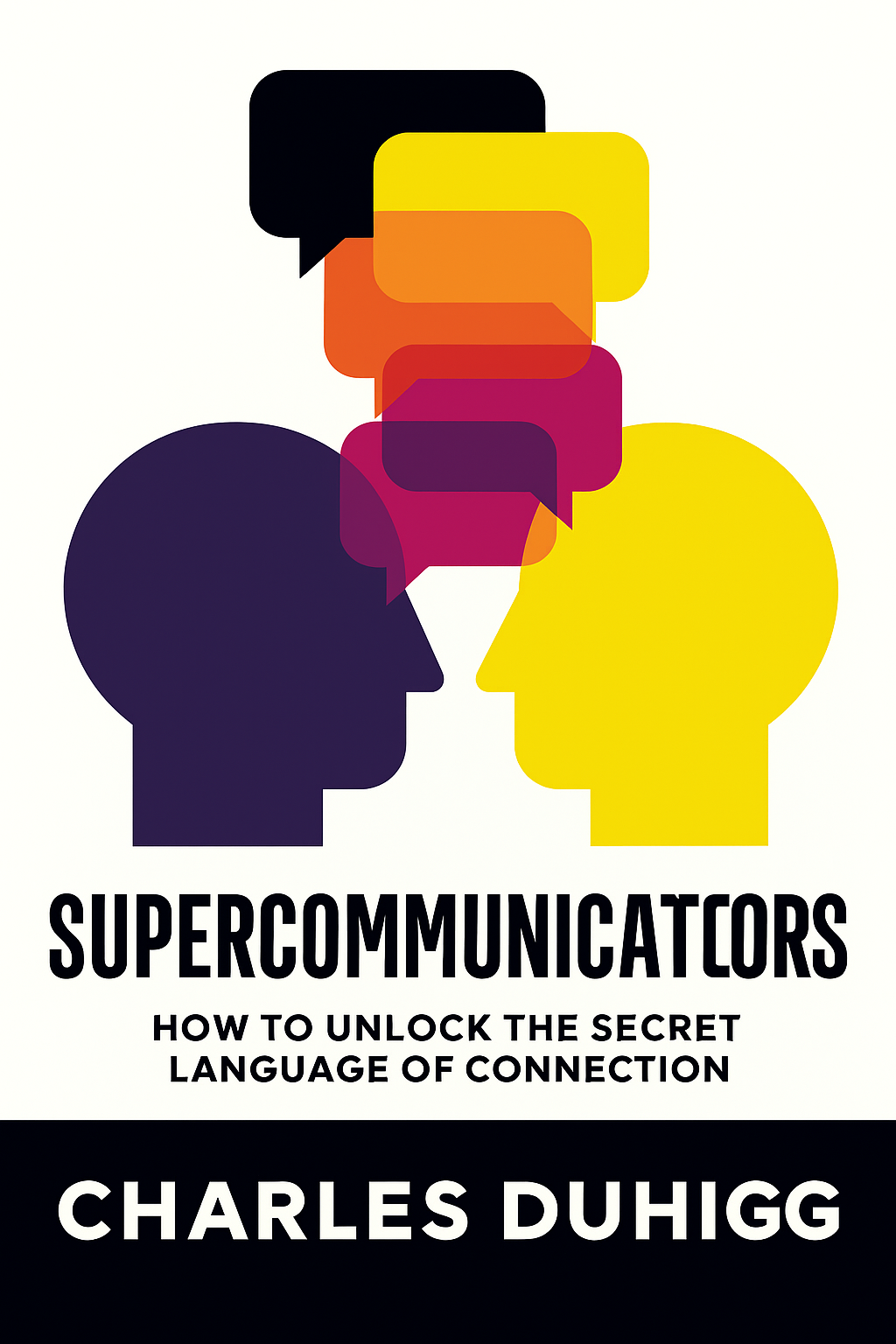
Supercommunicators
How to Unlock the Secret Language of Connection
Book Edition Details
Summary
In a world buzzing with words, Charles Duhigg's latest work deciphers the enigmatic allure of the supercommunicator—a rare breed who can transform conversations into artful exchanges. These individuals wield their linguistic prowess to navigate the stormiest discussions, leaving participants feeling heard and understood. But what secrets lie behind their seemingly effortless charm? Duhigg unveils the intricate dance of dialogue, revealing how strategic questioning and deft conversational tactics can forge connections even in the most contentious settings. Through riveting anecdotes—from a CIA operative's persuasive finesse to a doctor's engagement with a vaccine skeptic—this book promises to revolutionize how you perceive and perform communication. Get ready to unlock the power of words and transform every conversation into a meaningful encounter.
Introduction
Have you ever walked away from a conversation feeling completely misunderstood, even though you spoke the same language? Or found yourself in a meeting where everyone seemed to be talking past each other, despite sharing the same goals? These moments of disconnection happen more often than we'd like to admit, and they reveal a fundamental truth about human interaction: simply exchanging words isn't the same as truly communicating. The most successful people in every field share a remarkable ability to connect with others in ways that feel almost magical. They can walk into a room full of strangers and leave with genuine relationships. They can navigate difficult conversations with grace, turning potential conflicts into opportunities for deeper understanding. This extraordinary ability isn't a mysterious talent reserved for the naturally charismatic. It's a learnable set of skills based on understanding how our brains actually work when we communicate, recognizing the different types of conversations we engage in every day, and knowing how to align with others on a neurological level. When we master these principles, we don't just become better communicators we become catalysts for connection, understanding, and positive change in every interaction we have.
Recognize the Three Types of Every Conversation
Every meaningful interaction we have falls into one of three distinct categories, and recognizing which type of conversation you're in is the key to unlocking genuine connection. Most communication failures happen because people are having different types of conversations without realizing it, like two musicians trying to play together but in different keys. Jim Lawler, a CIA operative, discovered this principle during a high-stakes mission in Europe. He was tasked with recruiting a foreign intelligence officer, a woman named Yasmin, who had access to critical information. Traditional recruitment methods had failed repeatedly with similar targets, but Jim approached the situation differently. Instead of launching into his agenda about strategic intelligence sharing, he spent time understanding what kind of conversation Yasmin actually wanted to have. During their first meeting at a café, Jim noticed that Yasmin kept mentioning her young son and the challenges of balancing her demanding career with motherhood. Rather than steering the conversation toward intelligence matters, Jim began sharing his own experiences as a parent, his fears about failing at his job, and his genuine desire to make a meaningful difference. When Yasmin saw his authentic emotions, she began sharing her own struggles and dreams. That night, she agreed to work with the CIA, becoming one of their most valuable assets for the next two decades. The three types of conversations are practical conversations focused on solving problems and making decisions, emotional conversations centered on feelings and relationships, and social conversations that explore identity and belonging. The magic happens when you can identify which type your conversation partner needs and match their energy accordingly. To master this skill, start by asking yourself at the beginning of every important conversation: "What does this person really need right now?" Listen not just to their words, but to the emotional undertones and social cues they're sending. Then adjust your approach to meet them where they are, creating the foundation for genuine understanding and connection.
Ask Deep Questions That Create Authentic Bonds
The most powerful tool in any communicator's arsenal isn't the ability to speak persuasively it's the ability to ask questions that unlock authentic sharing and create genuine intimacy. Yet most of us default to surface-level inquiries that keep conversations trapped in shallow waters, missing countless opportunities for meaningful connection. Nicholas Epley, a psychology professor at the University of Chicago, discovered this principle while working with a room full of hedge fund managers. These were people accustomed to surface-level networking and transactional relationships. Epley asked them to engage in a simple exercise: spend ten minutes asking each other three specific questions, including "Can you describe a time you cried in front of another person?" The financiers initially dreaded the exercise, expecting it to be awkward and uncomfortable. Instead, something remarkable happened. The room filled with genuine laughter and tears as strangers began sharing deeply personal stories. One participant described the funeral of a beloved cousin, and his partner responded with such authentic empathy that both men were moved to tears. By the end of the exercise, people were hugging and exchanging contact information, having formed real connections in just minutes. The secret lies in understanding that vulnerability is contagious. When we share something meaningful about ourselves, it gives others permission to do the same. These "deep questions" create connection by inviting vulnerability and authentic sharing. Unlike shallow questions that can be answered with facts, deep questions require people to reveal something meaningful about themselves. This vulnerability triggers what psychologists call "emotional contagion" we naturally mirror and connect with the emotions others share with us. The key to asking deep questions is to focus on feelings, values, experiences, and aspirations rather than just facts. Before any important conversation, prepare a few questions that invite the other person to share something meaningful about themselves, remembering that the goal isn't to interrogate, but to create a safe space where authentic connection can flourish.
Navigate Identity Differences and Build Bridges
The most challenging conversations we face often involve our deepest sense of who we are our identities, backgrounds, and the groups we belong to. These discussions can feel like walking through a minefield, but when navigated skillfully, they become the foundation for the most meaningful connections and positive change in our relationships and communities. Consider the remarkable experiment conducted in Qaraqosh, Iraq, where Christians and Muslims had been bitter enemies following years of ISIS violence. Researcher Salma Mousa created a soccer league that brought together players from both communities. Initially, Christian players refused to speak to their Muslim teammates, sitting as far apart as possible during practices. The tension was palpable and seemed insurmountable. But Mousa had structured the league carefully. Every player received equal playing time, eliminating power imbalances. Players were given multiple roles goalkeeper, captain, equipment manager that created identities beyond religion. Most importantly, they were all working toward a common goal: winning games. Within weeks, the same players who had refused to acknowledge each other were celebrating goals together, sharing rides to practice, and inviting teammates to their homes for coffee. The transformation occurred because the environment allowed players to see each other as complex individuals rather than representatives of opposing groups. This approach worked because it recognized a fundamental truth about human psychology: we all contain multiple identities, and which ones become prominent depends on the situation and how others treat us. When we feel that our core identity is being attacked or dismissed, we become defensive and closed off. But when someone acknowledges and respects our various identities, we become more open to connection and even change. The key to navigating identity conversations is to remember that everyone is multidimensional. Before difficult discussions, take time to find genuine common ground whether it's shared values, similar experiences, or mutual concerns. Approach these conversations with curiosity rather than judgment, and always speak from your own experience rather than making generalizations about groups.
Summary
The ability to communicate meaningfully with others isn't just a nice-to-have skill it's essential for thriving in our increasingly complex world. As research reveals, "Every meaningful conversation is made up of countless small choices." These choices, made moment by moment, determine whether we create connection or division, understanding or confusion, trust or suspicion. The techniques explored here aren't manipulation tactics or superficial networking strategies. They're based on a fundamental truth about human nature: we all crave genuine connection and understanding. When we learn to recognize the type of conversation someone needs, ask questions that invite authentic sharing, and create environments where everyone feels safe to be themselves, we tap into our deepest capacity for empathy and connection. Your next conversation is an opportunity to practice these skills. Start small ask one deeper question, practice active listening with a colleague, or share something genuine about yourself with a friend. Notice how these small changes ripple outward, creating more meaningful relationships and richer experiences. The right conversation, at the right moment, truly can change everything.
Related Books
Download PDF & EPUB
To save this Black List summary for later, download the free PDF and EPUB. You can print it out, or read offline at your convenience.
By Charles Duhigg
