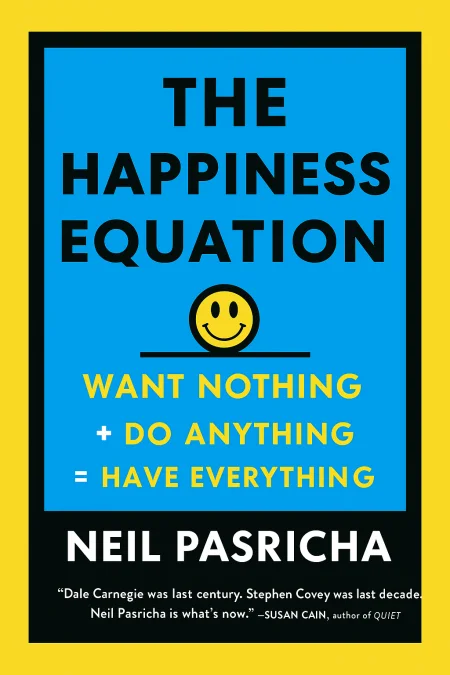
The Happiness Equation
Want Nothing + Do Anything = Have Everything
Book Edition Details
Summary
What if your path to happiness lay in unraveling the secrets hiding in plain sight? Neil Pasricha, celebrated author and thinker, invites you to flip conventional wisdom on its head with "The Happiness Equation." This isn't just another self-help book; it's a radical rethinking of life's most pressing questions. Imagine redefining success, questioning the value of advice, and challenging the myth of multitasking. Pasricha reveals nine transformative secrets, each a profound shift in perspective, poised to reshape your understanding of joy, wealth, and fulfillment. With insights like the Saturday Morning Test and the Five People Test, you'll navigate the world with newfound clarity and purpose. Whether you're seeking deeper connections or a more meaningful career, "The Happiness Equation" promises a revolutionized outlook, showing that sometimes wanting nothing is the key to having everything.
Introduction
Picture this: you're lying in bed on a Sunday morning, checking your phone, scrolling through social media feeds filled with friends' vacation photos, career announcements, and milestone celebrations. A familiar pang hits your chest - that quiet ache of wondering if you're falling behind, if you're happy enough, if you're doing life right. You're not alone in this feeling. Despite living in an age of unprecedented opportunity and connection, millions of people wake up each day struggling with the same fundamental question: how do we find genuine happiness? The conventional wisdom tells us to chase success first, then happiness will follow. Work harder, earn more, achieve bigger goals, and contentment will be our reward. But what if we've been approaching this backwards? What if the secret to a fulfilling life isn't about accumulating more, but about fundamentally shifting how we see ourselves and our relationship with the world around us? This exploration reveals a different path - one that begins with contentment, flows through purposeful action, and culminates in authentic fulfillment. Through real stories and practical insights, we'll discover how to break free from the exhausting cycle of endless striving and find the peace that comes from understanding what we truly need to thrive.
Want Nothing: The Foundation of True Contentment
A Harvard Business School professor once confided something shocking during office hours. Despite his tenure, prestigious position, and six-figure salary, he felt like a failure every single morning. Walking to his office, he'd see the Nobel Prize winner to his left and the twelve-book author to his right, and the comparison would crush his spirit before his day even began. Here was someone who had achieved what most would consider extraordinary success, yet he was trapped in a prison of perpetual inadequacy. This professor's confession reveals a fundamental truth about human psychology: our brains are hardwired for dissatisfaction. For 200,000 years, our ancestors survived by constantly scanning for threats and problems. Those who were content with "enough" often didn't live long enough to pass on their genes. This survival mechanism served us well when we faced saber-toothed tigers, but in our modern world of abundance, it becomes a source of chronic unhappiness. We've inherited brains designed for scarcity living in a world of plenty. The path to contentment begins with recognizing this ancient programming. Research shows that only 10% of our happiness comes from our circumstances - our job, income, or relationship status. The remaining 90% is determined by our genetic predisposition and, crucially, our intentional activities. This means we have far more control over our well-being than we typically realize. When we understand that our problem-scanning minds will always find something wrong, we can begin to consciously cultivate gratitude for what's already right.
Do Anything: Finding Freedom Through Purpose and Action
At age 65, Mr. Wilson, a beloved high school guidance counselor, was forced into mandatory retirement by government policy. He had spent decades helping students navigate their paths to college and careers, his eyes twinkling with genuine joy as he bounced through hallways, greeting everyone by name. The retirement celebration felt more like a funeral - cake and speeches couldn't mask the sadness in his eyes. One week later, he suffered a heart attack and died. Mr. Wilson's story illuminates a tragic misunderstanding about human fulfillment. The concept of retirement, invented in 1889 Germany when life expectancy was just 67 years, was designed as a brief respite before death. Yet we've built entire life plans around this notion of eventual withdrawal from productive activity. Meanwhile, in Okinawa, home to the world's longest-living people, there's no word for retirement. Instead, they have "ikigai" - a reason to get up each morning that continues throughout life. Work provides four essential elements that retirement strips away: social connection, structure, stimulation, and story. It gives us reasons to interact with diverse people, frameworks for organizing our time, challenges that engage our minds, and purposes larger than ourselves. The dream of doing nothing isn't actually what humans want - we want to do something meaningful. True freedom isn't the absence of obligation, but the presence of purpose that energizes rather than drains us.
Have Everything: Authentic Self and Meaningful Relationships
Roosevelt Grier stood 6'5" and weighed 300 pounds. As an NFL defensive tackle and part of the fearsome LA Rams foursome, he was the epitome of masculine toughness. Yet after retirement, this giant of a man discovered an unexpected passion: needlepoint. He embraced it so completely that he wrote "Rosey Grier's Needlepoint for Men," featuring himself on the cover with needle in hand. The potential for ridicule was enormous, but something beautiful happened instead - he found genuine joy in following his authentic interests. Rosey's story embodies the courage required to be genuinely yourself in a world constantly trying to shape you into someone else. Authenticity isn't about perfection or meeting others' expectations; it's about aligning what you think, say, and do with who you truly are. This alignment creates what Gandhi called the foundation of happiness - harmony between our inner and outer selves. The cost of living inauthentically is enormous. Many successful executives burn out not from overwork, but from the exhausting effort of pretending to be someone they're not. This cognitive dissonance drains our energy and clouds our judgment about what truly matters. Meanwhile, research on the dying reveals that the most common regret isn't about things people did, but about the authentic life they failed to live. When we have the courage to show up as ourselves - quirks, passions, and imperfections included - we create space for genuine connections and experiences that nourish rather than deplete us.
The Complete Path: Integrating All Nine Secrets
Jerry Seinfeld, one of the world's most successful comedians, faced the same creative struggles as any aspiring artist. How did he maintain consistency in his craft? By hanging a large calendar on his wall and marking each day he wrote with a red X. The visual chain of X's became its own motivation - he just had to keep the chain going. This simple system reveals a profound truth: we don't need to feel confident or motivated before we act; action itself generates confidence and motivation. This insight represents a complete reversal of how most people approach challenges. We typically believe we must first build confidence, then develop motivation, and finally take action. But this sequence keeps our goals perpetually out of reach. Instead, by starting with small actions, we create evidence of our capability, which builds genuine confidence, which fuels the desire to continue. It's not easier said than done - it's easier done than said. The ultimate integration of these principles means recognizing that happiness isn't a destination but a way of traveling. When we want nothing beyond what we have, we find contentment. When we align our actions with our authentic selves, we discover freedom. When we stop waiting for permission and start taking meaningful action, we begin to have everything that truly matters. This isn't about settling for less or abandoning ambition; it's about building success on a foundation of inner peace rather than external validation.
Summary
The journey to genuine fulfillment requires us to challenge three fundamental assumptions about human happiness. First, that we must achieve external success before we can be happy. Instead, happiness becomes the foundation from which great work and meaningful accomplishment naturally flow. Second, that retirement represents the ultimate goal of a life well-lived. True satisfaction comes from continued growth, contribution, and purpose throughout our lives, not from withdrawal from meaningful activity. Most profoundly, we must abandon the exhausting pursuit of becoming someone else and embrace the radical act of being ourselves. This doesn't mean indulgence or selfishness, but the deep self-knowledge that allows us to contribute our unique gifts to the world. When we stop seeking validation from external sources and start honoring our authentic interests and values, we discover that we already have access to everything we truly need for a rich and meaningful life. The secret isn't in getting more, but in recognizing the abundance that surrounds us when we approach life from a place of gratitude, purpose, and genuine self-acceptance.
Related Books
Download PDF & EPUB
To save this Black List summary for later, download the free PDF and EPUB. You can print it out, or read offline at your convenience.
By Neil Pasricha
