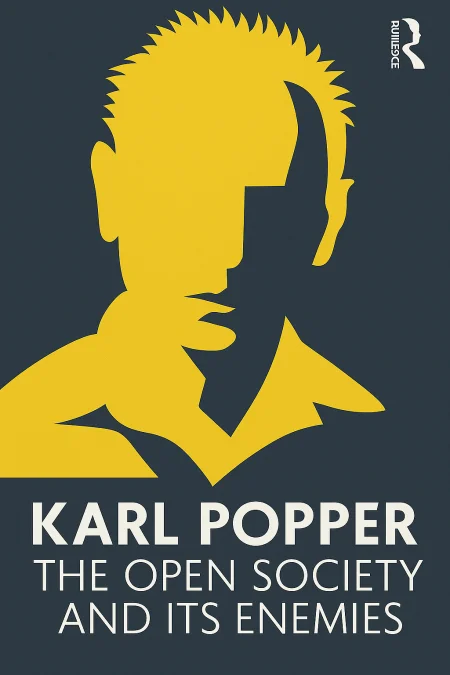
The Open Society and Its Enemies
Examine the Defense of Democracy and Freedom
Book Edition Details
Summary
In a world shadowed by authoritarian philosophies, "The Open Society and Its Enemies" emerges as a beacon of intellectual rebellion. Crafted amidst the turmoil of WWII, this provocative masterpiece takes a fierce stand against the intellectual giants—Plato, Hegel, and Marx—unveiling their roles in the architecture of oppressive regimes. Celebrated by Bertrand Russell, the book’s penetrating insights anticipated the downfall of communism in Eastern Europe, challenging readers to question the very fabric of societal constructs. Now, in a commemorative edition, this timeless critique of historicism and its threat to democracy invites you to ponder the essence of freedom and the relentless struggle for an open society. Prepare to engage with a work as vital today as it was upon its groundbreaking debut.
Introduction
The tension between individual freedom and collective order has shaped political philosophy for millennia, yet few works have dared to challenge one of Western civilization's most revered thinkers as directly as this philosophical investigation. By examining Plato's political theory through the lens of modern totalitarian movements, a startling parallel emerges that forces us to reconsider fundamental assumptions about democracy, justice, and the role of expertise in governance. The analysis reveals how seemingly noble ideals of wisdom, beauty, and perfect order can mask authoritarian impulses that threaten the very foundations of open society. This examination employs a method of historical and philosophical analysis that traces the intellectual lineage from ancient Greek political thought to contemporary struggles between democratic and totalitarian systems. The approach demonstrates how Plato's seemingly abstract metaphysical theories translate into concrete political programs that prioritize state unity over individual rights, expert rule over popular participation, and social stability over personal freedom. Through careful textual analysis and historical contextualization, the investigation exposes the dangerous appeal of utopian thinking and its tendency toward radical social engineering.
Plato's Totalitarian Blueprint: The Closed Society Ideal
Plato's Republic presents what appears to be a utopian vision of justice and social harmony, yet beneath its idealistic surface lies a comprehensive program for totalitarian control. The ideal state requires the complete subordination of individual interests to collective goals, justified through a theory of justice that defines righteousness as each person performing their assigned social function without question or deviation. The philosopher-king system represents perhaps the most sophisticated early argument for enlightened despotism, contending that only those who have achieved true knowledge through philosophical training possess the wisdom necessary to govern others. This creates an unbridgeable gap between rulers and ruled, where the masses must accept their subordinate status based on their alleged intellectual inferiority. The noble lie—a founding myth that tells citizens they are born with different metals in their souls—serves to legitimize this rigid class hierarchy as natural and divinely ordained. The systematic use of propaganda reveals the authoritarian nature of this ideal state, where education becomes indoctrination designed to produce compliant subjects rather than critical thinkers. The economic arrangements complete the totalitarian structure through the abolition of private property for the ruling classes and the collectivization of family relationships through the sharing of wives and children. These measures are justified as necessary to prevent corruption from personal attachments and material interests, but they ensure that no alternative sources of loyalty can compete with absolute devotion to the state. The rigid caste system destroys social mobility by assigning people permanent roles based on alleged natural aptitudes, reducing citizens to mere instruments of state policy. This philosophical framework provides intellectual justification for suppressing dissent by claiming that only philosopher-kings possess true knowledge, thereby delegitimizing any criticism from ordinary citizens. The apparent rationality of this approach masks its fundamentally anti-rational character, as it places certain ideas beyond question or debate, creating an unfalsifiable system of rule that eliminates the possibility of peaceful reform or democratic participation.
Historicism and Revolutionary Prophecy: From Hegel to Marx
Hegel transforms philosophy into a grand narrative of historical inevitability, where the unfolding of absolute spirit through time justifies whatever happens to emerge victorious. This historicist framework provides intellectual cover for the worship of power by suggesting that historical success demonstrates metaphysical truth. The state becomes the earthly manifestation of divine reason, making opposition to existing authority not merely politically dangerous but philosophically incoherent. The dialectical method appears sophisticated but ultimately serves to rationalize predetermined conclusions by treating contradictions as necessary stages in the development of absolute truth. Marx's historical materialism presents itself as scientific socialism, claiming to have discovered objective laws governing social development. This scientific pretension masks a fundamentally prophetic enterprise that predicts the inevitable collapse of capitalism and the emergence of a classless society. The deterministic framework creates a closed system of thought where contrary evidence can always be explained away as temporary setbacks in the inexorable march toward communist revolution. The labor theory of value and surplus value doctrine provide analytical foundations that rest on questionable philosophical assumptions about the nature of value and exploitation. The revolutionary implications become apparent in the treatment of political institutions and democratic processes. Since the state is viewed merely as an instrument of class oppression, democratic reforms are dismissed as illusory changes that leave fundamental power relationships intact. This analysis leads to the conclusion that violent revolution is necessary to achieve genuine social transformation, while peaceful reform efforts serve only to strengthen the existing system by providing it with legitimacy. The practical consequences emerge clearly in the history of communist movements, where belief in historical inevitability justifies the suppression of opposition parties and concentration of power in revolutionary vanguards. The promise of a future classless society serves to rationalize present-day authoritarianism as temporary necessity. The result is not the withering away of the state that Marx predicted, but the creation of new forms of totalitarian control justified by appeals to historical necessity and scientific socialism.
Defending Critical Rationalism Against Relativist and Utopian Challenges
Critical rationalism provides the intellectual foundation for democratic institutions and individual freedom by embracing fallibilism and the possibility of error. This approach recognizes that human knowledge is limited and provisional, requiring constant testing and revision through open debate and criticism. The acknowledgment of fallibility creates space for dissent and opposition rather than demanding absolute conformity to official doctrine. The principle distinguishes between the meaning of truth and criteria for recognizing it, allowing objective truth to remain meaningful even without infallible methods for identifying it. The sociology of knowledge claims that all ideas are products of social circumstances, initially appearing to promote tolerance by suggesting different perspectives reflect different social positions. However, when applied consistently, sociological relativism becomes self-defeating by undermining its own claims to validity. If all knowledge is socially determined, then the sociology of knowledge itself must be merely a reflection of its proponents' social position rather than objective analysis. This logical contradiction reveals the incoherent nature of radical relativism and its practical consequences in providing intellectual cover for authoritarianism. The defense against utopian thinking requires recognizing how abstract theories can become instruments of oppression when applied to concrete political situations. Utopian engineering demands complete reconstruction of society according to predetermined blueprints, requiring the suppression of criticism and opposition that might reveal flaws in the design. The method assumes planners possess complete knowledge of social dynamics and can predict consequences of sweeping changes, an assumption contradicted by the complexity and unpredictability of human societies. The alternative approach of piecemeal social engineering offers a more rational and humane method for addressing social problems by focusing on identifying and eliminating specific sources of suffering rather than pursuing perfect justice or ideal beauty. This method allows for continuous adjustment based on experience while maintaining democratic accountability by keeping changes within the comprehension of ordinary citizens who must live with the consequences.
Democratic Institutions and the Ongoing Defense of Open Society
Democratic institutions embody the principle of critical rationalism by providing mechanisms for peaceful change and error correction without violence. The separation of powers, protection of minority rights, and guarantee of free speech create conditions where bad policies can be identified and replaced through constitutional processes. These arrangements reflect understanding that no individual or group possesses infallible knowledge about social organization, making institutional safeguards essential for preventing the concentration of power that enables tyranny. The defense of individual rights rests not on claims about natural law or historical necessity but on practical recognition that diversity and freedom of choice produce better outcomes than central planning. The market economy, despite its imperfections, demonstrates the superiority of decentralized decision-making over comprehensive state control. This pragmatic approach avoids utopian fantasies while addressing real human needs and preferences through voluntary cooperation and competitive processes. The historical context reveals democratic innovations as humanity's first systematic attempt to create open society based on reason rather than tradition. The Great Generation of Athenian democracy developed new ideals of individual freedom, equality before the law, and rational discourse that challenged traditional aristocratic privileges. These democratic experiments demonstrated that ordinary people could govern themselves effectively and that social cooperation could emerge from free association rather than rigid hierarchy. The ongoing struggle between open and closed society takes new forms in each generation, but fundamental issues remain constant. Contemporary challenges include populist movements promising simple solutions to complex problems, manipulation of democratic processes by authoritarian leaders, and erosion of shared standards of evidence in public discourse. The defense of democratic civilization requires constant vigilance against the temptation to impose perfect solutions through force, cultivating intellectual humility, and maintaining institutions that protect the right to dissent and criticize authority.
Summary
The enduring insight emerging from this comprehensive analysis reveals that the greatest enemies of human freedom are not crude tyrants but sophisticated intellectuals who transform noble human desires for justice and truth into weapons against the very people they claim to serve. The totalitarian temptation operates by promising to resolve inherent tensions and uncertainties of human existence through allegedly scientific knowledge about history and human nature. This promise proves false because it misunderstands both knowledge and freedom, treating complex human beings as simple objects to be manipulated according to abstract theories. The defense of open society requires not counter-dogma but cultivation of critical thinking, institutional safeguards, and moral courage to accept responsibility for choices without the comfort of absolute certainty. Only by embracing the difficult freedom of democratic life can humanity hope to avoid the recurring nightmare of well-intentioned tyranny disguised as enlightened governance.
Related Books
Download PDF & EPUB
To save this Black List summary for later, download the free PDF and EPUB. You can print it out, or read offline at your convenience.

By Karl Popper
