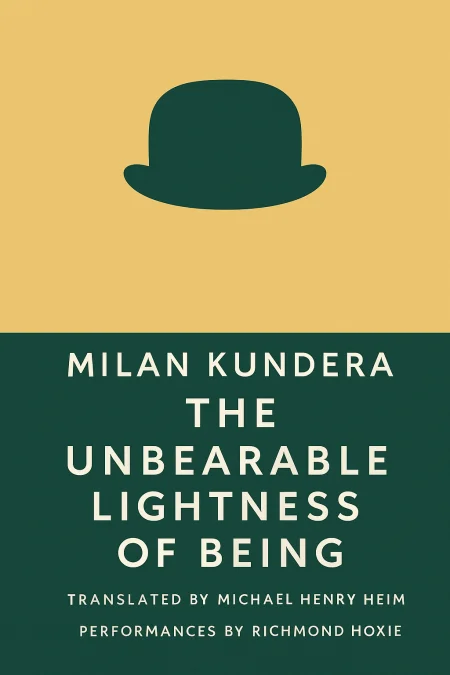
The Unbearable Lightness of Being
Embark on an Incredible Journey Through the Complexities of Love
byMilan Kundera, Michael Henry Heim, Richmond Hoxie
Book Edition Details
Summary
Amid the shadows of Soviet-era Czechoslovakia, Milan Kundera weaves an intricate tapestry of passion, fidelity, and the human soul's eternal search for meaning. "The Unbearable Lightness of Being" unfolds through the lives of two couples, bound by love yet pulled apart by desires and ideological currents. Kundera's masterful prose takes readers on a philosophical journey, challenging us to ponder the duality of existence: the heavy burden of choices against the ephemeral nature of love and freedom. This novel's brilliance lies in its exploration of profound themes with a grace that dances between the playful and the profound, securing its place as a monumental work of literary art.
Introduction
On a quiet Prague morning, a surgeon named Tomas stands at his window, watching the city wake beneath the weight of Russian tanks. His hands, once steady enough to save lives, now tremble with uncertainty. In his bed lies Tereza, the woman who arrived in his life like a child floating downstream in a basket, carrying nothing but hope and Anna Karenina. Their story unfolds against the backdrop of 1960s Czechoslovakia, where personal choices echo with the weight of history itself. This profound exploration of human existence reveals how we navigate the tension between lightness and weight in our lives, between the freedom to choose and the responsibility that choice demands. Through the intertwined destinies of lovers, artists, and dreamers, we discover that our deepest struggles are not merely personal but universal, touching the very essence of what it means to be human in a world where nothing is certain except the choices we make and their irreversible consequences.
Lightness and Weight: The Paradox of Choice
Tomas faces an impossible decision at his window, torn between the lightness of freedom and the weight of love. He recalls Nietzsche's concept of eternal return, the terrifying thought that every moment might repeat endlessly, giving infinite weight to each choice. If everything happens only once, does it matter at all? But if it repeats forever, the burden becomes unbearable. Tereza arrived at his door with a suitcase and fever, and now he must choose whether to embrace this chance encounter or preserve his carefully constructed bachelor existence. The arbitrary nature of their meeting, a chain of six coincidences beginning with his colleague's sciatica, reveals how randomness shapes our deepest connections. Standing in that Prague apartment, Tomas embodies our fundamental existential dilemma. We crave the lightness of unlimited possibilities, yet we yearn for the weight that gives our choices meaning. His medical career, built on the weight of life-and-death decisions, contrasts sharply with his light approach to love, collecting experiences like specimens. When faced with Tereza's overwhelming need, he discovers that lightness and weight are not opposites but dance partners in the complex choreography of human existence. The paradox reveals itself most clearly in our relationships. We want love without chains, passion without consequence, yet these very limitations give shape to our deepest experiences. Tomas must learn that choosing weight doesn't diminish us but rather grounds us in something larger than ourselves, transforming arbitrary encounters into profound meaning.
Love's Impossible Demands: Tereza and Tomas
Tereza's jealousy burns like acid through their relationship, manifesting in dreams where she marches naked with other women while Tomas shoots them one by one. Her soul, desperate to distinguish itself from her body, wars against his casual collection of female experiences. She sniffs his hair for traces of other women, transforms into a detective of infidelity, her hands trembling with the constant tension between love and suspicion. When she catches him washing away evidence of another encounter, the pain cuts deeper than any physical wound because it confirms her worst fear: she is replaceable, just another body in his endless catalog. In the countryside, their love finds a different rhythm. Tereza tends her heifers while Tomas drives the village truck, both stripped of their former identities as photographer and surgeon. Here, without the distractions of Prague's possibilities, they discover something unexpected. The weight of their shared exile, the simplicity of rural routines, and the absence of other choices create space for a different kind of intimacy. Tereza no longer needs to compete with phantom lovers because there are none. Their love, tested by the impossible demands of fidelity in an unfaithful world, begins to mature beyond jealousy into something more profound. The countryside teaches them that love's impossible demands often mask deeper needs. Tereza's jealousy was never really about other women but about finding her own unique place in existence. When stripped of professional achievements and urban sophistications, they discover that the weight of commitment, freely chosen, can paradoxically create the lightness of genuine peace.
The Grand March and Political Kitsch
Franz joins a march toward the Cambodian border, camera crews documenting every step as Western intellectuals attempt to force humanitarian aid into a suffering nation. The absurdity unfolds like a tragic comedy: French professors arguing with Americans about language rights while Cambodians die, an actress weeping for the cameras, photographers literally stepping on landmines for the perfect shot. The march degenerates into a performance where the medium becomes the message, and genuine suffering transforms into political theater. Sabina watches from her American exile, recognizing in Western activism the same kitsch she fled from Communist rallies. The American senator pointing proudly at his children playing on grass mirrors exactly the Communist officials who once smiled down from reviewing stands at forced celebrations of joy. Both sides march to the same drumbeat of collective emotion, demanding that individual doubt surrender to group certainty. The uniforms change, but the fundamental dishonesty remains: transforming complex human suffering into simple slogans. Franz dies in Bangkok, mugged while chasing his romantic vision of heroism, leaving behind only the inscription his wife chooses for his grave. His death completes the tragic irony of the Grand March: those who genuinely seek to do good become pawns in larger games they cannot control. The march continues without him, as it continued without millions of others, because the machine of collective meaning-making requires individual sacrifice. The Grand March reveals how our noblest impulses can be corrupted by the human need to feel significant. Whether Communist or capitalist, religious or secular, all ideologies risk transforming genuine suffering into opportunities for moral self-congratulation, turning justice into performance and compassion into kitsch.
Final Returns: Death, Memory, and Meaning
In their village refuge, Tomas and Tereza discover the rhythm of animal time through Karenin, their beloved dog whose simple needs structure their days. When cancer claims him, they face death not as doctors or philosophers but as creatures saying goodbye to another creature. Tereza holds his head while Tomas administers the injection, their tears falling on his fur as he passes into whatever peace awaits beyond consciousness. They bury him between apple trees with his collar, leash, and untouched chocolate, creating a monument to unconditional love in a world of conditions. Their own end comes suddenly, their truck careening off a mountain road as they return from their weekly night in town. The villagers speak of brake failure, but perhaps it was simply time for the story to close. They die together as they had learned to live together, their parallel lines finally converging in the mathematics of mortality. Their son inscribes Tomas's grave with words about seeking God's kingdom on earth, while Tereza's butterfly dream remains unrecorded, known only to the man who shared it. Death reveals the ultimate lightness of being: everything we struggle for, every weight we carry, dissolves into silence. Yet in that dissolution, paradoxically, we find the heaviest meaning of all. The memory of Karenin's trust, the warmth of shared sleep, the weight of choosing love despite its costs—these moments, light as air, prove heavier than empires. Franz's death in Bangkok and Tomas's death in rural Bohemia carry equal weight in the vast democracy of mortality, where surgeons and window washers, intellectuals and peasants, all contribute their brief notes to the infinite symphony of existence.
Summary
In the space between lightness and weight, between the freedom to choose and the responsibility that choice demands, human life unfolds its most profound mysteries. A surgeon's steady hands tremble not from age but from love. A photographer captures not just images but the fleeting weight of moments that matter. A dog's simple loyalty teaches lessons that philosophy cannot reach. Their stories remind us that we are forever suspended between the unbearable lightness of meaninglessness and the crushing weight of infinite significance. Yet in this suspension, in this eternal uncertainty, we discover our greatest strength: the courage to choose weight when lightness beckons, to commit when freedom calls, to love when loss is certain. The characters who step down from the grand march of history to tend their own small gardens teach us that the most revolutionary act may be the quietest one—choosing to stay, to care, to remain present to whatever life offers. In the end, the weight we choose to carry becomes the measure of our humanity, transforming arbitrary existence into purposeful being, one choice at a time.
Related Books
Download PDF & EPUB
To save this Black List summary for later, download the free PDF and EPUB. You can print it out, or read offline at your convenience.
By Milan Kundera
