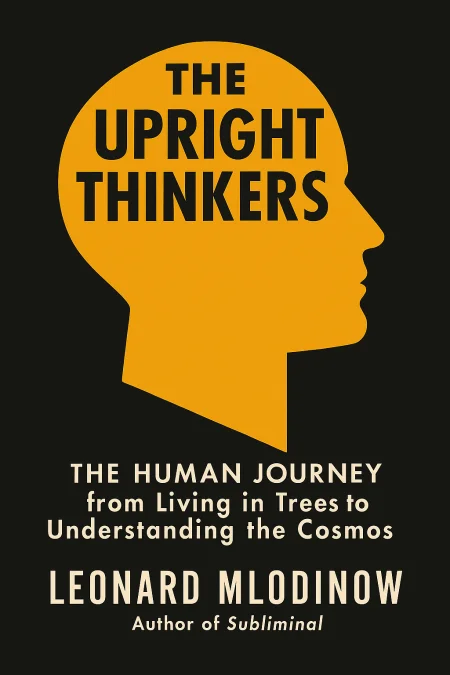
The Upright Thinkers
The Human Journey from Living in Trees to Understanding the Cosmos
Book Edition Details
Summary
From the dawn of consciousness, humanity has stretched its curious fingers toward the unknown, fueling a relentless quest to understand our universe. In "The Upright Thinkers," Leonard Mlodinow crafts a vibrant tapestry of human ingenuity, charting a journey from the spark of fire to the enigmas of quantum mechanics. This narrative dances through time, spotlighting the audacious minds that dared to ask "why" and "how," from Galileo's poetic soul to Newton's ocular experiments. Mlodinow delves into the cultural forces that shaped scientific evolution, painting vivid portraits of the thinkers who propelled our progress. For those enthralled by the beauty of scientific discovery and the power of creative thought, this book is an invitation to celebrate the boundless human spirit.
Introduction
Imagine standing in a cave 40,000 years ago, watching our ancestors create the first symbolic art on stone walls. These weren't mere decorations—they represented humanity's earliest attempts to understand and communicate about the world beyond immediate survival needs. This moment marked the beginning of an extraordinary intellectual journey that would eventually lead us from primitive wonder to quantum physics, from mythological explanations to mathematical laws governing the universe. This remarkable transformation reveals how humans developed the unique capacity to ask not just "how" but "why," evolving from instinct-driven creatures into systematic seekers of truth. We'll explore how ancient civilizations laid the intellectual foundations for modern thought, witness the revolutionary breakthroughs that shattered medieval worldviews, and discover how the scientific method emerged from centuries of philosophical inquiry. Along the way, we'll see how each generation's quest for understanding built upon previous discoveries, creating an accelerating spiral of knowledge that continues today. This story speaks to anyone fascinated by human nature, the origins of scientific thinking, or the question of what makes our species unique. Whether you're curious about how great discoveries actually happen, why certain ideas took centuries to develop, or how ancient insights still shape modern science, this exploration reveals the profound continuity between our ancestors' first questions about nature and today's most sophisticated theories about reality itself.
From Primitive Curiosity to Rational Inquiry (Ancient Times - Medieval Era)
The transformation from our earliest ancestors to systematic thinkers represents one of history's most profound revolutions. Around two million years ago, Homo habilis became the first species to deliberately shape tools, requiring the ability to envision future states and work backward to achieve them. This cognitive leap demanded more than manual skill—it represented the birth of abstract thinking that would eventually separate humans from all other species on Earth. The development of language around 100,000 years ago accelerated this intellectual evolution exponentially. Unlike other animals that communicate about immediate circumstances, humans began sharing complex ideas about past events, future possibilities, and abstract concepts. This breakthrough enabled what researchers call "cultural ratcheting"—the ability to build upon previous generations' knowledge rather than starting from scratch each time, creating an ever-expanding foundation of accumulated wisdom. The ancient Greeks revolutionized human thinking by introducing the radical idea that natural phenomena could be understood through reason rather than attributed solely to divine whims. Beginning around 600 BCE, thinkers like Thales proposed that the world operated according to discoverable principles, while Aristotle created the first systematic approach to understanding nature through careful observation and logical reasoning. His comprehensive framework would dominate Western thought for nearly two thousand years. Medieval scholars preserved and expanded this intellectual heritage through turbulent centuries. Islamic thinkers translated and built upon Greek knowledge, while European universities created new institutions dedicated to learning and debate. Medieval scholars at places like Merton College developed increasingly sophisticated mathematical tools for analyzing motion and change, establishing crucial foundations for the scientific revolution that would follow. Their work demonstrated that systematic investigation could reveal hidden truths about the natural world, setting the stage for an unprecedented transformation in human understanding.
The Scientific Revolution: Galileo, Newton and Mathematical Laws (1500-1700)
The sixteenth and seventeenth centuries witnessed an intellectual earthquake that fundamentally changed humanity's relationship with the natural world. Galileo Galilei embodied this transformation, combining careful observation with mathematical analysis to challenge assumptions that had stood for millennia. When he turned his improved telescope skyward and observed mountains on the Moon and moons orbiting Jupiter, he provided concrete evidence that the heavens were not perfect and unchanging as Aristotle had claimed. Galileo's revolutionary approach lay not just in his observations, but in his method of idealized experimentation. He understood that discovering nature's underlying laws required stripping away complicating factors to focus on essential relationships. His studies of falling objects revealed that, absent air resistance, all bodies fall at the same rate regardless of weight—a conclusion that contradicted both common sense and established physics. This methodology of controlled experimentation became a cornerstone of modern scientific practice. Isaac Newton synthesized these revolutionary insights into a comprehensive mathematical framework that could predict and explain motion throughout the universe. His three laws of motion and law of universal gravitation demonstrated that the same principles governing a falling apple also controlled planetary orbits. Newton's Principia revealed the universe as a vast, precise machine operating according to mathematical relationships that human reason could discover and comprehend. The success of Newton's system created unprecedented confidence in human reason and mathematics as tools for unlocking nature's secrets. For the first time in history, humans possessed a theoretical framework that could make accurate predictions about phenomena ranging from ocean tides to comet trajectories. This mechanistic worldview suggested that, given sufficient knowledge and computational power, every future event could theoretically be predicted—a vision that would dominate scientific thinking for the next two centuries and inspire revolutionary developments across all fields of human inquiry.
The Age of Discovery: Chemistry, Biology and Industrial Progress (1700-1900)
The eighteenth and nineteenth centuries witnessed an explosion of scientific discovery as Newton's methods spread to entirely new fields of investigation. Chemistry emerged from the mystical practices of alchemy through pioneers like Robert Boyle and Antoine Lavoisier, who applied rigorous quantitative methods to understand chemical reactions. Lavoisier's discovery of the conservation of mass provided chemistry with its first fundamental principle, while Dmitri Mendeleev's periodic table revealed that all known elements could be organized according to their atomic weights, even predicting properties of elements yet to be discovered. Biology faced the monumental challenge of applying scientific methods to living phenomena, overcoming humanity's natural reluctance to see ourselves as products of natural law rather than divine creation. The microscope revealed complex internal structures in even the simplest creatures, challenging ancient beliefs about spontaneous generation. Charles Darwin's theory of evolution through natural selection provided biology with its organizing principle, explaining the diversity of life through purely natural processes operating over vast periods of time. These scientific advances didn't occur in isolation but drove and were driven by the Industrial Revolution transforming European society. Steam engines, telegraphs, and electric lights emerged from scientific laboratories to revolutionize daily life. The success of applying scientific principles to practical problems demonstrated that systematic investigation could yield not just theoretical understanding but tangible improvements in human welfare and capability. The period established science as a collaborative enterprise supported by universities, scientific societies, and industrial patrons rather than the pursuit of isolated scholars. This institutional framework accelerated discovery by enabling researchers to build upon each other's work and share resources for increasingly complex investigations. The remarkable success of this approach seemed to promise that human reason could eventually explain everything in the universe, setting the stage for even more revolutionary discoveries in the century to come.
Quantum Revolution: Beyond Classical Physics to Modern Science (1900-Present)
The early twentieth century shattered the comfortable certainties of Newtonian physics when scientists exploring the atomic realm discovered that reality at its most fundamental level operates according to radically different principles. Max Planck's investigation of blackbody radiation forced him to propose that energy comes in discrete packets or "quanta," while Einstein's analysis of the photoelectric effect revealed that light itself consists of particles called photons, challenging the wave theory that had dominated physics for centuries. These discoveries culminated in quantum mechanics, developed primarily through Werner Heisenberg and Erwin Schrödinger's groundbreaking work. Heisenberg's uncertainty principle revealed that at the atomic scale, it's impossible to simultaneously know both position and velocity of a particle with perfect precision—not due to measurement limitations, but as a fundamental feature of reality itself. This revelation meant abandoning the classical notion that objects possess definite properties independent of observation. The quantum revolution forced scientists to accept that the universe is fundamentally probabilistic rather than deterministic. Unlike Newton's clockwork cosmos where every event was theoretically predictable, quantum mechanics revealed that nature operates according to statistical laws. Even Einstein, despite his crucial early contributions to quantum theory, struggled to accept this aspect, famously declaring that "God does not play dice with the universe," though experimental evidence consistently supported quantum predictions. The implications extended far beyond abstract physics, enabling technologies that transformed human civilization: computers, lasers, transistors, and countless innovations defining modern life emerged from understanding atomic behavior. More profoundly, quantum mechanics demonstrated that human knowledge has fundamental limits—that there are aspects of reality forever beyond complete understanding. This recognition represents both a humbling acknowledgment of human limitations and an empowering demonstration of our capacity to comprehend realms far beyond direct experience, continuing the ancient human quest for understanding in entirely new directions.
Summary
The journey from primitive curiosity to quantum mechanics reveals a central tension driving human intellectual development: the struggle between our desire for certainty and the universe's fundamental complexity. Each major breakthrough—from Greek rational inquiry to Newton's mathematical laws to quantum uncertainty—initially promised complete understanding, only to reveal new depths of mystery demanding even more sophisticated approaches to knowledge and investigation. This historical progression offers crucial insights for navigating our current era of rapid technological and scientific change. Genuine understanding often requires abandoning comfortable assumptions and embracing counterintuitive ideas, just as quantum pioneers had to accept that reality doesn't conform to everyday experience. The most revolutionary advances typically come from individuals willing to question established authorities and think differently, even when such thinking appears dangerous or absurd to their contemporaries. Perhaps most importantly, this intellectual odyssey demonstrates that human knowledge is both incredibly powerful and inherently limited. We can split atoms and explore distant galaxies, yet fundamental questions about consciousness, the nature of time, and reality's ultimate structure remain tantalizingly beyond our grasp. Recognizing these limits while continuing to push against them represents the essence of the scientific spirit—a combination of intellectual humility and relentless curiosity that has carried humanity from stone tools to quantum computers and will undoubtedly lead to discoveries we cannot yet imagine.
Related Books
Download PDF & EPUB
To save this Black List summary for later, download the free PDF and EPUB. You can print it out, or read offline at your convenience.
By Leonard Mlodinow
