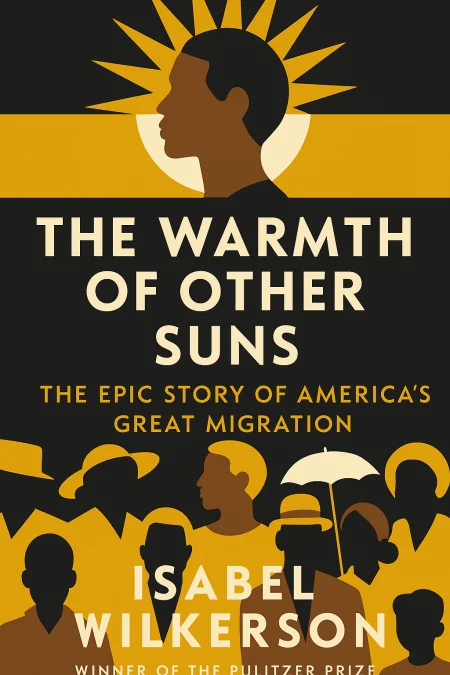
The Warmth of Other Suns
The Epic Story of America's Great Migration
Book Edition Details
Summary
Isabel Wilkerson’s "The Warmth of Other Suns" pulsates with the heartbeats of six million souls seeking sanctuary beyond the oppressive shadows of the Jim Crow South. From 1915 to 1970, this sweeping exodus reshaped America, as millions journeyed towards hope in the North and West. Wilkerson's narrative homes in on three courageous individuals: Ida Mae Gladney, who escaped Mississippi's fields for Chicago’s promise; George Starling, whose leap from Florida led him to Harlem’s vibrant heart; and Robert Foster, a Louisiana surgeon who pursued dreams in California's sunlit expanses. Their intertwined tales, fraught with peril and resilience, reveal the human spirit's unyielding quest for dignity and opportunity. This modern classic, rich in lyrical prose and profound insight, illuminates a pivotal, yet overlooked chapter of American history with unmatched grace and depth.
Introduction
Between 1915 and 1970, six million African Americans made one of the most consequential decisions in American history. They left behind the cotton fields, sharecropping farms, and suffocating restrictions of the Jim Crow South, boarding trains and buses bound for cities like Chicago, Detroit, New York, and Los Angeles. This was the Great Migration, a movement so vast and transformative that it reshaped the entire demographic, cultural, and political landscape of the United States. This epic journey reveals how ordinary people, through individual acts of extraordinary courage, can collectively rewrite the story of a nation. It illuminates the complex relationship between economic opportunity and human dignity, showing how the promise of better wages intertwined with the fundamental desire for freedom, respect, and the basic rights of citizenship. The migration exposes the brutal realities of systematic oppression while celebrating the remarkable resilience of those who refused to accept the limitations imposed upon them by an unjust system. Understanding this movement offers crucial insights into the roots of modern American urban culture, the persistence of racial inequality, and the ongoing struggle for civil rights. These stories speak to anyone seeking to comprehend how social change occurs, how communities form and evolve under pressure, and how individual determination can create ripple effects that transform society for generations. The Great Migration stands as testament to the power of hope over fear, and the enduring human capacity to seek better tomorrows despite overwhelming obstacles.
The Breaking Point: Escaping Jim Crow's Reign of Terror (1915-1940)
The American South of the early twentieth century operated as a carefully constructed caste system designed to maintain white supremacy through legal segregation, economic exploitation, and the constant threat of violence. Jim Crow laws regulated every aspect of daily life, from separate water fountains and restrooms to designated days when African Americans could visit public parks. This wasn't merely about separation but about creating a comprehensive system of control that extended into telephone booths, courtroom Bibles, and even cemetery plots. Violence undergirded this entire structure with horrifying efficiency. Between 1889 and 1929, someone was lynched every four days in the South, often for infractions as minor as "acting uppity" or failing to step aside for white pedestrians. These public spectacles, sometimes drawing crowds in the thousands, served as brutal reminders of the consequences of challenging the racial order. The sharecropping system trapped families in cycles of debt that differed little from slavery, while educational segregation ensured that future generations would remain locked in positions of subservience. World War I created the first significant crack in this seemingly impenetrable system. European immigration plummeted by ninety percent, leaving Northern factories desperate for workers just as war production demanded maximum output. Labor recruiters, often disguised as insurance salesmen or traveling preachers, began appearing in Southern communities with whispered promises of jobs paying dollars per hour instead of pennies per day. The Chicago Defender and other black newspapers circulated throughout the South, carrying letters from successful migrants and job advertisements that seemed almost too good to believe. The response was immediate and overwhelming. Entire communities began to empty as people abandoned cotton fields mid-harvest, leaving tools where they dropped them. Planters who had claimed to be doing their workers a favor suddenly panicked at the loss of cheap labor, revealing the economic foundation of their supposed benevolence. The very desperation of efforts to stop the migration exposed the lie that segregation somehow benefited those it oppressed, setting the stage for the massive demographic shift that would transform America forever.
Journey to the Promised Land: Migration and Urban Transformation (1940-1960)
The second great wave of migration coincided with World War II and its aftermath, as returning veterans and their families refused to accept the same subordinate status they had left behind. This generation was different from their predecessors, more educated, more worldly, and less willing to compromise with injustice. They had seen how life could be lived elsewhere and were determined to claim those possibilities for themselves and their children. The journey north was fraught with both practical challenges and symbolic significance. Migrants packed their worldly possessions into cardboard boxes and paper bags, sharing fried chicken and hope during long train rides on segregated cars. The Illinois Central Railroad became known as the "freedom train," carrying hundreds of thousands from Mississippi, Alabama, and Tennessee to Chicago and other Northern cities. The psychological border crossing often occurred at the Ohio River or Mason-Dixon Line, where Jim Crow car signs came down and segregated seating officially ended, though freedom remained elusive and incomplete. Upon arrival in Northern cities, migrants discovered both unprecedented opportunities and unexpected challenges. They could vote for the first time, send their children to better schools, and earn wages that seemed miraculous compared to Southern standards. Yet they also faced housing discrimination that confined them to overcrowded ghettos, employment restrictions that channeled them into the most dangerous jobs, and sometimes violent resistance from white neighbors who viewed their presence as a threat to property values and social order. The migrants' resilience proved remarkable as they created new institutions and transformed their adopted cities. They built churches, established businesses, and formed social clubs organized around their home states, maintaining cultural connections while adapting to urban life. Their children attended integrated schools and universities, becoming doctors, lawyers, and professionals in numbers unimaginable in the South. The music they brought with them evolved into urban blues, jazz, and eventually rhythm and blues, fundamentally reshaping American popular culture and creating new forms of artistic expression that would influence the entire world.
New Struggles in Northern Cities: Freedom's Complex Reality (1960-1970)
By the 1960s, the Great Migration had fundamentally altered American cities, but the promised land had revealed its own forms of discrimination and limitation. The civil rights victories of the decade created a paradox for many migrants, as legal segregation ended just as urban decay, white flight, and economic restructuring created new forms of isolation in Northern ghettos. The freedom they had sought for their children seemed to have morphed into different kinds of traps for their grandchildren. Northern racism proved more subtle but often equally effective as its Southern counterpart. Restrictive housing covenants and discriminatory lending practices confined black families to specific neighborhoods where they paid higher rents for inferior housing. Employment discrimination persisted despite civil rights legislation, while urban renewal projects often destroyed established black communities in the name of progress. Many migrants found themselves caught between worlds, no longer fully Southern but not entirely accepted as Northern either. The concentration of African Americans in Northern cities did create new centers of political power and cultural innovation. Black voters became a crucial constituency in national politics, helping to elect sympathetic officials and supporting civil rights legislation. The urban communities that migrants built became launching pads for the civil rights movement, providing both the population base and economic resources necessary to challenge segregation nationwide. Leaders like Martin Luther King Jr. could draw upon networks of support that stretched across the country, connecting Southern struggles with Northern resources and sympathy. Yet the migration also revealed the limitations of geographic solutions to systemic problems. Urban ghettos often replicated the poverty and limited opportunities of the rural South, just in different forms. The breakdown of extended family networks and community oversight left many young people adrift in ways their parents could not have foreseen. Drug addiction, crime, and family dissolution became serious problems in communities that had been built on hope and determination, forcing migrants to confront the reality that changing location alone could not solve America's racial problems.
Legacy of Courage: How Six Million Changed America Forever
The Great Migration's conclusion in the 1970s marked not an ending but a transformation of American society so profound that its effects continue to reverberate today. The six million people who made this journey fundamentally altered the nation's demographic, political, and cultural landscape in ways that would have been impossible to imagine when the movement began. Nearly half of all African Americans lived outside the South by 1970, compared to just ten percent when the migration started, forcing the entire country to confront racial issues that could no longer be dismissed as regional problems. The migration's children and grandchildren became the leaders, artists, and innovators who would define American culture for generations. From Toni Morrison to Barack Obama, from Miles Davis to Oprah Winfrey, the Great Migration produced individuals who might never have existed or achieved what they did had their families remained in the South. The urban black communities that migrants built became the foundation for the civil rights movement, while their cultural contributions from jazz to hip-hop became central to American identity and influenced artistic expression worldwide. Perhaps most importantly, the Great Migration demonstrated that change was possible and that ordinary people possessed extraordinary power to reshape their circumstances. By voting with their feet, six million individuals proved that they would not accept second-class citizenship indefinitely. Their departure forced the South to confront the economic and moral costs of segregation, ultimately contributing to the legal and social changes of the civil rights era. The movement showed that demographic shifts could be more powerful than legislation in driving social transformation. The migration also revealed the complex relationship between individual agency and structural change. Each person who left made a personal decision based on immediate circumstances, yet their collective action reshaped the nation's political, economic, and cultural landscape in ways none of them could have imagined. Their legacy reminds us that progress often comes not from grand gestures but from millions of individual decisions to demand better, and that the courage to leave familiar circumstances can open possibilities that seemed impossible from within systems of oppression.
Summary
The Great Migration represents one of history's most powerful demonstrations of how ordinary people, through individual acts of courage, can collectively transform society and challenge seemingly insurmountable systems of oppression. At its core, this movement embodied the fundamental human desire for dignity and opportunity, revealing the lengths people will go to secure both for themselves and their children. The six million African Americans who left the South between 1915 and 1970 were not merely seeking better economic conditions but claiming their right to full citizenship and human dignity in the face of systematic brutality and exclusion. This epic transformation offers crucial insights for contemporary America and the world. It demonstrates that meaningful social change often begins with individuals refusing to accept unjust conditions, even when the path forward remains uncertain and dangerous. The migration's legacy also reveals that progress is rarely linear or complete, as the North's promise of freedom came with its own forms of discrimination and limitation. Most importantly, these stories show how resilience, community building, and cultural creativity can flourish even under the most challenging circumstances, creating lasting contributions that enrich entire societies. For today's world, facing new forms of migration and demographic change, the Great Migration provides both inspiration and practical wisdom. It reminds us that sustainable social change requires both individual agency and structural transformation, that migration and mobility remain fundamental human rights worth protecting, and that the stories we tell about our past directly shape our capacity to imagine and create more just futures. The courage of these six million pioneers continues to light the way forward, proving that determined individuals can indeed bend the arc of history toward justice and that the pursuit of dignity and opportunity remains one of humanity's most powerful and transformative forces.
Related Books
Download PDF & EPUB
To save this Black List summary for later, download the free PDF and EPUB. You can print it out, or read offline at your convenience.
By Isabel Wilkerson
