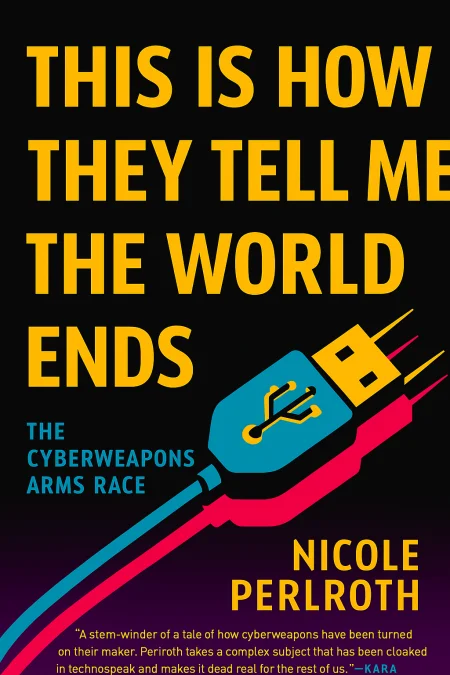
This Is How They Tell Me the World Ends
The Cyberweapons Arms Race
Book Edition Details
Summary
In the shadows of the digital realm, a clandestine marketplace thrives—a world where zero-day exploits, invisible yet potent, hold the power to topple nations and disrupt the very fabric of our daily lives. Nicole Perlroth, a seasoned journalist for The New York Times, ventures into this murky domain, unveiling the dark secrets of the cyberweapons trade. Her gripping narrative reveals how these elusive vulnerabilities, once tightly guarded by the U.S. government, have slipped into the hands of adversaries without conscience. This Is How They Tell Me the World Ends reads like a thriller, yet it is a sobering exposé on the precarious state of global cybersecurity. Through meticulous reporting and riveting accounts, Perlroth sounds the alarm on an arms race with stakes that could not be higher—a chilling reminder that inaction is not an option.
Introduction
In the shadowy corridors of Fort Meade, Maryland, a discovery in 1984 would forever change the nature of warfare and espionage. American intelligence officers had just uncovered Soviet bugs embedded in their embassy typewriters in Moscow—tiny magnetometers that captured every keystroke before encryption could protect the messages. This revelation marked humanity's first glimpse into a new battlefield where code could be as destructive as conventional weapons. The zero-day market represents one of the most consequential yet invisible industries of our time. These digital vulnerabilities—flaws in software and hardware that remain unknown to their creators—have evolved from Cold War espionage tools into a global arms race worth billions. They power everything from targeted surveillance of dissidents to nation-state attacks that can cripple entire power grids. This transformation reveals how governments, hackers, and private contractors have weaponized the very technology we depend on daily. Understanding this hidden market is essential for anyone seeking to comprehend modern geopolitics, cybersecurity, or the future of warfare. As our lives become increasingly digital, the stakes of this invisible arms race grow ever higher, affecting everyone from individual citizens to entire nations. The story that unfolds shows how America's quest for digital supremacy inadvertently created the very threats that now endanger democratic societies worldwide.
Cold War Genesis: From Soviet Typewriter Bugs to NSA Digital Arsenal (1980s-2000s)
The discovery of Soviet typewriter bugs in 1984 shattered American assumptions about technological superiority. Project Gunman, the classified NSA operation to uncover these implants, revealed that the Soviets had been intercepting American diplomatic communications for eight years through ingenious hardware modifications. The tiny magnetometers embedded in IBM Selectric typewriters converted keystrokes into magnetic disturbances, transmitting secrets via radio to nearby Soviet listening posts. This revelation catalyzed a fundamental shift in American intelligence strategy. James Gosler, the godfather of American cyberwar, recognized that the digital revolution presented both unprecedented opportunities and existential threats. As computers replaced typewriters and networks connected the world, the NSA faced a choice: adapt or become obsolete. The agency began recruiting mathematicians and hackers, transforming from a passive eavesdropping organization into an active digital predator. The internet's emergence in the 1990s accelerated this transformation. Where Cold War spies once risked their lives to photograph documents in foreign capitals, digital exploitation could now extract terabytes of intelligence from thousands of miles away. The NSA's Tailored Access Operations unit grew from a small team into a massive digital army, developing zero-day exploits and implanting surveillance tools across global networks. This period established the foundational principle that would define the coming decades: in cyberspace, offense trumped defense. The same vulnerabilities that enabled American spies to penetrate foreign networks would eventually become weapons in the hands of adversaries, setting the stage for a global arms race that continues to escalate today.
Market Birth: Commercial Brokers and the Underground Zero-Day Trade (2002-2010)
The public face of the zero-day market emerged almost by accident in 2002 when John Watters purchased the failing cybersecurity company iDefense for ten dollars. Frustrated by vendors who threatened hackers for reporting security flaws, iDefense launched the first legitimate bug bounty program, paying hackers modest sums for vulnerability discoveries. What began as a seventy-five dollar payment for a simple bug would evolve into a multimillion-dollar industry. Behind this public market lurked a far more lucrative shadow economy. Government contractors like Jimmy Sabien had been quietly purchasing zero-days since the mid-1990s, paying hackers six-figure sums for exploits that iDefense acquired for hundreds. These underground brokers operated through cash transactions, encrypted communications, and hotel room meetings, building an invisible supply chain that fed the intelligence community's growing appetite for digital weapons. The market's dynamics shifted dramatically after Microsoft's 2002 security initiative reduced the availability of easy exploits. As software became more secure, zero-days became exponentially more valuable. Charlie Miller's groundbreaking 2007 white paper exposed this underground trade, revealing that government agencies were paying up to two hundred fifty thousand dollars for individual exploits while maintaining public silence about their cyberweapons programs. The "No More Free Bugs" movement of 2009 marked a turning point, as frustrated security researchers abandoned responsible disclosure in favor of profit. This rebellion against vendor hostility drove talented hackers toward underground markets, where government buyers offered substantial rewards for silence. The stage was set for zero-days to become the ammunition of choice in an emerging era of cyber conflict.
Stuxnet's Legacy: Weaponization Triggers Global Cyber Arms Race (2010-2016)
The 2010 discovery of Stuxnet shattered the illusion that cyberweapons were merely tools of espionage. This joint American-Israeli operation against Iran's nuclear program demonstrated that code could achieve what previously required bombs and missiles. Using seven zero-day exploits, Stuxnet infiltrated Iran's air-gapped nuclear facility and destroyed nearly a thousand centrifuges while convincing operators that everything functioned normally. Stuxnet's accidental release into the wild marked cyberwarfare's equivalent of Hiroshima—the first use of a digital weapon of mass destruction. The worm's sophisticated design required unprecedented cooperation between intelligence agencies, national laboratories, and private contractors. Its success validated the strategic value of zero-day stockpiles and triggered a global scramble to acquire similar capabilities. The attack's aftermath revealed the fundamental paradox of cyber weapons: they inevitably proliferate beyond their creators' control. Within years, the same techniques used against Iran appeared in attacks by Russia, China, and North Korea. The NSA's response was not restraint but acceleration, doubling down on offensive capabilities while neglecting defensive measures. The agency's "Nobody But Us" philosophy assumed that only America possessed the sophistication to exploit certain vulnerabilities—an assumption that proved catastrophically wrong. By 2013, the NSA was spending twenty-five million dollars annually on zero-day acquisitions while managing eighty-five thousand digital implants worldwide. This industrial-scale exploitation created a vast attack surface that adversaries would eventually turn against America itself. Stuxnet had opened Pandora's box, unleashing forces that would reshape global conflict and render traditional notions of national security obsolete.
Boomerang Effect: America's Tools Return as Weapons Against Itself (2016-2020)
The inevitable reckoning arrived in the summer of 2016, when a mysterious group calling itself the Shadow Brokers began auctioning NSA cyberweapons online. The leaked tools, including the devastating EternalBlue exploit, represented decades of American investment in offensive cyber capabilities. Within months, these same weapons were being used against American cities, hospitals, and businesses by the very adversaries they were designed to target. The most dramatic demonstration came in May 2017, when North Korean hackers used EternalBlue to launch WannaCry, a ransomware attack that infected three hundred thousand computers across one hundred fifty countries. British hospitals turned away patients, Chinese universities shut down, and global shipping ground to a halt. Two months later, Russian intelligence used the same American tool to launch NotPetya, causing over ten billion dollars in damages worldwide and proving that cyberweapons, once released, recognize no borders. The attacks revealed the fundamental flaw in America's cyber strategy: the same vulnerabilities that enabled offensive operations also left American systems exposed. Every zero-day exploit hoarded by intelligence agencies was a potential weapon in enemy hands. The NSA's own tools were now being used to attack American cities from Baltimore to Atlanta, with local officials forced to pay millions in ransom or reconstruction costs. Meanwhile, the zero-day market had evolved into a global industry enabling unprecedented surveillance and oppression. Israeli firm NSO Group's Pegasus spyware could remotely transform any smartphone into a comprehensive surveillance device, with prices starting at six hundred fifty thousand dollars for ten targets. Authoritarian regimes worldwide gained access to tools rivaling those of the NSA, using them to monitor journalists, dissidents, and human rights activists. The market that America created had fundamentally shifted the global balance of power, completing a vicious circle that continues to accelerate today.
Summary
The zero-day market's evolution from Cold War espionage tool to global commodity reveals the central paradox of digital age security: the same technologies that connect and empower us also enable unprecedented surveillance and control. This transformation reflects a deeper tension between innovation and security, freedom and control, that will define the twenty-first century. What began as defensive measures against Soviet typewriter bugs evolved into offensive weapons that now threaten the very infrastructure they were meant to protect. The market's history demonstrates how technological capabilities inevitably proliferate beyond their original creators, often with unintended consequences. The commercialization of these capabilities has democratized surveillance powers once reserved for superpowers, enabling authoritarian regimes to monitor and suppress their populations with unprecedented precision. The false choice between security and privacy must be rejected in favor of approaches that strengthen both simultaneously. Three critical lessons emerge from this hidden history. First, societies must recognize that cybersecurity is not merely a technical problem but a fundamental challenge to democratic governance and human rights. Second, the international community must develop new frameworks for governing cyberspace that prevent the weaponization of the internet while preserving its benefits for humanity. Finally, we must abandon the illusion that offensive cyber capabilities can be controlled and contained, instead focusing on building resilient systems that can withstand attack. The stakes of getting this balance right could not be higher—the future of democratic society itself hangs in the balance.
Related Books
Download PDF & EPUB
To save this Black List summary for later, download the free PDF and EPUB. You can print it out, or read offline at your convenience.
By Nicole Perlroth
