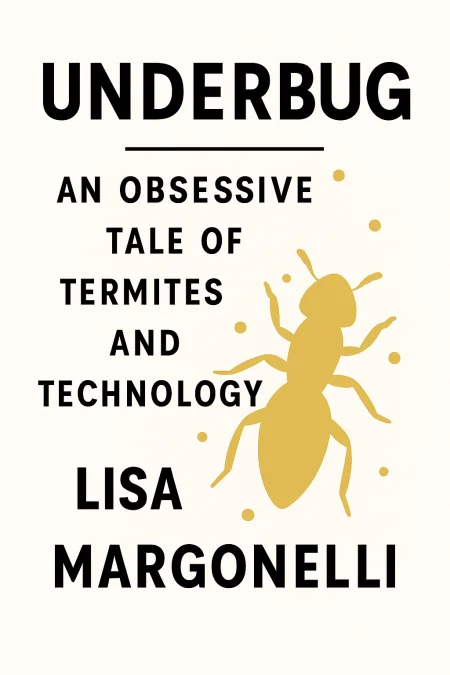
Underbug
An Obsessive Tale of Termites and Technology
Book Edition Details
Summary
In the whimsical dance of science and storytelling, "Underbug" by Lisa Margonelli peels back the layers on one of nature's most enigmatic architects: the termite. Not just a tale of these industrious insects, Margonelli’s narrative spirals into the eccentric minds of scientists who scrutinize these creatures, from biologists to roboticists. She deftly navigates their labyrinthine worlds, uncovering how termites’ synergy with ancient fungi and microscopic allies has sculpted their survival story. This is a saga of redemption for a bug often overshadowed by its more notorious cousin, the cockroach. With vivid prose and infectious curiosity, Margonelli invites readers to reconsider the termite, urging them to see not a pest, but a pivotal player in the ecological symphony.
Introduction
Imagine discovering that the insects you consider household pests are actually master engineers whose innovations could solve some of humanity's greatest challenges. While we spray pesticides to eliminate termites from our homes, scientists around the world are studying these remarkable creatures to unlock secrets that could revolutionize robotics, renewable energy, and artificial intelligence. These tiny insects have spent 150 million years perfecting technologies that still baffle our brightest minds: they construct towering architectural marvels without blueprints, convert wood into energy more efficiently than any industrial process, and coordinate the activities of millions of individuals without a single leader giving orders. What makes this even more extraordinary is that each termite has a brain smaller than a pinhead, yet together they create some of nature's most sophisticated societies. This journey into the hidden world of termites reveals how these underestimated insects are inspiring breakthrough innovations in swarm robotics, sustainable biofuels, and collective intelligence systems. Along the way, you'll discover that understanding termites isn't just about appreciating nature's ingenuity—it's about reimagining how we might solve complex problems by harnessing the power of cooperation, distributed intelligence, and biological wisdom that has been tested and refined across geological time scales.
Superorganisms and Collective Intelligence: Distributed Minds in Nature
A termite colony represents one of nature's most remarkable examples of collective intelligence, where millions of simple individuals create a unified superorganism capable of sophisticated problem-solving that no single termite could achieve alone. Think of it like a biological computer network, where each termite functions as a simple processor contributing to a distributed intelligence that emerges from their interactions. Unlike human organizations with hierarchical command structures, termite colonies operate through what scientists call stigmergy—a form of indirect coordination where individuals modify their environment in ways that guide the behavior of others, creating complex patterns and structures without central planning. The key to this collective intelligence lies in how termites communicate through chemical signals, physical interactions, and environmental cues. When a termite encounters a problem, such as a breach in the colony's defenses, it doesn't report to a supervisor or consult a manual. Instead, it begins responding according to simple behavioral rules—follow chemical trails, carry materials toward areas of activity, place building materials where others have placed them. As thousands of termites follow these basic guidelines simultaneously, sophisticated solutions emerge automatically. The colony can "remember" through the physical structure of their mound, "learn" by modifying construction patterns based on environmental feedback, and "decide" through collective behavioral responses that arise from the bottom up rather than being imposed from the top down. This distributed intelligence challenges our traditional assumptions about how complex problems get solved and how intelligence itself operates. Rather than requiring a centralized brain or conscious planning, termite colonies demonstrate that remarkable coordination and problem-solving can emerge from simple interactions between many individuals following basic rules. The implications extend far beyond entomology, influencing how we design everything from computer networks to traffic management systems to emergency response protocols. Scientists studying termite superorganisms have discovered principles that apply to understanding intelligence in many contexts, from neural networks in brains to decision-making processes in human organizations. By revealing how sophisticated behaviors can emerge from simple interactions, termites are teaching us new ways to think about artificial intelligence, organizational design, and the fundamental nature of consciousness itself, suggesting that intelligence might be better understood as a property of systems rather than individuals.
Biological Factories: From Termite Guts to Sustainable Biofuels
Inside every termite's digestive system operates one of nature's most efficient chemical factories, a microscopic ecosystem that has captured the attention of energy researchers seeking sustainable alternatives to fossil fuels. The termite gut contains hundreds of species of bacteria and other microorganisms working in perfect harmony to accomplish something that stumps our most advanced industrial processes: breaking down cellulose, the tough structural material that makes up plant cell walls and represents the most abundant organic compound on Earth. While human factories require extreme temperatures, harsh chemicals, and enormous amounts of energy to process plant materials, termites accomplish the same task at body temperature using nothing but biological catalysts and water. The process begins when termites chew wood or grass into tiny fragments, but the real magic happens in their hindgut, where specialized bacteria produce hundreds of different enzymes that can slice through cellulose's complex molecular structure like molecular scissors. These enzymes work with remarkable precision and efficiency, breaking down materials that would require industrial processes involving temperatures of several hundred degrees and corrosive chemicals. The bacteria then ferment the resulting sugars into compounds that termites can absorb for energy, creating a closed-loop system where nothing is wasted and every byproduct becomes useful to some member of the gut community. Scientists have identified over a thousand different enzymes in termite guts, many completely unknown to science before advanced DNA sequencing techniques allowed researchers to study these microscopic ecosystems in detail. By understanding the genetic blueprints of these gut bacteria, researchers are learning to produce these powerful enzymes in laboratory settings, with the goal of harnessing this biological machinery to convert agricultural waste, wood chips, and other plant materials into biofuels that could replace gasoline and diesel. This could potentially transform everything from corn stalks to sawdust into clean-burning fuel, offering a sustainable alternative to fossil fuels that works with natural processes rather than against them. This termite-inspired approach to biofuel production represents a fundamental shift from traditional industrial chemistry toward what scientists call green chemistry, using biological processes that evolved over millions of years to solve modern technological challenges. The implications extend far beyond energy production, as these same enzymatic processes could revolutionize paper manufacturing, textile production, and waste processing, pointing toward a future where industrial processes mimic the efficiency and sustainability of biological systems rather than overwhelming them with brute force approaches.
Swarm Robotics: Engineering Tomorrow with Termite-Inspired Technology
The challenge of creating robots that can work together like termites has revolutionized robotics by demonstrating that complex behaviors can emerge from simple machines following basic rules rather than requiring sophisticated individual intelligence. Traditional robotics focuses on creating highly capable individual machines with complex programming and expensive sensors, but termite-inspired robotics takes the opposite approach, using simple, inexpensive robots that achieve remarkable collective capabilities through coordinated action. This paradigm shift has led to breakthrough developments in swarm robotics, where hundreds or thousands of basic robots work together to accomplish tasks that would be impossible for any individual machine, no matter how sophisticated. The key insight from termite behavior is that complex construction projects and problem-solving can emerge from simple algorithms executed by many individuals simultaneously. Termite-inspired robots follow basic rules—pick up materials, follow certain paths, deposit materials according to simple criteria—yet when many robots execute these rules at the same time, they can build sophisticated structures, navigate complex environments, and adapt to changing conditions without any central coordination or detailed programming. This approach eliminates single points of failure that plague traditional robotic systems and creates networks that can continue functioning even when individual robots break down or encounter obstacles. Engineers have successfully demonstrated robot swarms that can build walls, towers, and complex three-dimensional structures by following termite-inspired principles, using minimal sensors and processing power that makes them inexpensive to produce and deploy in large numbers. These robots communicate through simple signals and environmental modifications, much like termites use pheromone trails and physical structures to coordinate their activities. The applications extend far beyond construction, with researchers developing robot swarms for environmental monitoring, search and rescue operations, space exploration, and even medical applications where tiny robots could work together inside the human body to deliver drugs or repair tissues. Perhaps most significantly, this bio-inspired approach is teaching engineers new ways to think about automation and artificial intelligence, suggesting that the future of robotics might lie not in creating individual machines that think like humans, but in developing swarms of simple machines that work together like biological systems. This insight is influencing everything from autonomous vehicle coordination to smart building systems to distributed manufacturing, pointing toward a future where collective artificial intelligence emerges from the interactions of many simple components rather than being programmed into individual sophisticated machines.
Ecosystem Engineers: Building Resilient Landscapes Through Collective Action
Termites function as ecosystem engineers on a massive scale, fundamentally reshaping entire landscapes and creating conditions that support countless other species in ways that scientists are only beginning to fully appreciate. A single termite colony can move tons of soil each year, creating complex underground tunnel networks that improve water infiltration, enhance soil fertility, and create microhabitats for everything from microscopic soil organisms to large mammals. These activities transform what might otherwise be barren landscapes into thriving biological communities, demonstrating how small-scale biological processes can create large-scale environmental benefits that ripple through entire ecosystems. The environmental impact of termite engineering extends far beyond individual colonies through a phenomenon scientists call spatial self-organization, where termite mounds create regular patterns across landscapes that can be observed from satellite imagery. Each colony's foraging territory creates a roughly hexagonal zone of influence, maximizing the distance between competing colonies while creating a network of fertility hotspots distributed across the landscape. This natural geometry increases biodiversity, improves ecosystem stability, and enhances the land's ability to retain water and nutrients, creating a more resilient environment that can better withstand droughts, floods, and other environmental stresses. Recent research using mathematical models and long-term ecological studies has revealed that termite-engineered landscapes are remarkably resilient to environmental change, including the increasing droughts and temperature fluctuations associated with climate change. Ecosystems with active termite populations are less likely to undergo catastrophic transitions to desert conditions and more likely to recover from environmental disturbances. This resilience emerges from the termites' role in creating spatial heterogeneity—patches of enhanced fertility and water retention that serve as refuges for plants and animals during difficult periods and sources of recolonization when conditions improve. These discoveries are reshaping how scientists think about ecosystem management and restoration in an era of rapid environmental change, informing new approaches to agriculture, land restoration, and conservation that work with natural processes rather than against them. Understanding how termites create resilient landscapes is inspiring engineers and urban planners to design human settlements and agricultural systems that mimic these natural patterns of spatial organization. As climate change intensifies and human activities continue to degrade ecosystems worldwide, the termite model offers insights into how biological engineering can create environmental benefits at landscape scales, suggesting that sometimes the most effective way to engineer sustainable systems is to learn from nature's original engineers who have been perfecting these techniques for millions of years.
Summary
The remarkable world of termites reveals a profound truth about intelligence, engineering, and environmental stewardship: some of nature's most sophisticated innovations emerge from the collective actions of simple organisms working together according to fundamental principles of cooperation and distributed problem-solving. These tiny insects demonstrate that complex behaviors don't require centralized control or individual genius—instead, they can arise from the interactions of many simple components following basic rules of communication and coordination that have been refined over millions of years of evolution. This insight is revolutionizing fields from robotics to renewable energy to ecosystem management, showing us how to harness collective intelligence for technological innovation while learning from biological systems that achieve remarkable efficiency and sustainability through cooperation rather than competition. As we face mounting global challenges related to climate change, resource depletion, and the need for sustainable technologies, the termite model offers both practical solutions and a fundamentally new way of thinking about complex problems that emphasizes emergence, adaptation, and working with natural processes rather than against them. How might we apply these principles of collective intelligence and biological engineering to create more resilient human communities and sustainable technologies? What other overlooked organisms might hold keys to solving our most pressing environmental and technological challenges? For readers fascinated by biomimicry and sustainable innovation, or those seeking to understand how nature's principles can guide human problem-solving, exploring these questions opens pathways to a future where human engineering works in harmony with the deep wisdom embedded in natural systems.
Related Books
Download PDF & EPUB
To save this Black List summary for later, download the free PDF and EPUB. You can print it out, or read offline at your convenience.
By Lisa Margonelli
