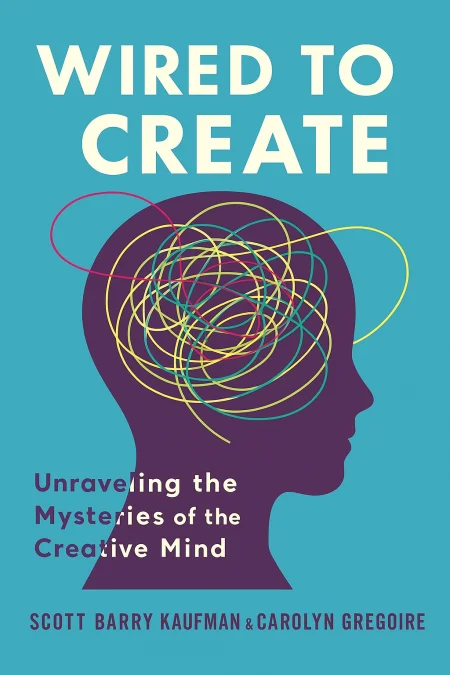
Wired To Create
Unraveling the Mysteries of the Creative Mind
byScott Barry Kaufman, Carolyn Gregoire
Book Edition Details
Summary
A symphony of contradictions forms the heart of "Wired to Create," where the enigmatic dance of creativity is unveiled through the lens of psychology and neuroscience. Psychologist Scott Barry Kaufman and writer Carolyn Gregoire take you on a vivid exploration into the 'messy minds' of history's most imaginative figures—Picasso, Kahlo, Lennon, and more. This book isn't just about habits; it's about embracing paradox. From passionate solitude to playful seriousness, from intuition to adversity, each chapter delves into the duality that fuels innovation. Whether you're an artist, a thinker, or a dreamer, discover how these contradictions can unlock the hidden depths of your own creativity and transform your perception of what's possible.
Introduction
Have you ever wondered why some people seem to effortlessly generate brilliant ideas while others struggle to think outside the box? Or why certain individuals can transform their wildest dreams into groundbreaking innovations that change the world? The mystery of creativity has captivated humans for centuries, often dismissed as divine inspiration or random luck. However, modern science reveals a far more fascinating truth: creativity isn't a mystical gift reserved for a chosen few, but rather a complex interplay of neurological networks, personality traits, and learnable behaviors that we can all develop and harness. This exploration into the creative mind unveils the surprising contradictions that fuel innovation. You'll discover how the most creative individuals paradoxically combine laser-sharp focus with mind-wandering daydreams, embrace both solitude and collaboration, and transform their greatest struggles into their most profound artistic achievements. Perhaps most remarkably, you'll learn that creativity isn't just about making art or inventing gadgets—it's a fundamental way of engaging with the world that can enrich every aspect of your life, from problem-solving at work to finding deeper meaning in everyday experiences.
The Neuroscience of Creative Thought and Brain Networks
The romantic notion that creativity springs from one hemisphere of the brain has been thoroughly debunked by modern neuroscience. Instead of residing in a single location, creative thinking emerges from the dynamic interaction of multiple brain networks working together like a sophisticated orchestra. Think of your brain as having three primary creative networks: the imagination network, which generates ideas and makes novel connections; the executive attention network, which focuses and refines those ideas; and the salience network, which determines which ideas deserve our attention and effort. What makes highly creative people unique isn't that they have different brains, but rather that their brains are exceptionally flexible at switching between these networks. While most people struggle to activate opposing networks simultaneously, creative individuals can seamlessly toggle between generating wild, unconventional ideas and then critically evaluating and refining them. This neurological flexibility allows them to enter flow states during idea generation while maintaining the cognitive control needed to shape their visions into reality. The imagination network, often called the brain's default mode, becomes active during rest periods and mind-wandering moments. Far from being idle time, these periods of apparent mental inactivity are when our brains make unexpected connections between disparate memories, experiences, and concepts. This explains why breakthrough insights often occur in the shower, during walks, or just before falling asleep—moments when our executive attention relaxes its grip and allows the imagination network to freely explore and combine ideas in novel ways. Perhaps most remarkably, recent brain imaging studies show that during peak creative moments, these typically competing networks actually work in harmony, creating a unique neurological state that allows for both uninhibited idea generation and sophisticated evaluation. This discovery suggests that creativity isn't about choosing between logic and imagination, but rather about integrating both modes of thinking into a unified creative process that leverages the full power of the human mind.
Essential Traits: From Openness to Sensitivity
Creative individuals share a constellation of personality traits that, while seemingly contradictory, work together to fuel innovative thinking. The most powerful predictor of creative achievement is openness to experience—an insatiable curiosity about both the inner world of thoughts and emotions and the external world of sensations and possibilities. This trait manifests as an intellectual hunger for complex problems, an aesthetic appreciation for beauty and art, and an emotional willingness to explore the full spectrum of human feelings, even when they're uncomfortable or challenging. Sensitivity, often misunderstood as a weakness, actually serves as creativity's secret weapon. Highly sensitive individuals process sensory information more deeply, notice subtle patterns others miss, and experience emotions with greater intensity. This heightened awareness provides richer raw material for creative work, allowing artists to capture nuances of human experience that resonate deeply with audiences. The painter who notices how light falls differently on each leaf, the musician who hears emotional undertones in everyday conversations, and the writer who feels the weight of unspoken words all draw from this wellspring of heightened perception. The dopamine system, our brain's primary motivation and reward network, plays a crucial role in driving creative exploration. Creative individuals often have variations in dopamine function that make them natural seekers of novelty and complexity. This neurochemical difference explains why creative people are drawn to ambiguous situations, unconventional ideas, and uncharted territories that others might find uncomfortable or threatening. Their brains are literally wired to find reward in the unknown and uncertain. However, these traits come with challenges. The same sensitivity that enriches creative work can also lead to feeling overwhelmed by stimulation. The openness that drives innovation can also make individuals vulnerable to mental health struggles. The key to thriving creatively lies not in eliminating these challenges, but in learning to harness both the light and shadow aspects of the creative personality, using sensitivity as a compass for deeper truth and employing openness as a tool for continuous growth and discovery.
Creative Process: Play, Passion and Mindful Innovation
The creative process begins not with serious deliberation, but with the spirit of play that we often abandon in adulthood. Imaginative play serves as creativity's foundation, allowing the mind to explore possibilities without the constraints of practical outcomes or logical consistency. When children build elaborate worlds with simple blocks or when adults engage in creative hobbies without specific goals, they're exercising the same cognitive flexibility that fuels professional innovation. This playful exploration creates new neural pathways and helps break down the mental barriers that limit conventional thinking. Passion provides the emotional fuel that sustains creative work through inevitable obstacles and setbacks. However, not all passion is created equal. Harmonious passion—where creative work feels integrated with one's authentic self—leads to sustained motivation and deeper satisfaction. In contrast, obsessive passion, driven by external validation or compulsive need, often leads to burnout and creative blocks. The difference lies in whether you feel in control of your passion or controlled by it. True creative passion feels like falling in love with the process itself, not just the potential outcomes. Mindfulness and focused attention play crucial but often misunderstood roles in creativity. While complete present-moment awareness helps artists observe the world with fresh eyes and notice subtle details others miss, creativity also requires periods of mind-wandering and mental time travel. The most productive creative minds learn to balance external focus with internal exploration, using mindfulness techniques to enhance observation while also creating space for daydreaming and imaginative wandering. This dynamic balance allows for both the careful attention needed to craft quality work and the mental freedom necessary for breakthrough insights. The creative process is inherently messy and nonlinear, involving frequent cycles of expansion and contraction, generation and refinement, inspiration and perspiration. Rather than following a neat sequence of steps, creativity spirals through periods of intense focus and relaxed reflection, often requiring creators to hold multiple contradictory ideas simultaneously. This tolerance for ambiguity and comfort with uncertainty distinguishes highly creative individuals from those who prefer clear, predictable processes. Embracing this messiness, rather than fighting it, often leads to the most innovative and meaningful creative outcomes.
Summary
The creative mind emerges not from mystical inspiration or genetic lottery, but from the dynamic interplay of flexible brain networks, distinctive personality traits, and learnable processes that anyone can develop and refine. The most profound insight from creativity research is that our capacity for innovation stems from embracing contradictions—combining focused attention with playful exploration, sensitivity with resilience, and logical analysis with intuitive leaps. Rather than viewing creativity as a rare talent, we can understand it as a fundamental human capacity that enriches problem-solving, enhances emotional intelligence, and deepens our connection to both ourselves and the world around us. As you reflect on these insights, consider how you might cultivate greater cognitive flexibility in your own life and work. What mental barriers might be limiting your creative potential, and how could embracing uncertainty and playful exploration unlock new possibilities? The science of creativity suggests that innovation isn't about waiting for lightning to strike, but about creating the conditions—through mindful attention, passionate engagement, and openness to experience—that allow our natural creative capacities to flourish and contribute meaningfully to the challenges and opportunities that surround us.
Related Books
Download PDF & EPUB
To save this Black List summary for later, download the free PDF and EPUB. You can print it out, or read offline at your convenience.
By Scott Barry Kaufman
