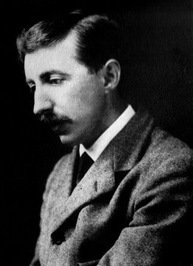
E.M. Forster
Born on January 1, 1879, in London, England, Edward Morgan Forster emerged as a luminary in the world of English literature, his writings deeply rooted in the social and cultural contexts of his time. The only child of an architect father who died young and a nurturing mother, Forster was educated at the prestigious King's College, Cambridge, where he forged enduring friendships and honed his intellectual prowess. These formative years profoundly influenced his literary perspective, imbuing his works with deep humanism and a perceptive exploration of class and social conventions. His experiences traveling to India further expanded his horizons, leading him to question the rigidities of the British Empire and explore themes of cultural and racial tensions, which would become hallmarks of his writing. Among Forster's oeuvre, "A Passage to India," published in 1924, stands as a magnum opus that garnered critical acclaim and secured his place in the annals of literary history. This novel, a profound exploration of the complexities of colonial rule and the fraught dynamics between the British and Indians, won the James Tait Black Memorial Prize and was later adapted into an award-winning film. In addition to "A Passage to India," Forster penned other notable works such as "Howards End" and "A Room with a View," each unraveling the intricacies of English society with keen insight and narrative elegance. His novels are celebrated for their incisive critique of the social mores of Edwardian England and their enduring relevance in discussions of identity and belonging. Forster's literary style is distinguished by its eloquent prose and the deft interweaving of social commentary with deeply personal narratives. His narrative voice, at once compassionate and incisive, deftly captures the subtleties of human relationships and the often unspoken tensions that underlie them. Forster's enduring contribution to literature lies in his ability to illuminate the human condition with both clarity and empathy, challenging readers to reconsider their preconceptions about society and self. Through an oeuvre that transcends time and geography, E.M. Forster remains a pivotal figure in the canon of English literature, his works continuing to resonate with readers worldwide.


by Paul J. Zak
by Rory Vaden
by Robert C. Solomon, Fernando Flores
by Brett Gardner
by Dennis S. Reina
by Julian Baggini
by Larry Downes, Omar Abbosh, Paul Nunes
by Jacqueline Woodson
by Kevin Oakes
by Lindsey Pollak, Kimberly B. Cummings, Kimberly Brown
