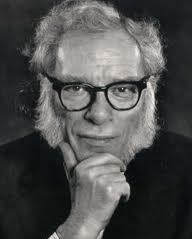
Isaac Asimov
Isaac Asimov, a Russian-American polymath born in 1920, emerged as one of the titans of science fiction and popular science writing in the 20th century. Emigrating from Russia to the United States at a young age, Asimov was profoundly shaped by his New York upbringing and academic pursuits, culminating in a Ph.D. in biochemistry from Columbia University. His dual passions for science and storytelling seamlessly intertwined throughout his prolific career, allowing him to illuminate complex scientific concepts with clarity and wit. Asimov's influence extended beyond the pages of his books; he was a revered public intellectual and a leading voice in the humanist movement, serving as president of the American Humanist Association. Among Asimov's extensive oeuvre, the "Foundation" series stands as a seminal work of science fiction, initially published as a trilogy between 1951 and 1953. The series explores the rise and fall of civilizations, underpinned by the concept of "psychohistory," a fictional science that merges mathematics and sociology to predict the future. This visionary narrative earned Asimov the Hugo Award for Best All-Time Series in 1966. His mastery of the genre is further exemplified in the "Galactic Empire" and "Robot" series, which he later interwove with the "Foundation" universe to create a cohesive future history. Additionally, his short story "Nightfall" was lauded as the finest science fiction story ever written, attesting to his enduring legacy in speculative fiction. Asimov's breadth extended to mysteries and fantasies, as well as an impressive array of nonfiction works that demystified scientific principles for a general audience, including "The Guide to Science" and "Understanding Physics." Asimov's literary style is distinguished by its lucidity and depth, characterized by a curiosity-driven narrative that invites readers to ponder the intricacies of technology and human nature. His works often delve into themes of rationalism and the ethical implications of scientific advancement, reflecting his own philosophical leanings. His contributions to literature and science communication have been immortalized through various honors, including the naming of asteroid 5020 Asimov and the establishment of Asimov's Science Fiction magazine. Though he held a reluctant vice presidency at Mensa International, he found greater fulfillment in promoting humanism, leaving behind a legacy that continues to inspire and challenge readers to explore the universe of ideas.


by Paul J. Zak
by Rory Vaden
by Robert C. Solomon, Fernando Flores
by Brett Gardner
by Dennis S. Reina
by Julian Baggini
by Larry Downes, Omar Abbosh, Paul Nunes
by Jacqueline Woodson
by Kevin Oakes
by Lindsey Pollak, Kimberly B. Cummings, Kimberly Brown
