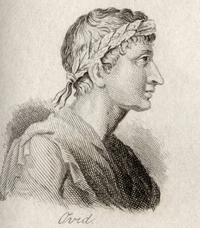
Ovid
Publius Ovidius Naso, known to posterity as Ovid, emerged as a luminary of Roman poetry during the reign of Augustus. Born on March 20, 43 BC, Ovid stands alongside Virgil and Horace as one of the triumvirate of canonical poets who indelibly shaped Latin literature. His career, however, took a dramatic turn when Augustus exiled him to the remote outpost of Tomis on the Black Sea, a fate Ovid enigmatically attributed to a "poem and a mistake," prompting centuries of scholarly conjecture. Despite this ignominious end, his influence endured, reverberating through the corridors of Western art and literature. Ovid's oeuvre is crowned by the "Metamorphoses," an ambitious mythological tapestry spanning fifteen books, composed in the majestic dactylic hexameter. This magnum opus remains a cornerstone of classical mythology. Alongside it stands "Ars Amatoria" ("The Art of Love"), a masterful exploration of romantic entanglements crafted in elegiac couplets, and "Fasti," a poetic calendar of Roman festivals. These works, celebrated for their wit and narrative prowess, captivated audiences across Late Antiquity and the Middle Ages, securing Ovid's place in the literary pantheon. Renowned for his elegant and sophisticated style, Ovid deftly wove themes of transformation, desire, and the capriciousness of fate into his poetry. His verses exhibit a remarkable psychological acuity, exploring the complexities of human emotion with both irony and empathy. As the last of the Latin love elegists, Ovid's legacy is one of enduring influence, his work a testament to the power of storytelling to transcend time and cultural boundaries.


by Paul J. Zak
by Rory Vaden
by Robert C. Solomon, Fernando Flores
by Brett Gardner
by Dennis S. Reina
by Julian Baggini
by Larry Downes, Omar Abbosh, Paul Nunes
by Jacqueline Woodson
by Kevin Oakes
by Lindsey Pollak, Kimberly B. Cummings, Kimberly Brown
