
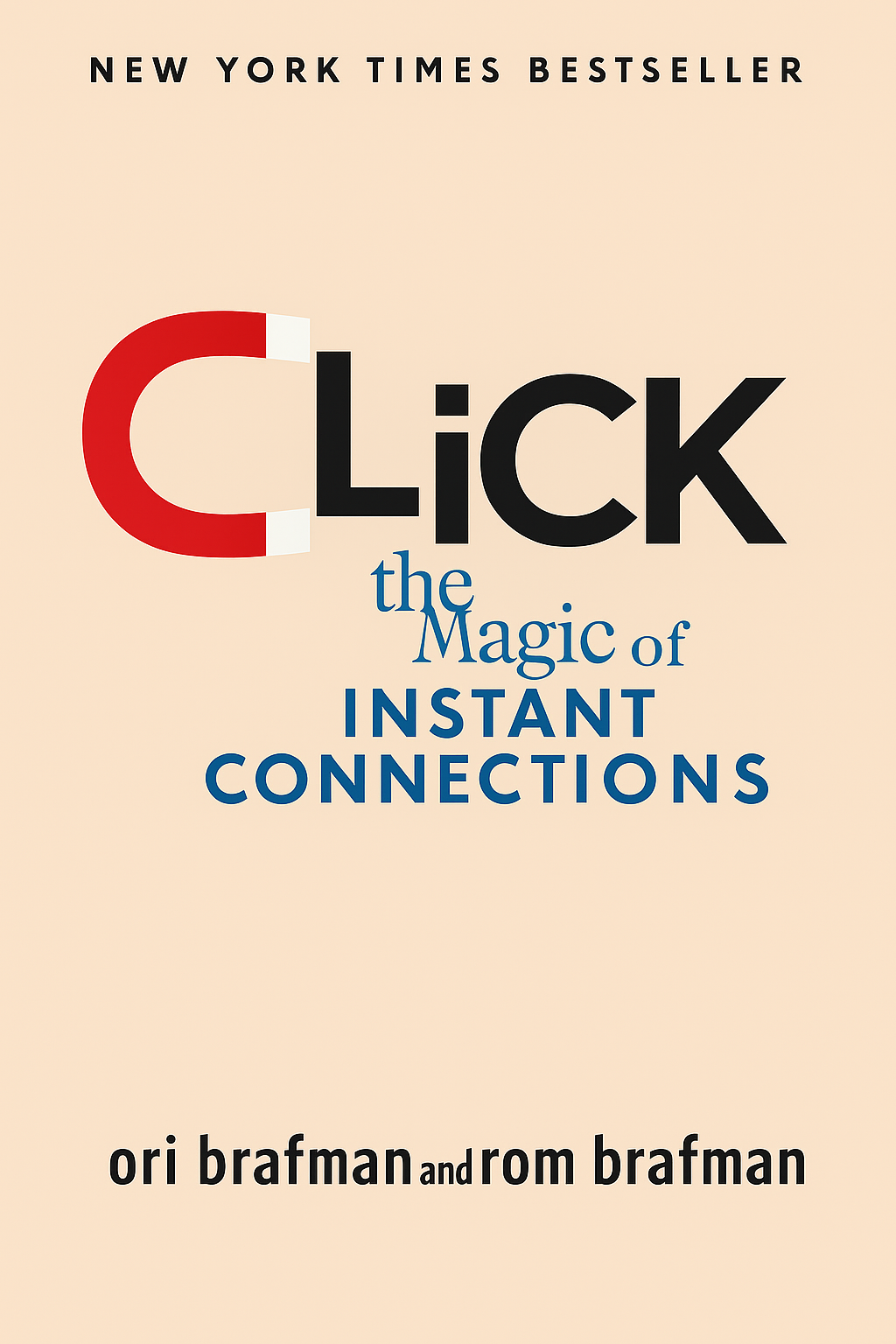
Click
The science of magical connections
Book Edition Details
Summary
In the realm of human connection, some moments shimmer with an inexplicable magic. Ori and Rom Brafman, celebrated authors of Sway, unravel this enigmatic allure in Click, a riveting exploration of the forces that bind us to people and passions. Through captivating stories—from whirlwind romances to groundbreaking scientific collaborations—this book delves into the psychology behind these rare, yet transformative experiences. With insight drawn from the latest psychological and sociological research, the Brafmans unveil five key "accelerators" that can spark these connections, inviting us to ponder whether such serendipity can be cultivated. Whether you're seeking deeper relationships or greater fulfillment in your work, Click promises to illuminate the path to those enchanting instances when everything falls effortlessly into place.
Introduction
Have you ever met someone and felt an immediate spark, as if you'd known them for years rather than minutes? Picture Paul, a former special forces officer, sitting by a hotel pool in Pasadena with Nadia, a nuclear engineer he'd met just days before during an intense business project. Despite their professional backgrounds and the brief time they'd known each other, something magical was happening. By their third evening together, Paul found himself asking Nadia to marry him, and she said yes. A month later, they were wed, and decades later, they describe that same magic as still being at the heart of their relationship. This extraordinary connection isn't limited to romantic encounters. Consider Jim West and Gerhard Sessler, two physicists at Bell Labs who clicked instantly despite their vastly different backgrounds. Jim, an African American from Virginia who grew up during the Great Depression, and Gerhard, a German immigrant who survived World War II, formed an immediate bond that led to one of the greatest achievements in acoustics history: the invention of the modern microphone that's in every cell phone and laptop today. What creates these moments of instant connection? Why do some encounters leave us feeling deeply understood and energized while others remain surface-level pleasantries? This exploration reveals that clicking isn't just a random occurrence, it's a phenomenon we can understand and even cultivate. Through neuroscience research, psychology studies, and countless real-life stories, we'll discover the hidden forces that transform ordinary moments into magical ones, and how these connections can permanently alter our relationships and bring out the best in ourselves.
The Magic of Instant Connection
Mario Andretti gripped the steering wheel as he approached the final lap of the 1978 Grand Prix at Monza. For most of the race, he had deliberately stayed behind rising star Gilles Villeneuve, making it appear as though he was struggling to pass. "I sort of tried to pass him," Andretti recalled years later, "I made it look like I was trying and trying, but I had no intention of actually passing." It was a calculated psychological game. Andretti gave Villeneuve space so he wouldn't feel threatened, waiting for the perfect moment. On that final turn, with everything on the line, Andretti made his move and overtook Villeneuve to win. But what makes this story remarkable isn't just the strategic brilliance, it's how Andretti described the experience. As he recounted the race decades later, his voice lifted with excitement, his energy escalated, and he seemed to relive that sense of being completely alive and in tune with everything around him. "It's when the race car is talking back to you," he explained, describing those moments when driver and machine become one. Neuroscientists have discovered that when we experience these moments of complete engagement, whether in love, work, or competition, our brains flood with dopamine, the same chemical that creates the euphoria associated with certain drugs. Brain scans reveal that people who describe themselves as "madly in love" show extraordinary activity in regions responsible for pleasure and reward. Conversely, when we feel socially disconnected, the same brain regions that process physical pain become active. Our minds are literally wired to reward connection and punish isolation. These aren't just pleasant feelings, they're fundamental biological drives that shape how we experience life and relationships. When everything clicks, we're not just performing better or feeling happier, we're tapping into one of the most powerful reward systems in human biology.
The Five Accelerators of Clicking
Police officer Greg Sancier raced through San Jose traffic, knowing that every minute mattered in the hostage situation awaiting him. When he arrived, he faced Ed Jones, a "three-striker" gang member who knew that another conviction meant life in prison. Jones had nothing to lose and was prepared to go out in what gang members call "a blaze of glory." For fifteen hours, Sancier talked with Jones, not as a cop to a criminal, but as one human being to another. The breakthrough came when Sancier shared something deeply personal: "Once I went through a tough situation myself. Not like yours, but I remember, like when my mother died." Jones couldn't help responding, "Your mother died?" In that moment, Sancier knew he'd made a connection that would save lives. What Sancier did instinctively reveals the first accelerator of instant connection: vulnerability. Most of us believe that revealing our fears and weaknesses puts us at a disadvantage, making us appear unprofessional or needy. But research shows the opposite is true. When we make ourselves vulnerable, we create an environment where others feel safe to do the same. Studies demonstrate that conversations progressing from small talk to genuine emotional sharing create bonds that can be stronger than relationships people have maintained for years. The key lies in moving from transactional communication, which conveys basic information, to connective communication, which reveals our authentic feelings and experiences. At Stanford Business School's famous "Touchy-Feely" groups, MBA students who spent their careers as buttoned-down consultants and investment bankers discovered this power firsthand. When one student finally shared a childhood story he'd never told anyone, the entire dynamic shifted. Others began revealing their own fears, anxieties, and secret hopes. The vulnerability became contagious, creating an intensity and sense of connection that many described as magical. The lesson is clear: our willingness to be authentic and open doesn't weaken our relationships, it strengthens them by giving others permission to be equally genuine with us.
When Everything Falls Into Place
Mike Welch stood backstage, clutching his comedy material and preparing for what should have been the biggest break of his career. After six years of performing in front of sparse audiences for little money, he was finally opening for the Righteous Brothers in front of two thousand people with cameras rolling. But when the master of ceremonies introduced him, disaster struck: "All right, everybody, I'm glad you listen to our radio station. We've got some kind of comedian, but I forget his name. Let's bring him on." It was a comedian's nightmare, facing a disinterested crowd after the worst introduction possible. But instead of panicking, Welch did something remarkable. He turned to the audience and said, "Let's do this introduction over again. Pretend I'm the MC, okay?" He then proceeded to give himself the enthusiastic introduction he deserved, transforming potential disaster into comedy gold. What happened next was what Welch described as the best performance of his career. The audience was completely engaged, people lined up for autographs afterward, and everyone talked about how unexpectedly funny he was. Welch's transformation illustrates the power of resonance, the state that emerges when we combine two elements: flow, which occurs when we're fully engaged and challenged in something we've mastered, and presence, which means being completely attuned to those around us. Research in healthcare shows that when nurses demonstrate true presence with patients, taking time to really see and understand them rather than just checking charts, patients feel dramatically better both immediately and weeks later. Similarly, when chef Lidia Bastianich cooks with complete passion and presence on her PBS shows, she creates such powerful resonance that even autistic children, who typically struggle to connect with others, sit mesmerized by her programs. The magic lies not just in being skilled at what we do, but in being fully present with others while doing it. This resonance becomes contagious, drawing people into our energy and creating moments where everything clicks into perfect harmony.
The Power of Personal Elevation
In the jungle of Chiapas, Mexico, two unlikely companions sat surrounded by ancient Maya ruins, about to solve a mystery that had baffled experts for decades. Peter Mathews, a twenty-one-year-old Australian anthropology student with a notebook full of carefully cataloged hieroglyphs, had met Linda Schele, a boisterous art teacher from Tennessee, just days earlier at a small archaeological conference. Despite their vastly different backgrounds and personalities, they had clicked immediately, spending hours walking through the ruins and discussing the mysterious Maya writing system that no one had been able to decode. On their last afternoon together, while other conference attendees relaxed or explored, Peter and Linda decided to play with the data Peter had meticulously gathered. They spread out large sheets of paper and began arranging Maya dates and symbols chronologically, throwing out ideas without fear of being wrong. What happened next was extraordinary. As they laid out segments where calendar dates appeared near rulers' names, a pattern suddenly emerged before their eyes. They realized they were looking at birth dates, coronation dates, and death dates of Maya kings, with precise calculations of how long each ruler had reigned. In just three hours, these two unlikely collaborators had cracked a code that had stumped experts for two centuries. Their breakthrough reveals how clicking transforms not just our relationships, but our capabilities. When we connect deeply with others, we experience what researchers call personal elevation, becoming our best selves in ways that would be impossible alone. Studies of MBA students working in teams show that those who clicked with their teammates didn't just get along better, they performed dramatically better, constructing 20 percent more models and achieving 70 percent greater accuracy on complex tasks. The teams that clicked brought more energy and enthusiasm to their work, cheered each other on during challenges, and engaged in healthy intellectual conflict that sharpened their thinking rather than creating personal animosity. When we truly connect with others, we don't just feel better, we become more creative, more willing to take risks, and more capable of achieving things that seemed impossible when we were working alone.
Summary
The magic of human connection isn't mystical, it's deeply practical. From Paul and Nadia's poolside proposal to Peter and Linda's archaeological breakthrough, we see that instant connections follow recognizable patterns. They thrive on vulnerability rather than perfection, proximity rather than distance, resonance rather than mere competence, similarity rather than difference, and environments that bring out our authentic selves rather than our polished facades. Perhaps most remarkably, these connections don't just make us feel good in the moment, they permanently alter the trajectory of our relationships and unlock capabilities we never knew we possessed. The couples who experience love at first sight maintain higher levels of passion decades later. The physicists who clicked at Bell Labs continued to describe their collaboration as magical fifty years after they met. The comedy that emerged from disaster, the archaeological breakthrough that changed history, the hostage situation resolved through human connection, all remind us that our most meaningful achievements often spring from our deepest connections with others. The invitation is clear: instead of leaving these transformative moments to chance, we can cultivate the conditions that make them more likely. By embracing vulnerability in our communications, seeking proximity in our relationships, bringing our full presence to our interactions, celebrating the similarities that bind us together, and creating environments where authenticity can flourish, we open ourselves to experiences that don't just enrich our lives, but reveal the extraordinary potential that emerges when human beings truly connect. In a world that often feels fragmented and isolating, the ability to click with others isn't just a personal gift, it's a pathway to the joy, creativity, and sense of belonging that makes life worth living.
Related Books
Download PDF & EPUB
To save this Black List summary for later, download the free PDF and EPUB. You can print it out, or read offline at your convenience.
By Ori Brafman
