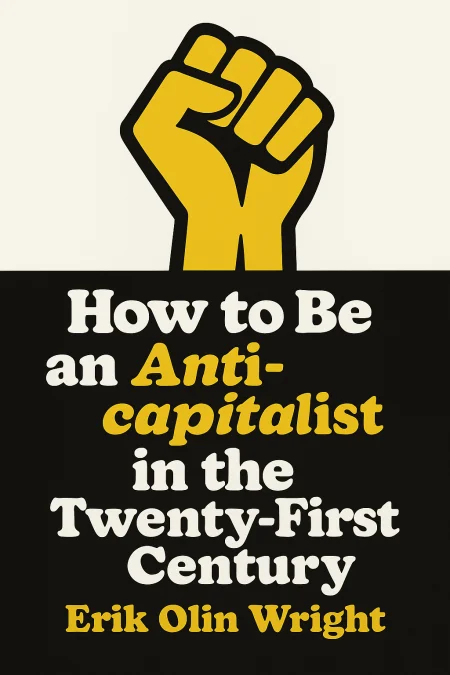
How to Be an Anticapitalist in the 21st Century
A pragmatic strategic guide to building an alternative economic system
Book Edition Details
Summary
In a world where the relentless engine of capitalism churns both progress and pain, Erik Olin Wright offers a compelling compass pointing towards a new societal frontier. "How to Be an Anticapitalist in the Twenty-First Century" isn't merely a critique—it's a clarion call for transformation, a strategic blueprint for weaving the threads of equality, freedom, and solidarity into the very fabric of our communities. With a powerful blend of moral insight and pragmatic vision, Wright distills decades of scholarly rigor into a roadmap for democratic socialism, making a persuasive case that a just and thriving society isn't just a dream—it's an attainable reality. Enhanced by an illuminating afterword from Michael Burawoy, this work stands as an essential guide for those yearning to imagine and construct a world where human flourishing is the ultimate goal.
Introduction
The resurgence of socialist ideas among younger generations signals a profound shift in political consciousness, yet many who critique capitalism lack a coherent vision of what might replace it. This exploration addresses a fundamental paradox of our time: while capitalism's failures become increasingly evident—from environmental destruction to unprecedented inequality—the path toward meaningful alternatives remains obscured by both ideological confusion and practical obstacles. The analysis proceeds through a rigorous examination of capitalism's structural contradictions, not merely its surface-level problems, revealing how these contradictions create spaces for transformative change. The framework employed here transcends traditional revolutionary versus reformist debates by introducing the concept of "eroding capitalism"—a strategic approach that combines grassroots alternatives with institutional reform. This method recognizes that sustainable change requires both dismantling capitalism's harmful mechanisms and constructing viable alternatives within existing structures. Rather than waiting for systematic collapse or relying solely on electoral politics, this approach identifies concrete pathways for expanding democratic, egalitarian economic relations that can gradually displace capitalist dominance. The journey through these ideas will demonstrate how seemingly utopian alternatives are not only possible but already emerging within capitalism's own contradictory development.
The Case Against Capitalism: Moral Foundations and Strategic Imperatives
Capitalism's fundamental incompatibility with human flourishing rests on three interconnected moral failures that permeate every aspect of contemporary life. The system systematically violates principles of equality and fairness by generating levels of inequality that deny millions access to basic conditions for dignified existence. This inequality is not incidental but structurally necessary—capitalism requires a pool of desperate workers willing to accept exploitative conditions while concentrating wealth among property owners who profit from others' labor. The democratic deficit under capitalism extends far beyond electoral politics into the heart of economic life. Private ownership of capital grants a small class of individuals extraordinary power over investment decisions that affect entire communities, while workers experience workplace authoritarianism as a daily reality. This concentration of economic power corrupts political democracy by enabling wealthy interests to capture state institutions, creating a feedback loop that entrenches both economic and political inequality. The promise of market freedom becomes hollow when most people lack the resources to exercise meaningful choice. Capitalism's cultural impact proves equally corrosive to human community and solidarity. The system's competitive logic transforms social relationships into market transactions, fostering individualism that fragments collective action and mutual aid. Fear and greed become normalized motivations as people compete for artificially scarce resources, while consumerism redirects human creativity toward private accumulation rather than shared flourishing. This cultural transformation weakens the social bonds necessary for democratic governance and collective problem-solving. These moral failures intersect with practical crises that capitalism cannot resolve through its own mechanisms. Environmental destruction, technological unemployment, and recurring financial instability all stem from capitalism's growth imperative and profit maximization logic. The system's short-term orientation prevents adequate responses to long-term challenges like climate change, while its dependence on exploitation ensures continued social conflict and political instability.
Strategic Pathways: From Revolutionary Rupture to Erosive Transformation
Historical experience demonstrates the futility of revolutionary rupture as a path to democratic socialism, despite its emotional appeal to those frustrated with capitalism's persistence. The twentieth century's attempted system-breaks—from Russia to China to Cuba—consistently failed to produce the promised democratic alternatives, instead generating authoritarian regimes that reproduced oppression in new forms. This pattern suggests that the complexity of modern economies makes sudden institutional replacement both practically impossible and strategically counterproductive. Traditional social democratic approaches of gradually dismantling capitalism through state ownership have likewise proven inadequate to contemporary challenges. While nationalization programs achieved important gains in the post-war period, they remained vulnerable to neoliberal rollback and failed to fundamentally alter capitalism's underlying dynamics. The modern global economy's complexity and capital mobility have further reduced the effectiveness of purely state-centered transformation strategies. The strategic synthesis that emerges from these historical lessons combines multiple approaches within an overarching framework of erosion. Rather than seeking to destroy capitalism through rupture or replace it through comprehensive state planning, this approach aims to gradually reduce capitalism's dominance within a mixed economic ecosystem. The strategy operates simultaneously from above and below: using state power to expand spaces for democratic alternatives while building those alternatives through grassroots organizing and community development. This erosive approach recognizes that capitalist societies already contain extensive non-capitalist elements—from public libraries to cooperatives to peer-to-peer production networks. The task becomes expanding and connecting these alternatives while using political power to create more favorable conditions for their growth. Key interventions include policies like universal basic income that reduce workers' dependence on capitalist employment, public banking systems that direct credit toward social priorities, and regulatory frameworks that favor cooperative and community-controlled enterprises. Success requires patient work to build both the institutional infrastructure and cultural foundations for a more democratic economy.
Building Democratic Socialism: Institutional Design and State Power
Democratic socialism emerges not as a blueprint imposed from above but as an ecosystem of economic relations organized around social power rather than private ownership or state control. This conception transcends traditional debates between market and planning by focusing on who exercises power within economic institutions. Where capitalism concentrates power among property owners and statism centralizes it in bureaucratic hierarchies, democratic socialism distributes economic power through participatory institutions accountable to affected communities. The building blocks of such a system already exist in embryonic form within capitalist societies. Universal basic income would provide economic security that enables people to refuse exploitative employment while pursuing cooperative enterprises, artistic endeavors, and community care work. Worker cooperatives operating within supportive policy frameworks could gradually displace corporate hierarchies in many sectors, especially as technological changes reduce optimal firm size. Public banking systems could direct credit flows according to social priorities rather than profit maximization. State provision of goods and services would expand beyond traditional functions to encompass most care work, infrastructure, and knowledge production. This expansion need not follow bureaucratic models but could involve diverse partnerships between public institutions and community organizations. Libraries exemplify this possibility—they already provide universal access to information, meeting spaces, and increasingly tools and technology, operating on principles of equality rather than ability to pay. The knowledge commons represents perhaps the most revolutionary aspect of democratic socialism's institutional architecture. Peer-to-peer collaborative production, exemplified by open-source software and Wikipedia, demonstrates how complex goods can be produced through voluntary cooperation rather than market competition or state direction. As information technology reduces the costs of collaboration and small-scale production, these models could extend to physical goods through shared design libraries and community-controlled manufacturing facilities. The viability of these alternatives depends on creating supportive legal and cultural frameworks that currently exist only in fragmented form. Patent reform, cooperative development funds, participatory budgeting processes, and workplace democracy requirements all represent policy interventions that could accelerate the transition. The challenge lies not in designing perfect institutions but in creating conditions for democratic experimentation that allows communities to develop economic relations suited to their specific needs and values.
Collective Agency and Political Realization: Challenges and Prospects
The formation of collective actors capable of pursuing democratic socialist transformation confronts three fundamental obstacles embedded in capitalism's cultural and structural dynamics. Privatized individualism, fostered by competitive markets and consumerist culture, fragments potential constituencies into isolated units focused on personal advancement rather than collective action. This atomization makes it difficult to build the sustained solidarity necessary for challenging entrenched power structures. Contemporary class structures compound this fragmentation through their increasing complexity and internal differentiation. Rather than the simplified worker-capitalist opposition that classical Marxism anticipated, modern economies generate multiple, often contradictory class positions with divergent interests. Professional workers, precarious service employees, small business owners, and traditional industrial workers may share opposition to extreme inequality while disagreeing on specific policies and priorities. Building unity across these divisions requires careful attention to both shared interests and distinct experiences. The multiplication of identity-based movements around race, gender, sexuality, and other forms of oppression creates both opportunities and challenges for anticapitalist organizing. These movements embody egalitarian values that align with democratic socialism's vision while addressing forms of domination that class analysis alone cannot capture. However, their distinct organizational cultures and strategic priorities can compete with class-based mobilization for activists' time and energy. Successful collective action under these conditions requires political formations that can unite diverse constituencies around shared values rather than identical interests. Democracy emerges as a particularly promising unifying theme because it speaks to experiences of powerlessness that cross class and identity lines. Environmental sustainability offers another potential bridge, as climate change affects everyone while disproportionately harming working-class and marginalized communities. The practical work of building such formations occurs primarily at local and regional levels where face-to-face relationships can overcome abstract political differences. Municipal governments, labor unions, community organizations, and social movement coalitions provide concrete venues for developing both political skills and working relationships across traditional boundaries. These local formations can then connect through broader networks while maintaining their rootedness in particular communities and struggles.
Summary
The erosion of capitalism emerges as a viable alternative to both revolutionary rupture and gradual reform through its recognition that transformation occurs within complex, contradictory systems rather than through their wholesale replacement. This strategic orientation acknowledges capitalism's continued dynamism while identifying the spaces where democratic alternatives can take root and gradually expand their influence. The approach succeeds by working with rather than against the mixed character of contemporary economies, strengthening existing cooperative elements while weakening exploitative ones. Success ultimately depends on building broad coalitions united around democratic values and committed to patient work of institutional transformation. This vision offers hope for those seeking systemic change without requiring faith in either revolutionary upheaval or electoral miracles.
Related Books
Download PDF & EPUB
To save this Black List summary for later, download the free PDF and EPUB. You can print it out, or read offline at your convenience.
By Erik Olin Wright
