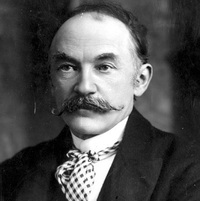
Thomas Hardy
Thomas Hardy, OM, an eminent English novelist and poet, emerged from the rural landscapes of Dorset, which profoundly influenced his literary canvas. Born in 1840, Hardy's early experiences in the countryside fostered a deep connection to the natural world, which would become a hallmark of his work. Although he is often associated with the naturalist movement, Hardy's oeuvre is imbued with elements of romanticism, reflecting his lifelong intrigue with the supernatural and the unseen forces shaping human destiny. Despite his self-identification as a poet, Hardy initially turned to novel writing as a means of economic sustenance, crafting narratives that explore the inexorable struggle between human passions and societal constraints. Among his most celebrated works, "Tess of the D’Urbervilles" stands as a testament to Hardy's mastery in portraying the vicissitudes of fate and the moral complexities of Victorian society. His novels, predominantly set in the semi-fictional realm of Wessex, offer poignant critiques of social conventions and the often harsh realities of rural life. The term "cliffhanger," now integral to the lexicon of suspense, is believed to have originated from Hardy's serialized narrative "A Pair of Blue Eyes," where he ingeniously left a character's fate literally hanging in the balance—a technique that has since become an enduring device in literary storytelling. Hardy's literary style is distinguished by its rich descriptive prose and profound psychological insight, characterizing human experience as a tapestry interwoven with chance and inevitability. His contribution to literature extends beyond his novels, as his poetry, first published in his later years, garnered significant recognition and influence, particularly during the mid-20th century with The Movement. Through his exploration of existential themes and his nuanced portrayal of the human condition, Thomas Hardy has secured his place as a seminal figure in English literature, whose work continues to resonate with readers and scholars alike.


by Paul J. Zak
by Rory Vaden
by Robert C. Solomon, Fernando Flores
by Brett Gardner
by Dennis S. Reina
by Julian Baggini
by Larry Downes, Omar Abbosh, Paul Nunes
by Jacqueline Woodson
by Kevin Oakes
by Lindsey Pollak, Kimberly B. Cummings, Kimberly Brown
