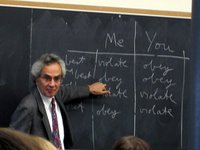
Thomas Nagel
Thomas Nagel, a distinguished figure in contemporary philosophy, was born in Belgrade, then Yugoslavia, to a Jewish family before emigrating to the United States. His academic journey led him to Cornell University, where he completed his Bachelor of Arts in 1958, followed by a BPhil from Oxford University and a PhD from Harvard University under the guidance of the eminent philosopher John Rawls. Since 1980, Nagel has been a prominent presence at New York University, holding the positions of University Professor and Professor of Philosophy and Law. His profound exploration of the human condition, particularly in the realms of philosophy of mind, political theory, and ethics, has established him as a pivotal thinker of his generation. Nagel's intellectual oeuvre is perhaps best encapsulated in his influential essay "What Is it Like to Be a Bat?" (1974), where he challenges reductionist views of consciousness by famously questioning the subjective experience of non-human entities. This work, alongside his seminal text "The Possibility of Altruism" (1970), reveals his deep engagement with deontological ethics and political philosophy. In "What Does It All Mean? A Very Short Introduction to Philosophy," Nagel distills complex philosophical ideas into an accessible narrative, thereby broadening his reach beyond academic circles. His contributions have not gone unnoticed, garnering him accolades such as the Rolf Schock Prize and the Balzan Prize, as well as an honorary Doctor of Letters from Oxford University. Nagel's writing is marked by clarity and incisiveness, often probing the intricate relationship between subjective experience and objective reality. His works are characterized by a rigorous yet accessible style, making profound philosophical inquiries approachable to a wider audience. As a Fellow of both the American Academy of Arts and Sciences and a Corresponding Fellow of the British Academy, Nagel continues to shape philosophical discourse, challenging readers to reconsider fundamental questions about consciousness, ethics, and the nature of reality itself. His enduring influence is reflected in the generations of philosophers he has mentored, who continue to build upon his foundational ideas.


by Paul J. Zak
by Rory Vaden
by Robert C. Solomon, Fernando Flores
by Brett Gardner
by Dennis S. Reina
by Julian Baggini
by Larry Downes, Omar Abbosh, Paul Nunes
by Jacqueline Woodson
by Kevin Oakes
by Lindsey Pollak, Kimberly B. Cummings, Kimberly Brown
