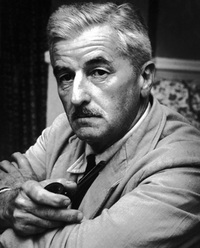
William Faulkner
William Cuthbert Faulkner, an illustrious figure in American literature, emerged from the heart of the South, born in New Albany, Mississippi, and nurtured in Oxford. His Southern roots profoundly influenced his literary creations, particularly his intricate depictions of the fictional Yoknapatawpha County, a microcosm of the Southern experience. A brief stint in the Royal Canadian Air Force during World War I, though devoid of combat, nonetheless broadened his horizons. Afterward, Faulkner briefly attended the University of Mississippi before embarking on his literary career. His time in New Orleans proved pivotal, as it was there he penned his debut novel, "Soldiers' Pay" in 1925, setting the stage for his illustrious career. Faulkner's oeuvre is celebrated for its profound exploration of the human condition and the complexities of Southern life. Among his most revered works are "A Rose for Emily," a haunting short story that delves into themes of isolation and the passage of time, and "As I Lay Dying," a novel acclaimed for its innovative narrative structure and psychological depth. His magnum opus, "The Sound and the Fury," published in 1929, exemplifies his mastery of stream-of-consciousness technique and intricate character development. During the late 1930s, Faulkner continued to build his legacy with novels such as "Light in August" and "Absalom, Absalom!" which further solidified his reputation. His literary genius was recognized globally with the Nobel Prize in Literature in 1949, honoring his unique contribution to the modern American novel. Faulkner's writing is distinguished by its complex narrative techniques and deep psychological insights, often weaving intricate tales of human frailty and societal decay. His works frequently encapsulate themes of identity, memory, and the inexorable passage of time, rendered with a lyrical yet unflinching prose style. Beyond his novels, Faulkner contributed to the film industry as a screenwriter, enriching the cinematic adaptations of literary classics. His legacy endures as a towering figure in Southern literature, revered for his unparalleled ability to capture the multifaceted nature of the human spirit and the cultural tapestry of the American South.
New From William Faulkner
More Books by William Faulkner


by Paul J. Zak
by Rory Vaden
by Robert C. Solomon, Fernando Flores
by Brett Gardner
by Dennis S. Reina
by Julian Baggini
by Larry Downes, Omar Abbosh, Paul Nunes
by Jacqueline Woodson
by Kevin Oakes
by Lindsey Pollak, Kimberly B. Cummings, Kimberly Brown
