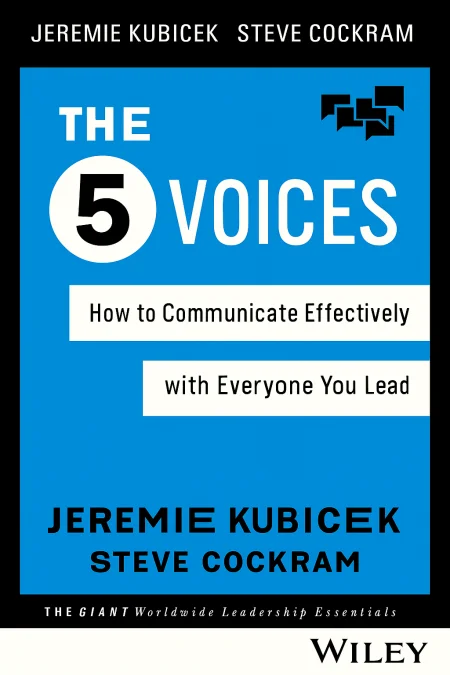
5 Voices
How to Communicate Effectively with Everyone You Lead
byJeremie Kubicek, Steve Cockram
Book Edition Details
Summary
Within the pages of "5 Voices," a symphony of self-discovery awaits those ready to revolutionize their leadership style. Jeremie Kubicek and Steve Cockram present a transformative guide that decodes the hidden nuances of personal and professional communication. Picture a world where each interaction becomes an opportunity for growth and understanding. This book introduces five distinct leadership voices—the Pioneer, Connector, Creative, Guardian, and Nurturer—each with their own strengths and opportunities for development. As you uncover your true leadership voice, you'll learn to listen and adapt to the voices around you, fostering genuine connections and mutual respect. By embracing these voices, you cultivate a communication skill set that transcends typical boundaries, enhancing emotional intelligence and reducing friction in every sphere of your life. "5 Voices" is not just a book; it's your key to unlocking meaningful, drama-free dialogues that elevate both personal and professional relationships to their highest potential.
Introduction
Why do some leaders inspire unwavering loyalty while others struggle to gain basic cooperation? The answer often lies not in what they say, but in how they communicate and understand the diverse voices within their teams. Traditional personality assessments label people but fail to provide practical tools for effective leadership communication. This book introduces a revolutionary framework that transforms how leaders understand themselves and connect with others through the identification of five distinct leadership voices. The 5 Voices framework represents a sophisticated yet accessible approach to leadership development that addresses the complexity of human communication in organizational settings. Rather than oversimplifying personality into static categories, this system recognizes that effective leadership emerges from understanding both your natural communication style and your ability to value and engage with different voices around you. The framework explores how nature, nurture, and personal choices shape our leadership behaviors, while providing concrete tools for building high-performing teams where every voice contributes meaningfully to collective success.
Understanding the 5 Voices: Pioneer, Connector, Guardian, Creative, and Nurturer
The foundation of effective leadership communication rests on recognizing five distinct voices that shape how individuals process information, make decisions, and interact with others. Each voice represents a unique perspective and contribution style, forming a comprehensive system that accounts for the full spectrum of human leadership behaviors. The Pioneer voice drives strategic vision and decisive action, naturally gravitating toward future possibilities and systematic problem-solving. The Connector voice specializes in relationship building and network creation, serving as the bridge between ideas and people. The Guardian voice provides stability and protection, ensuring that resources are stewarded wisely and traditions are honored. The Creative voice generates innovation and maintains organizational integrity, constantly scanning for new possibilities while upholding core values. The Nurturer voice champions people and relationships, creating environments where individuals feel valued and supported. These voices operate along a volume spectrum, with Pioneers speaking loudest and Nurturers typically quieter, which creates natural dynamics in team settings. The framework recognizes that while everyone possesses all five voices, individuals have a foundational voice that filters their communication and shapes how others experience them. This foundational voice represents your natural wiring, though life experiences and conscious choices can influence how prominently different voices appear in your leadership style. Understanding this system allows leaders to recognize why certain team members seem to speak different languages even when discussing the same topics. A Pioneer's urgent call for action may sound like reckless endangerment to a Guardian, while a Creative's innovative proposal might feel like impractical dreaming to a Nurturer focused on immediate people needs. By learning to identify and appreciate these different voices, leaders can create environments where diverse perspectives enhance rather than hinder team effectiveness. The power of the 5 Voices framework lies in its practical application to real-world leadership challenges. When leaders understand their team members' foundational voices, they can tailor their communication style, delegate appropriately, and create systems that leverage everyone's natural strengths while addressing potential blind spots. This creates a multiplication effect where team performance exceeds the sum of individual contributions.
Voice Dynamics: Weapons Systems, Rules of Engagement, and Team Interactions
Every voice carries a unique communication style that can be understood as a weapons system, reflecting how each voice naturally engages in conflict, presents ideas, and responds to challenges. This metaphor illuminates both the power and potential danger of different communication styles when used without awareness or maturity. Pioneers wield verbal grenades, delivering forceful critiques and strategic directives that can demolish opposition but may also cause collateral damage to relationships. Their communication style reflects military precision and competitive intensity, which can inspire followers but intimidate those with quieter voices. Connectors employ cyber warfare tactics, leveraging their extensive networks and social influence to advance their ideas and occasionally to undermine opposition through relationship-based pressure. Guardians operate interrogation chambers, systematically questioning proposals and plans to ensure thoroughness and viability, though this can feel overwhelming to those being questioned. Creatives function as either snipers, delivering precise analytical critiques, or as hulks, exploding with passionate defense of their values when provoked. Nurturers carry medical kits, focusing on healing and supporting rather than attacking, often sacrificing themselves to protect others from more aggressive communication styles. The rules of engagement provide a structured approach to team communication that ensures every voice is heard and valued. This system requires voices to speak in a specific order during meetings, starting with Nurturers, followed by Creatives, Guardians, Connectors, and finally Pioneers. This ordering compensates for the natural volume differences and ensures that quieter voices contribute before louder ones dominate the conversation. Nurturers need assurance that their opinions matter and won't be immediately criticized. Creatives require permission to dream big and clarifying questions to help articulate their vision. Guardians need freedom to ask difficult questions without being rushed. Connectors need encouragement to share passionately while understanding that critique isn't personal. Pioneers must listen to others first and moderate their critique to avoid overwhelming their teammates. This structured approach transforms team dynamics by creating psychological safety for all voices while maintaining productivity and decision-making effectiveness. Teams that implement these rules of engagement report significantly improved communication, reduced conflict, and better decision-making outcomes because they access the full wisdom available within their group rather than defaulting to the loudest or most confident voices.
Leading Effective Change Through Voice-Aware Communication
Understanding how different voices respond to change and communicate vision represents a critical leadership competency that can determine the success or failure of organizational initiatives. The framework reveals that voices have dramatically different capacities for communicating change effectively, often contrary to leaders' assumptions about who makes the best communicators. Pioneers, despite their confidence and strategic thinking, only reach approximately thirty-two percent of their audience when communicating vision. Their natural intensity and future focus can overwhelm the majority of people who need more detailed explanations and reassurance about proposed changes. Connectors serve as natural bridges between future-oriented and present-minded voices, reaching nearly half of any given audience through their relationship-focused communication style and ability to translate abstract concepts into personal benefits. Guardians and Nurturers, though often overlooked as communicators, actually reach the largest percentage of audiences because their careful, detailed approach reassures the majority of people who are naturally cautious about change. When a Guardian or Nurturer endorses a vision, it carries implicit assurance that proper due diligence has been conducted and that people's needs have been considered. The Build the Bridge concept addresses the fundamental challenge that future-oriented voices face when trying to move present-minded voices toward change. Guardians and Nurturers need to see clear, detailed steps that will safely transport everyone from current reality to the proposed future. They won't follow compelling visions without understanding the practical implementation details and having confidence that people and resources will be protected throughout the transition. This requires future-oriented leaders to slow down their natural pace and involve more conservative voices in planning and communication processes. Effective change leadership often requires creating advisory groups composed of voices that complement the leader's natural style. A Pioneer leader might assemble Guardians, Nurturers, and Connectors to help shape communications and ensure that change initiatives address the concerns of different constituency groups. This collaborative approach may feel slower initially, but it creates the broad-based support necessary for sustainable change implementation. The most successful change initiatives often involve having Guardians or Nurturers communicate the vision rather than the originating Pioneer or Creative, because their endorsement carries unique credibility with the majority of organizational members who share their cautious approach to change.
Building 100X Teams: Mastering Your Voice to Transform Organizations
The pinnacle of voice-aware leadership involves creating teams that operate at maximum effectiveness while continuously multiplying their health and capabilities throughout their organizations. The 100X Teams concept represents a systematic approach to achieving near-perfect team alignment, synergy, performance, communication, capacity, and relationships through the intentional application of voice dynamics and leadership principles. This approach recognizes that traditional leadership development focuses too heavily on the top ten percent of an organization while failing to provide practical tools and common language for the remaining ninety percent of team members. Building a 100X Team requires leaders to first master their own voice, understanding both their natural strengths and their unconscious incompetencies in less natural voices. The 70/30 Principle provides a framework for ensuring that team members spend approximately seventy percent of their time operating in their foundational voices, which maintains their energy and enthusiasm for handling the thirty percent of tasks that require their less natural voices. When this ratio becomes inverted, team members experience burnout and decreased effectiveness regardless of their technical competence or organizational incentives. The multiplication aspect of 100X Teams involves creating systems where team health and effectiveness spread throughout the organization rather than remaining isolated at the leadership level. This requires developing a common leadership vocabulary that ninety percent of organizational members can understand, use, and teach others. Visual tools and memorable frameworks enable leaders at every level to apply voice principles in their own spheres of influence, creating a cascade effect that transforms organizational culture over time. Successful 100X Teams implement regular assessment practices that measure team effectiveness across key dimensions while using voice-aware communication to address gaps and opportunities. They create cultures where honest conversations become routine rather than exceptional, where different voices feel genuinely valued rather than merely tolerated, and where individual development directly contributes to collective success. These teams serve as proving grounds for leadership principles and practices that can be scaled throughout entire organizations, creating competitive advantages that compound over time through improved communication, reduced conflict, and enhanced innovation capabilities.
Summary
True leadership transformation occurs when we understand that effective communication isn't about speaking louder or more persuasively, but about creating environments where every voice can contribute its unique wisdom to collective success. The 5 Voices framework provides leaders with both the mirror to see themselves clearly and the tools to build teams that multiply health and effectiveness throughout their organizations. By mastering our own voice while learning to value and engage the full spectrum of human communication styles, we unlock the potential for authentic leadership that creates lasting positive change in our families, teams, and communities.
Related Books
Download PDF & EPUB
To save this Black List summary for later, download the free PDF and EPUB. You can print it out, or read offline at your convenience.
By Jeremie Kubicek
