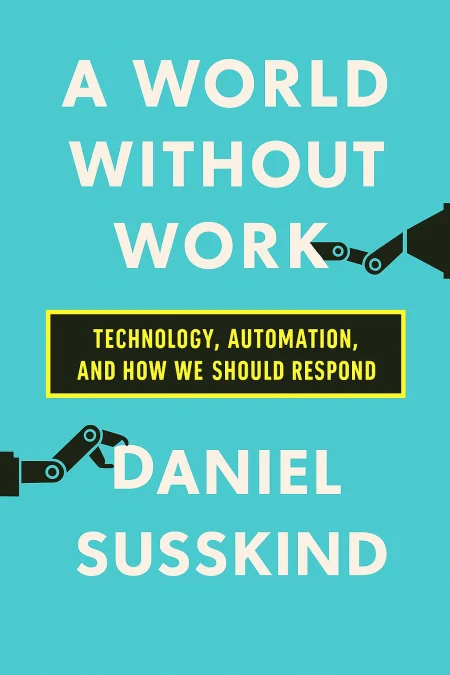
A World Without Work
Technology, Automation, and How We Should Respond
Book Edition Details
Summary
What if the future of work isn't about doing more, but redefining what it means to thrive? Daniel Susskind's "A World Without Work" catapults us into a near-future where artificial intelligence reshapes the very fabric of employment. Gone are the days when machines merely aided our labor; they now stand poised to eclipse our capabilities in fields once thought untouchable—from healthcare diagnostics to legal drafting. But fear not, Susskind offers a refreshingly optimistic vision amid this seismic shift. He argues that technology's advance doesn't herald doom but rather a chance to reimagine prosperity, equity, and purpose. As the specter of technological unemployment looms, the real challenge lies in harnessing AI's potential to craft a society where well-being and fulfillment replace the grind of the daily job. This compelling narrative not only anticipates a radical transformation but also inspires a hopeful rethinking of life's possibilities beyond the paycheck.
Introduction
The relationship between technological advancement and human employment has reached an unprecedented inflection point that challenges fundamental assumptions about economic progress and social organization. While previous generations witnessed machines replacing physical labor, contemporary artificial intelligence systems demonstrate capabilities extending into cognitive and creative domains once considered exclusively human territory. This transformation represents more than cyclical economic disruption; it signals a potential structural shift toward a post-work society where human labor becomes economically obsolete across vast sectors of activity. The analysis employs rigorous examination of historical patterns, technological capabilities, and economic theory to demonstrate why conventional wisdom about technological unemployment may prove dangerously inadequate. Rather than accepting optimistic assumptions that markets will naturally adjust to automation, the investigation scrutinizes the mechanisms through which AI systems differ qualitatively from previous technologies. The approach combines theoretical frameworks with empirical evidence to reveal how task encroachment, capital concentration, and institutional inadequacy converge to create unprecedented challenges for employment-based economic systems. The exploration moves systematically through layers of complexity, beginning with technological capabilities and progressing through economic dynamics to institutional responses. By dissecting both the substitution effects that eliminate jobs and the complementarity effects that historically created new opportunities, the analysis illuminates why traditional solutions may prove insufficient. The investigation ultimately reveals that addressing technological unemployment requires fundamental reconstruction of social institutions rather than incremental policy adjustments.
Why Current AI Automation Differs from Historical Precedents
Historical technological revolutions consistently generated fears about mass unemployment that ultimately proved unfounded, creating confidence that markets naturally adapt to innovation. The Industrial Revolution, despite initial disruption, eventually produced unprecedented prosperity and employment growth. Mechanization of agriculture freed workers for manufacturing, while later automation created service sector opportunities. This pattern established the economic consensus that technological progress generates complementary effects that offset job displacement through increased productivity, lower prices, and new categories of work. Contemporary artificial intelligence systems operate through fundamentally different mechanisms that challenge these historical patterns. Previous technologies automated specific, well-defined tasks through explicit programming, leaving complex cognitive functions to humans. Modern machine learning systems can perform tasks without predetermined rules, learning patterns from data and adapting to new situations. This capability enables AI to encroach upon activities requiring judgment, creativity, and social intelligence that previously provided natural barriers to automation. The scope and speed of current technological development amplifies these differences. Multiple technological streams including robotics, natural language processing, computer vision, and machine learning are advancing simultaneously, creating synergistic effects that accelerate displacement across diverse sectors. Unlike previous innovations that affected specific industries sequentially, AI applications emerge across healthcare, finance, transportation, and creative industries simultaneously, compressing adjustment periods and overwhelming traditional adaptive mechanisms. Economic indicators already reflect these structural changes. Labor's share of national income has declined across developed economies while returns to capital have increased, suggesting that productivity gains increasingly benefit technology owners rather than workers. The complementary relationship between human skills and technological tools appears to be weakening in favor of direct substitution, undermining the economic logic that historically protected employment during technological transitions.
The Failure of Education-Based Solutions to Technological Unemployment
Educational responses to automation anxiety rest on the assumption that workers can acquire new skills to stay ahead of technological change, maintaining the complementary relationship between human capabilities and machine systems. This approach treats technological unemployment as fundamentally a skills mismatch problem, solvable through improved training programs, lifelong learning initiatives, and educational reform. The strategy assumes that human cognitive abilities can indefinitely expand to match machine performance across economically relevant domains. Evidence increasingly challenges these educational optimism assumptions. Adult skill acquisition has plateaued in many developed countries despite massive educational investments, while the cognitive demands of working alongside advanced AI systems may exceed realistic human learning capacity. The pace of technological development appears to outstrip human adaptation capabilities, creating an unwinnable race between education and automation. Skills mismatches represent only one dimension of technological unemployment, failing to address identity mismatches where workers reject available employment or geographic mismatches where opportunities exist in inaccessible locations. More fundamentally, educational solutions cannot address structural unemployment that emerges when total demand for human labor falls below workforce availability. Even perfectly educated workers face unemployment when insufficient jobs exist, regardless of skill levels or training quality. As AI systems demonstrate superior performance across expanding ranges of cognitive tasks, the absolute demand for human capabilities may decline below population levels seeking employment. The distributional implications of technological change further limit educational effectiveness. Even when some workers successfully adapt to new technological realities, productivity gains may accrue primarily to capital owners rather than labor. This dynamic exacerbates inequality and creates new forms of economic stratification based on asset ownership rather than human skills, requiring solutions that move beyond individual capability development toward fundamental questions about how technological progress should be distributed across society.
Economic Inequality and the Concentration of Capital Power
Technological advancement increasingly concentrates economic power among owners of productive capital while diminishing the bargaining position of workers across skill levels. Unlike previous eras where productivity gains eventually translated into broad-based wage growth, contemporary technological progress primarily benefits a narrow class of technology owners, platform controllers, and algorithm designers. This concentration creates new forms of economic dependency that traditional regulatory frameworks struggle to address effectively. The emergence of superstar firms and individuals reflects these changing power dynamics. Technology-enabled businesses achieve massive scale with minimal employment, generating enormous returns for owners while providing limited direct job creation. Platform companies control vast economic ecosystems with relatively few employees, extracting value from millions of users and smaller businesses while concentrating profits among shareholders and executives. The resulting income distribution exhibits extreme concentration at the top, with median wages stagnating despite overall economic growth. Power concentration extends beyond simple wealth inequality to encompass control over information flows, market access, and technological infrastructure. A small number of technology companies wield unprecedented influence over commercial transactions, social interactions, and knowledge distribution. This dominance creates new forms of economic rent-seeking that allow platform owners to capture value created by others, further concentrating resources and reducing competitive pressures that might otherwise distribute benefits more broadly. Traditional policy tools designed for industrial economies prove inadequate for addressing these new forms of market power. Antitrust frameworks struggle with platform dynamics where network effects create natural monopolies, while tax systems fail to capture value created through data collection and algorithmic optimization. The challenge requires new approaches to economic governance that can effectively regulate technological platforms while ensuring that productivity gains benefit society broadly rather than concentrating among capital owners.
Institutional Reconstruction for a Post-Work Society
Addressing widespread technological unemployment requires fundamental reconstruction of social institutions designed around full employment assumptions. Traditional welfare systems, educational frameworks, and political structures all presuppose that most adults engage in paid work throughout their lives. As this assumption becomes untenable, new institutional arrangements must emerge to maintain social cohesion, individual opportunity, and democratic governance in post-work societies. Universal basic income represents one approach to decoupling survival from employment, providing unconditional payments that enable individuals to meet basic needs regardless of labor market participation. However, implementation faces significant challenges including funding mechanisms, inflation effects, and political feasibility. Alternative approaches such as universal basic services, stakeholder capitalism, or public ownership of automated systems offer different pathways toward ensuring broad access to technological dividends while maintaining work incentives and social contribution. Educational institutions require transformation beyond skill development to prepare individuals for lives where traditional career paths may no longer exist. Rather than focusing primarily on job-specific training, education must emphasize creativity, critical thinking, civic engagement, and personal fulfillment. New models of lifelong learning, community participation, and social contribution become essential as the pace of technological change accelerates and traditional employment becomes less available. Political and democratic institutions face particular challenges when large populations lack economic stake in society through employment. New forms of civic engagement, social recognition, and collective decision-making may be necessary to maintain political legitimacy and social solidarity. The transition requires careful management to prevent technological advancement from undermining the social foundations that enable democratic societies to function effectively while ensuring that post-work arrangements preserve human dignity and meaningful social participation.
Summary
The convergence of artificial intelligence capabilities, economic inequality, and institutional inadequacy creates unprecedented challenges for employment-based societies that require fundamental rather than incremental responses. Contemporary AI systems differ qualitatively from previous technologies by demonstrating the capacity to substitute for human workers across expanding ranges of cognitive and manual tasks, potentially severing the historical link between technological progress and broad-based prosperity. Educational solutions prove insufficient to address structural unemployment that emerges when total demand for human labor falls below workforce availability, while traditional policy frameworks cannot effectively regulate the concentration of economic power among technology platform owners. The analysis reveals that maintaining social cohesion and individual opportunity in an age of machine intelligence demands comprehensive reconstruction of economic distribution mechanisms, educational purposes, and democratic governance structures rather than relying on market forces to naturally adapt to technological disruption.
Related Books
Download PDF & EPUB
To save this Black List summary for later, download the free PDF and EPUB. You can print it out, or read offline at your convenience.
By Daniel Susskind
