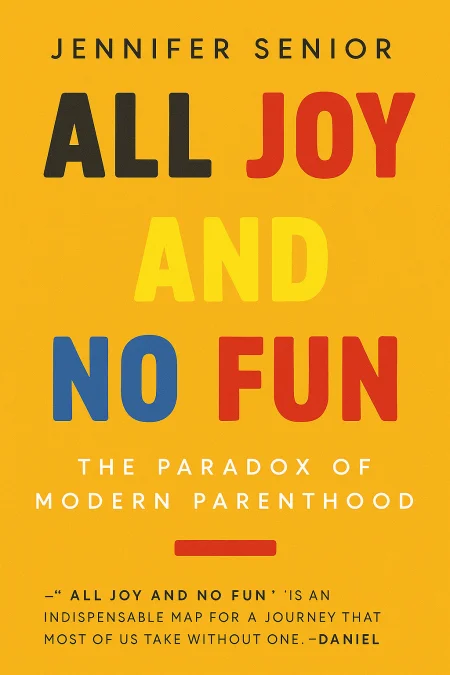
All Joy and No Fun
The Paradox of Modern Parenthood
Book Edition Details
Summary
In the intricate dance of family life, it's not just the parents who shape the children; children profoundly transform their parents too. "All Joy and No Fun" by Jennifer Senior delves into this compelling dynamic with a blend of humor, insight, and meticulous research. Senior paints vivid portraits of modern parenthood, exploring how the arrival of children can upend careers, marriages, and personal identities. In an era where parenting roles are as challenging as they are undefined, this book offers a rare glimpse into the emotional and societal shifts experienced by today's mothers and fathers. By shifting the lens from parenting to parenthood, Senior unearths the profound joys and unexpected trials that define the journey of raising children. Whether you're knee-deep in diapers or navigating teenage turbulence, this is essential reading that captures the essence of parental evolution with elegance and empathy.
Introduction
At 6:30 AM, Maria finds herself in the familiar dance of morning chaos. Her four-year-old refuses to wear anything but his superhero costume to preschool, while her seven-year-old daughter melts down over a slightly bent waffle. Her husband juggles coffee and car keys, already mentally at his first meeting. In this moment of beautiful pandemonium, Maria catches herself thinking: "I love these children more than anything in the world, so why do I feel like I'm drowning?" This scene unfolds in countless homes every morning, revealing one of modern life's most profound paradoxes. Today's parents are more devoted to their children's wellbeing than any generation before, yet studies consistently show they report lower happiness levels than their childless peers. This contradiction isn't a sign of failure or ingratitude—it's a window into the unique landscape of contemporary family life. Through intimate portraits of real families navigating the complexities of modern parenthood, we discover that raising children today requires skills no previous generation needed. The rules have shifted, expectations have multiplied, and traditional support systems have crumbled. Yet within these challenges lie extraordinary opportunities for growth, connection, and joy that can transform not only our children's lives, but our own understanding of resilience, love, and what it truly means to be human in relationship with others.
Shattered Sleep and Lost Identity: The Early Years Reality
Jessica stares at her reflection in the bathroom mirror at 3 AM, her three-month-old son finally asleep in her arms after two hours of walking, bouncing, and desperate shushing. She barely recognizes the woman looking back at her—hair unwashed for days, wearing the same milk-stained shirt for the third consecutive day, eyes rimmed with the kind of exhaustion that goes bone-deep. Before motherhood, she was a marketing executive who thrived on deadlines and strategic thinking. Now, she struggles to remember if she brushed her teeth this morning. Her husband finds her crying in the kitchen the next afternoon, overwhelmed by the simple task of making lunch while the baby screams in his bouncer. She tries to explain that it's not just the crying or the sleeplessness—it's the complete dissolution of her former self. The woman who once managed million-dollar campaigns now feels defeated by diaper changes and feeding schedules. She loves her son with a fierce intensity that surprises her, yet mourns the person she used to be with equal intensity. The early years of parenthood represent one of life's most jarring transitions. Unlike other major life changes that happen gradually, becoming a parent transforms everything overnight. The autonomy, spontaneity, and sense of competence that defined adult life vanish, replaced by round-the-clock responsibility for someone completely dependent on you. This isn't just about missing sleep or adult conversation—it's about reconciling the person you were with the person you're becoming, learning to find meaning in the beautiful surrender that new parenthood demands.
The Pressure Cooker: When Love Becomes Performance
In the parking lot of an elite preschool in suburban Denver, parents huddle over smartphones, comparing notes about Mandarin immersion programs and coding camps for four-year-olds. Sarah listens as another mother describes her son's schedule: violin lessons, advanced math tutoring, soccer practice, and art classes, all carefully orchestrated to build the perfect foundation for future success. The conversation makes her stomach clench with familiar anxiety about whether she's doing enough for her own daughter. At home, Sarah's kitchen counter overflows with educational materials, craft supplies, and enrichment activities she's researched online. She documents her daughter's milestones obsessively, comparing them to developmental charts and other children's achievements. Playdates become informal assessments where she evaluates her parenting choices against other families' approaches. The simple joy of watching her child discover the world has been overshadowed by the constant pressure to optimize every moment for maximum developmental benefit. This transformation of childhood into a high-stakes performance affects entire families. Children sense their parents' anxiety and begin to internalize the message that their worth depends on achievement rather than simply being loved. Parents exhaust themselves trying to provide every possible advantage, turning family life into a series of scheduled activities and learning opportunities. The irony is profound: in our desperate attempt to give our children the best possible start in life, we often rob them of the very thing they need most—relaxed, present parents who enjoy their company without agenda or expectation.
Letting Go: Adolescence and the Art of Stepping Back
Linda sits in her car outside her sixteen-year-old daughter Emma's school, debating whether to text about the forgotten lunch money. For years, she's been Emma's safety net, swooping in to solve problems and smooth rough patches. But lately, Emma's responses to her help have grown increasingly sharp: "Mom, I can handle it myself." The lunch money incident becomes a moment of reckoning—does she rescue again, or let Emma figure it out? The shift began subtly. Emma stopped sharing details about her day, started closing her bedroom door during phone calls, and began questioning family rules she'd previously accepted without argument. Linda found herself mourning the loss of their close relationship while simultaneously feeling rejected by the child she'd devoted herself to raising. The girl who once sought her advice about everything now seemed to view her mother's input as unwelcome interference. At a coffee shop with other mothers of teenagers, Linda discovers she's not alone. One friend describes her son's eye-rolling response to her college application reminders, another shares her daughter's angry accusation that she's "too involved" in her social life. These mothers, who spent years being the center of their children's worlds, now must learn to become supporting characters in their teenagers' stories. The rejection feels personal because it is personal—adolescents are literally rejecting the version of themselves that existed in relationship to their parents, working to discover who they are as independent beings. The parents who navigate this transition most successfully learn to see their teenager's growing autonomy not as loss, but as evidence that their years of nurturing have succeeded in creating young people ready to engage the world on their own terms. This requires a fundamental shift from protection to preparation, from solving problems to teaching problem-solving skills, from being needed to being available when called upon.
Summary
The stories woven throughout these pages reveal a truth both simple and transformative: modern parenthood asks us to hold two seemingly contradictory realities simultaneously. We experience genuine hardship—sleepless nights, strained relationships, lost autonomy, and constant worry about our adequacy—while also discovering depths of love and meaning we never knew existed. This isn't a contradiction to be solved, but a paradox to be embraced with grace and understanding. The challenges these families face aren't signs of personal failure, but symptoms of a society that hasn't caught up to the realities of contemporary family life. When we understand that our struggles are shared, we can stop blaming ourselves for finding parenthood difficult and start building the support systems families actually need. The most liberating insight isn't that parenting gets easier—it's that the difficulty doesn't diminish the joy, and the joy doesn't erase the difficulty. Perhaps the greatest gift we can offer ourselves as parents is permission to be imperfect, to acknowledge that loving our children fiercely doesn't require sacrificing our own humanity. The families who thrive aren't those who avoid the struggles of modern parenthood, but those who face them with honesty, humor, and the understanding that raising children ultimately raises us—making us more patient, more generous, and more capable of unconditional love than we ever imagined possible.
Related Books
Download PDF & EPUB
To save this Black List summary for later, download the free PDF and EPUB. You can print it out, or read offline at your convenience.
By Jennifer Senior
