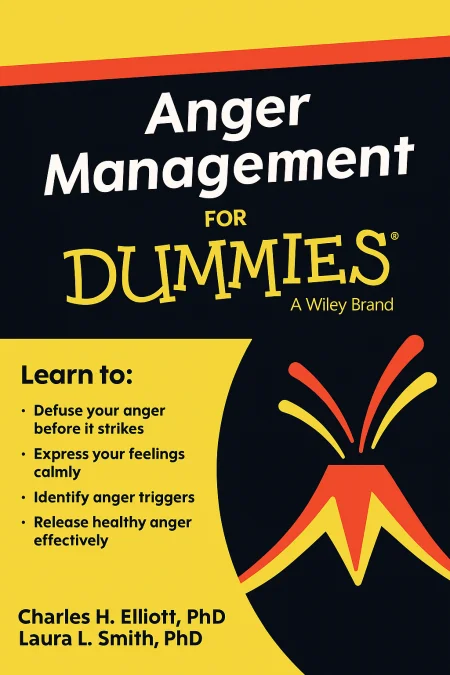
Anger Management for Dummies
Your One-Stop Guide to Anger Management
byCharles H. Elliott, Laura L. Smith
Book Edition Details
Summary
Anger—a force as primal as fire, yet as potentially destructive. When it spirals beyond control, it leaves a trail of chaos in its wake, from shattered relationships to turbulent workplaces. Charles H. Elliott and Laura L. Smith, esteemed figures in psychology, have crafted a guide that doesn't just tame this beast but transforms it. With cutting-edge insights into modern rage phenomena like road and air rage, and heartfelt strategies for managing anger in children, this book is your map to emotional mastery. Discover a toolkit brimming with techniques to defuse your inner storms, heal past wounds, and step into a life of peace and resilience. Unleash a version of yourself unburdened by fury, ready to embrace a world of calm and connection.
Introduction
Picture this: You're stuck in traffic, running late for an important meeting, when someone cuts you off without signaling. Your heart pounds, your jaw clenches, and suddenly you're shouting at a stranger who can't even hear you. Sound familiar? You're not alone in this struggle. Millions of people find themselves hijacked by anger daily, watching helplessly as this powerful emotion damages their relationships, careers, and inner peace. But here's the transformative truth: anger doesn't have to control you. Instead of being a destructive force that leaves regret in its wake, anger can become your ally—a source of energy, clarity, and positive change. The journey from reactive rage to purposeful power begins with understanding that you have far more control over your emotional responses than you might believe. Every moment of anger is actually an opportunity to practice a new way of being, one that honors your feelings while protecting what matters most to you.
Understand Your Anger Triggers and Patterns
Anger rarely appears out of nowhere. Like a smoke alarm that signals fire, your anger is responding to specific triggers that threaten something you value deeply. These triggers typically fall into six major categories: unfairness, time pressure and frustration, dishonesty and disappointment, threats to self-esteem, prejudice and discrimination, and direct attacks. Understanding your personal anger profile is like having a roadmap to your emotional landscape. Consider Cheryl, a dedicated engineer whose work was exceptional but whose colleagues complained about her frequent irritability. When her boss pointed this out during her annual review, Cheryl insisted she never got angry with anyone. Yet her pulse quickened and her face reddened as she spoke, revealing the very anger she claimed didn't exist. Cheryl's transformation began when she started tracking her physical sensations throughout the day. She noticed her palms getting damp during her commute, tightness in her throat during afternoon meetings, and feeling unusually cold despite normal building temperatures. By connecting these bodily signals to her emotions, Cheryl discovered she was experiencing irritation, resentment, and frustration long before they erupted into visible anger. This awareness gave her the power to intervene early, creating space for choice rather than automatic reaction. To map your own anger triggers, pay attention to your body's early warning system. Notice rapid breathing, muscle tension, changes in temperature, or that familiar knot in your stomach. Rate each trigger category from one to five based on how frequently you encounter it and how problematic it feels. Your highest-scoring combinations reveal your personal hot buttons—the situations that consistently push you toward anger. Remember that awareness is the first step toward change, and once you can identify your triggers before they fully activate, you've created space for transformation.
Master Essential Anger Management Techniques
The most powerful anger management techniques work by interrupting the escalation process before it reaches the point of no return. These tools become your emotional circuit breakers, preventing destructive outbursts while preserving your energy for constructive action. Think of these techniques as your personal toolkit for emotional regulation, each one designed to give you back control when anger threatens to take over. Walter, a man in his early 60s, had transitioned from a successful tech career to owning a small vineyard, finding real meaning in his new life. However, his idyllic existence was shattered when a drunk driver ran through a red light and crashed into his truck, leaving him with chronic back pain. Walter's biggest challenge wasn't the physical pain but his ever-increasing rage at the drunk driver. He couldn't stop thinking about the unfairness and injustice he had suffered, and his anger was making both his pain and his life unbearable. Walter discovered that imagery became his most effective tool for managing overwhelming anger and pain. When his fury became intolerable, he would announce to those around him, "I'm going fishing!" Everyone knew this meant Walter was taking a mental break. He would sit on a bench in his vineyard, close his eyes, and vividly imagine himself fishing by a peaceful pond, completely alone in his version of heaven on earth. After about ten minutes of this mental escape, both his pain and anger would subside to manageable levels, allowing him to return to his life with renewed calm. Begin building your own anger management toolkit by selecting three techniques that resonate with you. Deep breathing is universally effective: inhale slowly for four counts, hold for four, then exhale for six counts while thinking a calming word like "release" or "peace." For immediate relief, try the "STOP" technique: Stop what you're doing, Take a breath, Observe your thoughts and feelings, then Proceed with intention rather than reaction. Practice these techniques daily when you're calm, not just during angry moments, because consistency and vivid detail make these tools more powerful when you truly need them.
Build Healthy Relationships Through Communication
Anger often destroys the very relationships we value most, but when we learn to communicate our feelings constructively, we can actually strengthen our connections with others. The secret lies in expressing your needs without attacking the other person's character or worth. Assertive communication becomes the bridge between passive silence and aggressive attack, allowing you to maintain respect for both yourself and others. Amy, a successful physician, had worked hard to overcome an abusive childhood and build a good life. When her aging parents moved into her home, they continued their pattern of criticism and disrespect despite her care for them. Amy found herself increasingly irritated and angry, with the stress affecting her husband and children. Finally, she gathered the courage to speak assertively: "I feel unhappy and irritated when you criticize me in my home. I feel like I am doing everything to take care of you. I would like you to be polite and courteous in my home." Her parents were stunned by her direct but respectful communication. They felt deeply ashamed and asked for her forgiveness, promising to change their behavior. This single assertive conversation transformed their relationship because Amy had learned to express her feelings without attacking their character, state the problem behavior clearly, and request specific changes. Transform your relationship communication by using "I" statements that focus on your feelings rather than the other person's faults. Instead of saying "You never listen to me," try "I feel unheard when I'm interrupted." Practice the art of timing by choosing moments when both parties are calm and receptive. Before difficult conversations, prepare by identifying your core need or request, not just your complaint. Learn to validate the other person's perspective even when you disagree, using phrases like "I can understand why you might see it that way." Remember, the goal isn't to win arguments but to strengthen relationships and find mutually satisfactory solutions that honor everyone's needs.
Create Your Anger-Free Future
Building an anger-free future requires more than just managing explosive moments; it demands a fundamental shift in how you view yourself, others, and life's inevitable challenges. This transformation happens when you align your daily actions with your deepest values and create meaning beyond your immediate frustrations. Your anger-free future isn't about perfection—it's about progress and the courage to choose growth over grievance. Jack, now in his 50s with poor health and disability, had become a broken man with little to show for his life. He had alienated himself from his family years earlier, turning away the very people who tried to help him. While Jack regretted many things about his life, he remained unforgiving toward his mother, who had briefly placed him in an orphanage when he was very young due to difficult circumstances. "She abandoned me," he would say, his voice elevating and tears filling his eyes 45 years after the fact. His mother had returned for him after a year when she could provide a stable home, raised him until high school graduation, and supported him through joining the Army. But none of that mattered to Jack. His lifelong anger toward his mother had cost him two marriages, his relationship with his son, his job, and ultimately his health. The anger that Jack carried throughout his life had broken him completely, yet even in his current state, he remained unforgiving. His story demonstrates how holding onto past anger can poison every aspect of our lives and rob us of the relationships and experiences that make life meaningful. Creating your anger-free future begins with a daily practice of gratitude and forgiveness. Start each morning by mentally listing three things you're thankful for, no matter how small. This shifts your focus from what's wrong to what's working in your life. Develop a personal mission statement that reflects your core values and desired legacy. Ask yourself: "How do I want to be remembered?" and "What kind of person do I want to become?" Invest in activities that create flow states where you lose track of time because you're fully engaged in meaningful work or hobbies. Most importantly, practice the radical act of forgiveness, not because others deserve it, but because you deserve the freedom that comes from releasing old resentments.
Summary
Your anger has been both your burden and your teacher, showing you exactly where your deepest values and boundaries lie. As you've discovered throughout this exploration, the goal isn't to eliminate anger entirely but to transform it from a destructive force into a constructive ally. Remember this powerful truth: "Nothing you can achieve in anger can't be achieved without it." This profound wisdom reminds us that while anger may feel powerful in the moment, our greatest strength lies in choosing how we respond to this intense emotion. Today, choose one small step toward emotional freedom. Whether it's practicing deep breathing when you feel triggered, writing in a gratitude journal, or having an honest conversation with someone you've been avoiding, take that step with confidence. Your anger-free future isn't a distant dream—it's a daily choice, and every moment of awareness brings you closer to the peaceful, purposeful life you deserve.
Related Books
Download PDF & EPUB
To save this Black List summary for later, download the free PDF and EPUB. You can print it out, or read offline at your convenience.
By Charles H. Elliott
