
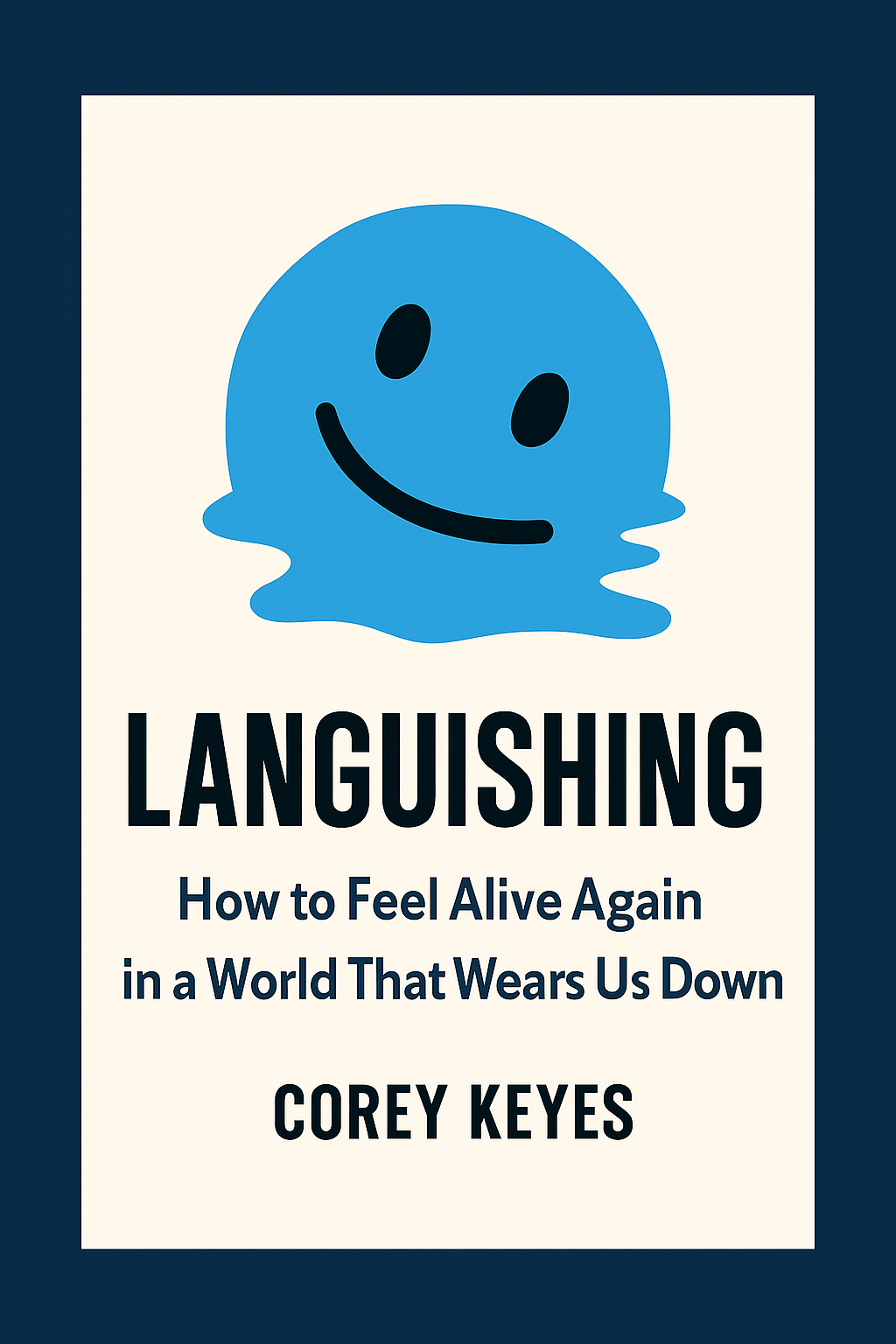
Languishing
How to Feel Alive Again in a World That Wears Us Down
Book Edition Details
Summary
In a world where the hustle never ends, many find themselves drifting in a peculiar haze—neither content nor clinically unwell, but somewhere eerily in between. This state of 'languishing'—as unveiled by renowned sociologist Corey Keyes—drains vitality and ambition, leaving lives muted and purpose elusive. Keyes masterfully unravels this modern malaise, revealing its insidious grip and the societal forces that nurture it. But there is hope. With profound insight and practical guidance, he offers a roadmap to reclaiming vibrancy and meaning. Dismiss the quick-fix allure of self-help fads; true flourishing demands embracing our authentic selves, nurturing connections, and finding joy in the everyday. This transformative guide is for anyone weary of feeling adrift, eager to rise above the gray and thrive in technicolor.
Introduction
Picture yourself going through the motions of daily life, checking off tasks and meeting obligations, yet feeling strangely empty inside. You're not depressed exactly, but you're certainly not thriving either. This peculiar state of emotional flatness affects millions of people worldwide, yet most of us lack the vocabulary to describe it. Psychologists call this condition "languishing," and it represents one of the most overlooked mental health challenges of our time. Unlike clinical depression, languishing doesn't announce itself with obvious symptoms. Instead, it quietly drains our sense of purpose, connection, and joy, leaving us functioning but not flourishing. The fascinating discovery that has emerged from decades of research is that mental health isn't simply the absence of mental illness. We can actually cultivate specific practices that move us from languishing toward genuine flourishing, regardless of our starting point. This book reveals the hidden science behind this transformation, introducing you to evidence-based strategies that can fundamentally change how you experience life. You'll discover why traditional approaches to mental health miss half the picture, learn about the five essential vitamins that nourish psychological well-being, and understand how individual flourishing can create ripple effects that transform entire communities.
Understanding Languishing: The Invisible Mental Health Crisis
Languishing feels like being stuck in psychological quicksand. You're not sinking rapidly like someone experiencing depression, but you're certainly not moving forward either. People who are languishing often describe their experience as living life through a fog, where everything feels muted and distant. They go to work, maintain relationships, and complete daily tasks, but these activities feel mechanical rather than meaningful. Unlike depression, which involves active emotional pain, languishing is characterized by the absence of positive emotions rather than the presence of negative ones. What makes languishing particularly dangerous is its invisibility. Because languishers can still function in their daily lives, their struggle often goes unrecognized by family members, colleagues, and even healthcare providers. They might attribute their feelings to stress, aging, or simply having unrealistic expectations about happiness. This lack of recognition means that millions of people accept a diminished quality of life as normal when they're actually experiencing a distinct psychological state that can be addressed. Research reveals that languishing is far more common than most diagnosed mental illnesses, affecting approximately one in six adults at any given time. More troubling is its predictive power for future mental health problems. People who are languishing today are significantly more likely to develop depression, anxiety disorders, and post-traumatic stress in the future. This makes languishing not just a current quality-of-life issue but a warning sign of potential mental health crises to come. The modern world seems almost designed to promote languishing. Social media creates constant opportunities for comparison and envy, urban living can foster isolation despite being surrounded by people, and the relentless pace of contemporary life leaves little time for the deep connections and meaningful activities that nourish our psychological well-being. Understanding languishing as a distinct condition opens up entirely new possibilities for prevention and intervention, shifting our focus from merely avoiding mental illness to actively cultivating mental wellness.
The Dual-Continua Model: Redefining Mental Wellness
For decades, mental health professionals operated under a fundamental misconception about the nature of psychological well-being. They assumed that mental health and mental illness existed on a single continuum, like a thermometer where reducing symptoms of depression or anxiety would automatically increase overall well-being. This model suggested that if you weren't mentally ill, you must be mentally healthy. Recent research has shattered this assumption, revealing that mental health actually operates on two separate but related dimensions. The dual-continua model shows that mental illness and mental wellness are distinct concepts that can coexist in surprising ways. You can have low levels of mental illness symptoms while also having low levels of mental wellness, which is precisely what defines languishing. Conversely, someone can manage a mental health condition like depression while still experiencing high levels of flourishing in other areas of their life. This explains why traditional treatments that focus solely on reducing symptoms often leave patients feeling better but not necessarily thriving. Think of this like physical health. Someone can be free from disease yet still lack physical fitness, energy, and vitality. The absence of illness doesn't automatically create the presence of robust health. Similarly, the absence of depression doesn't automatically create joy, engagement, or meaning. These positive characteristics must be actively cultivated through different practices and approaches than those used to treat mental illness. This discovery has revolutionary implications for how we approach mental health care and prevention. Instead of focusing exclusively on what's wrong with people, we can also focus on what's right with them and how to make it stronger. Research shows that people high in positive mental health characteristics are more resilient to stress, recover faster from setbacks, and are less likely to develop mental illness in the first place. By treating mental wellness as a skill that can be developed rather than simply the absence of problems, we open up entirely new pathways to psychological well-being that complement traditional therapeutic approaches.
Five Vitamins of Flourishing: Evidence-Based Practices
Just as our bodies require specific nutrients to function optimally, our psychological well-being depends on five essential practices that researchers have identified as fundamental to human flourishing. These aren't abstract concepts but concrete, measurable activities that can be cultivated through intentional effort and lifestyle choices. Think of them as vitamins for your mental health, each addressing different but interconnected aspects of what it means to thrive as a human being. The first vitamin is Learn, which involves engaging in autonomous learning that promotes personal growth and expands our sense of possibility. This isn't about formal education or acquiring skills for external validation, but rather pursuing knowledge and experiences that intrinsically interest us and help us grow. When we learn something new by choice, for our own reasons, we strengthen our sense of agency and build confidence in our ability to adapt and change. This might involve taking up painting, learning about astronomy, or exploring a subject that has always fascinated us. The Connect vitamin focuses on building warm, trusting relationships characterized by mutual support, understanding, and emotional intimacy. These connections provide a sense of belonging and mattering that is essential for human well-being. Research consistently shows that the quality of our relationships matters more than quantity, and that meaningful connections can protect us from loneliness, depression, and even physical illness. True connection goes beyond casual friendships to encompass relationships where we feel genuinely seen, valued, and supported. The Transcend vitamin involves practices that connect us to something larger than ourselves, whether through spirituality, meditation, time in nature, or experiences of awe and wonder. These practices help quiet the constant chatter of our minds, reduce ego-driven reactivity, and foster acceptance of life's inevitable challenges. The Help vitamin centers on finding and pursuing our authentic purpose through service to others and contribution to our communities. This involves identifying how our unique talents and passions can address real needs in the world around us. The Play vitamin encourages us to engage in activities purely for joy and intrinsic satisfaction, stepping outside our goal-oriented mindset to experience flow and delight. Together, these five vitamins create a comprehensive approach to mental wellness that addresses the full spectrum of human psychological needs.
Building Resilient Communities: From Individual to Collective Thriving
While personal flourishing is valuable in itself, the ultimate vision extends far beyond individual well-being to the creation of communities and societies where everyone has the opportunity to thrive. Research consistently demonstrates that flourishing is contagious, spreading through social networks like a beneficial virus. When individuals develop higher levels of well-being, it creates ripple effects that positively influence their families, workplaces, and broader communities. This social dimension of flourishing reveals why addressing languishing isn't just a personal health issue but a collective responsibility that requires systemic change. Communities that naturally support flourishing share certain key characteristics. They provide abundant opportunities for meaningful social connection, offer pathways for personal growth and contribution, and create environments where people feel valued and supported regardless of their background or circumstances. These communities understand that mental health isn't just about individual therapy or medication but about creating social conditions that naturally promote well-being. They invest in public spaces that encourage interaction, support local organizations that provide opportunities for service and engagement, and foster cultures of inclusion where everyone can find their place to belong. The workplace represents a particularly crucial arena for promoting collective flourishing. Organizations that prioritize employee well-being don't just see improvements in productivity and retention, they create cultures where people can bring their authentic selves to work and find genuine meaning in their contributions. This involves more than wellness programs or mental health benefits; it requires fundamental shifts in how work is structured, how people are treated, and what values guide organizational decision-making. When workplaces become environments that support the five vitamins of flourishing, they transform from places people endure to communities where people thrive. Building resilient communities also requires addressing systemic barriers to flourishing, including inequality, discrimination, and social isolation. These challenges can't be solved through individual effort alone but require collective action and policy changes that create more equitable opportunities for well-being. The vision is ambitious but achievable: communities where languishing becomes increasingly rare not because we've become better at treating it, but because we've created conditions where flourishing is the natural state for all members of society.
Summary
The most profound insight from this exploration of mental wellness is that flourishing represents a fundamentally different way of being in the world than simply avoiding mental illness. True well-being emerges not from the absence of problems but from the presence of meaning, connection, growth, and contribution. The dual-continua model reveals that we can actively cultivate positive mental health through specific practices, regardless of our mental health status, while the five vitamins of flourishing provide a practical roadmap for this transformation. Perhaps most importantly, we've learned that individual flourishing creates ripple effects that can transform entire communities, making mental wellness both a personal journey and a collective responsibility. As we face increasing rates of anxiety, depression, and social isolation in modern society, how might we redesign our institutions and communities to actively promote flourishing rather than simply prevent illness? What would our world look like if we measured success not just by the absence of problems but by the presence of human potential realized? These questions invite us to envision and work toward a society that doesn't just help people survive but empowers everyone to truly thrive, making this understanding of mental wellness essential for anyone seeking to create positive change in their own life and the world around them.
Related Books
Download PDF & EPUB
To save this Black List summary for later, download the free PDF and EPUB. You can print it out, or read offline at your convenience.
By Corey Keyes
