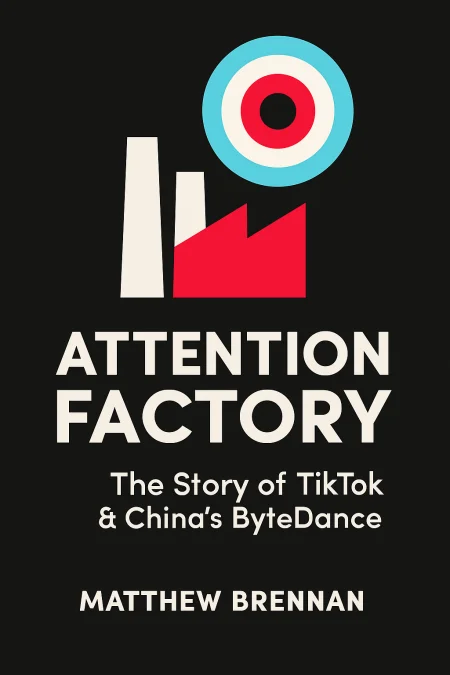
Attention Factory
The Story of TikTok and China's ByteDance
Book Edition Details
Summary
In the whirlwind digital age, where apps rise and fall with the tap of a screen, one story of technological triumph stands out: the meteoric ascent of ByteDance, the Chinese titan that gave the world TikTok. Crafted by China internet connoisseur Matthew Brennan and fine-tuned by TechCrunch's Rita Liao, "Attention Factory" peels back the curtain on this $100 billion behemoth's journey from a modest Beijing apartment to global stardom. Amidst tales of Vine and Musical.ly's demise and the magnetic Zhang Yiming's vision, this book reveals the potent alchemy of recommendation engines and growth hacking. Perfect for tech enthusiasts and business strategists alike, it's a compelling narrative of how ByteDance reshaped the global digital landscape.
Introduction
In the summer of 2018, when Mark Zuckerberg stood before his employees at Facebook headquarters, one question cut through the usual corporate optimism: "Are we concerned about TikTok's growing cultural clout among teens and Gen Z?" The CEO's measured response betrayed an uncomfortable truth—a Chinese entrepreneur named Zhang Yiming had achieved something unprecedented in Silicon Valley's backyard. Through his company ByteDance and its flagship apps, Yiming had cracked the code of global attention, creating platforms that would reshape how billions consume information and entertainment. From the converted apartments of Beijing where Yiming first sketched his vision on a napkin, to the algorithm-driven empire that would challenge Facebook's dominance, this is a story that reveals the intersection of technical brilliance and strategic audacity. Yiming's journey illuminates the transformation of China's internet landscape from copycat to innovator, while demonstrating how a quiet, methodical engineer could orchestrate one of the most dramatic disruptions in digital media history. Through his relentless focus on algorithmic recommendation and his systematic approach to global expansion, readers will discover the principles that built an attention economy worth over $100 billion and the man who dared to dream beyond China's borders.
The Algorithm Visionary: From Student to Tech Pioneer
Zhang Yiming's transformation from an unremarkable college student to one of the world's most influential entrepreneurs began with an unusual obsession: consuming information. While his peers at Nankai University played cards or watched movies, Yiming devoured newspapers, technical journals, and programming tutorials. His methodical approach to life was evident even in personal decisions—he chose his university based on four simple criteria, including proximity to the ocean and whether it snowed in winter, dismissing the conventional wisdom of prestige-focused selection. This systematic thinking would become Yiming's signature trait throughout his career. After graduation, he deliberately sought out challenging environments that would accelerate his learning curve. At travel startup Kuxun, he worked alongside what would later become known as the "Kuxun entrepreneurship gang"—a cohort that produced over thirty successful entrepreneurs. His brief stint at Microsoft taught him the limitations of bureaucratic corporate culture, while his time at the Twitter clone Fanfou introduced him to the delicate balance between social networking and information distribution. By 2011, as smartphones began transforming how Chinese consumers accessed information, Yiming recognized a fundamental shift occurring. He observed commuters transitioning from reading print newspapers to consuming content on mobile devices within months. This wasn't merely a change in technology—it represented a revolution in how information would be discovered, curated, and consumed. His experience building real estate apps at 99Fang had already demonstrated the power of automated content aggregation, but Yiming sensed a much larger opportunity emerging. The young entrepreneur's early failures and pivots built the foundation for his later success. Each venture taught him crucial lessons: the importance of technical excellence from Kuxun, the value of efficiency over process from Microsoft, and the potential of algorithmic content distribution from 99Fang. When he finally committed to founding ByteDance in 2012, Yiming brought a unique combination of technical depth, operational experience, and strategic vision that few entrepreneurs could match.
Building the Recommendation Engine: Toutiao's Revolutionary Path
The creation of Toutiao represented Yiming's boldest bet: that machine learning could revolutionize content distribution by replacing human editors with algorithmic recommendation. In an era when China's major news portals still relied on traditional editorial curation, this vision seemed almost heretical. The small ByteDance team, working from converted apartments in Beijing, faced the daunting challenge of building sophisticated recommendation technology with limited resources and expertise. Yiming's solution was characteristically systematic. Rather than attempting to develop the technology internally, he embarked on an aggressive campaign to recruit China's top algorithmic talent from search giant Baidu. The breakthrough came in 2014 when Yang Zhenyuan, Baidu's Deputy Director of Search, joined as ByteDance's VP of Technology. This hire opened the floodgates to a stream of Baidu engineers, bringing the technical firepower necessary to build a world-class recommendation engine. The team developed sophisticated systems that could analyze user behavior patterns, content characteristics, and environmental factors to create personalized feeds. The early growth strategy combined technological innovation with unconventional user acquisition tactics. ByteDance pioneered the use of smartphone pre-installation deals, spending millions to ensure Toutiao appeared on devices before they reached consumers. This grey-market approach, while controversial, provided the scale necessary to train their machine learning systems. The company's willingness to pay above-market rates for these deals shifted the entire industry's economics and established ByteDance as a major force in user acquisition. The platform's success stemmed from its ability to solve the fundamental problem of information overload in the mobile era. By analyzing billions of user interactions, Toutiao could surface relevant content from an ocean of available information. The system learned not just what users read, but how long they spent reading, whether they shared content, and what they chose to ignore. This created a virtuous cycle where increased usage led to better recommendations, which drove further engagement and attracted more content creators.
The Global Breakthrough: Musical.ly, Douyin, and TikTok's Rise
ByteDance's entry into short video represented a calculated expansion from its news aggregation success. The company's three-pronged strategy targeted different market segments: Xigua Video to compete with YouTube, Huoshan Video to challenge domestic leader Kuaishou, and A.me (later Douyin) to adapt the Musical.ly format for Chinese users. Initially considered the least promising of the three, the Musical.ly clone struggled through a lengthy cold start period with minimal user engagement and internal skepticism about its viability. The transformation of A.me into Douyin required both strategic repositioning and technological breakthrough. The team, led by Kelly Zhang, systematically cultivated a community of young, fashionable content creators from art colleges across China. This carefully curated seed group established the platform's aspirational tone, attracting urban youth who saw Douyin as a trendy alternative to existing platforms. The app's distinctive black interface and glitchy logo design reinforced its positioning as cutting-edge and creative. The decisive moment came when ByteDance integrated its powerful recommendation engine into Douyin's backend systems. Zhu Wenjia, one of the company's top algorithmic experts, led the technical transformation that would prove transformational. During China's Golden Week holiday in October 2017, daily users doubled as the improved recommendation system dramatically enhanced content discovery and user retention. The same technology that had made Toutiao successful in news aggregation proved even more powerful when applied to short video content. Douyin's success validated ByteDance's core thesis about algorithmic content distribution. Unlike social platforms that relied on following relationships, Douyin could surface engaging content from unknown creators and match it with receptive audiences. A farmer in rural China could create a video that would be seen by millions if the content resonated with viewers. This democratization of attention created powerful network effects, as more creators produced content and more users spent time on the platform, continuously improving the recommendation engine's accuracy.
Conquering the World: TikTok's International Dominance
ByteDance's global expansion strategy centered on replicating Douyin's success while adapting to local markets and regulatory environments. TikTok launched in challenging markets like Japan, where few Chinese internet services had succeeded, proving that the short video format could transcend cultural boundaries. The approach balanced standardized core technology—the recommendation engine, user interface, and basic features—with localized content pools and marketing strategies tailored to each region. The $800 million acquisition of Musical.ly in 2017 provided ByteDance with immediate access to Western markets and eliminated a potential competitor. However, the real breakthrough came when ByteDance merged Musical.ly into TikTok, replacing the platform's basic recommendation system with Douyin's sophisticated algorithmic backend. This technical upgrade doubled user engagement time and unlocked TikTok's true potential as a content discovery platform rather than just a social network. TikTok's explosive growth in Western markets was fueled by an unprecedented advertising blitz, with ByteDance reportedly spending over $1 billion in 2018 alone on user acquisition. The company's willingness to pay Facebook and Google billions in advertising fees, while simultaneously building a platform to compete with them, demonstrated Yiming's long-term strategic thinking. This aggressive investment created a winner-take-all dynamic in short video, establishing TikTok's dominance before established players could respond effectively. The platform's success rested on multiple defensive moats: superior recommendation technology, a rich creator ecosystem, powerful brand recognition, and continuous innovation in video editing tools and AR filters. By the time competitors like Facebook's Lasso or Instagram's Reels launched, TikTok had already achieved critical mass in content variety and user engagement. The app's ability to make unknown creators famous overnight, demonstrated by viral sensations like Lil Nas X's "Old Town Road," proved that TikTok offered unique value that established platforms couldn't easily replicate.
Summary
Zhang Yiming's greatest achievement lies not in building individual successful products, but in proving that algorithmic recommendation could become the dominant paradigm for content distribution in the mobile internet age. His systematic approach to identifying talent, solving technical challenges, and scaling globally transformed ByteDance from a small Beijing startup into a company that rivals Facebook and Google in reach and influence. Through TikTok's unprecedented success, Yiming demonstrated that Chinese internet companies could move beyond copying Western models to create genuinely innovative platforms with worldwide appeal. The principles underlying Yiming's success—patient capital allocation, relentless focus on data-driven decision making, and willingness to invest heavily in promising opportunities—offer valuable lessons for entrepreneurs and business leaders. His story illustrates how technical excellence combined with strategic audacity can disrupt established industries, even when competing against much larger and better-resourced incumbents. For anyone seeking to understand the future of digital media, artificial intelligence applications, or global technology competition, Yiming's journey from algorithm obsessive to architect of the attention economy provides essential insights into how the next generation of internet platforms will be built.
Related Books
Download PDF & EPUB
To save this Black List summary for later, download the free PDF and EPUB. You can print it out, or read offline at your convenience.
By Matthew Brennan
