
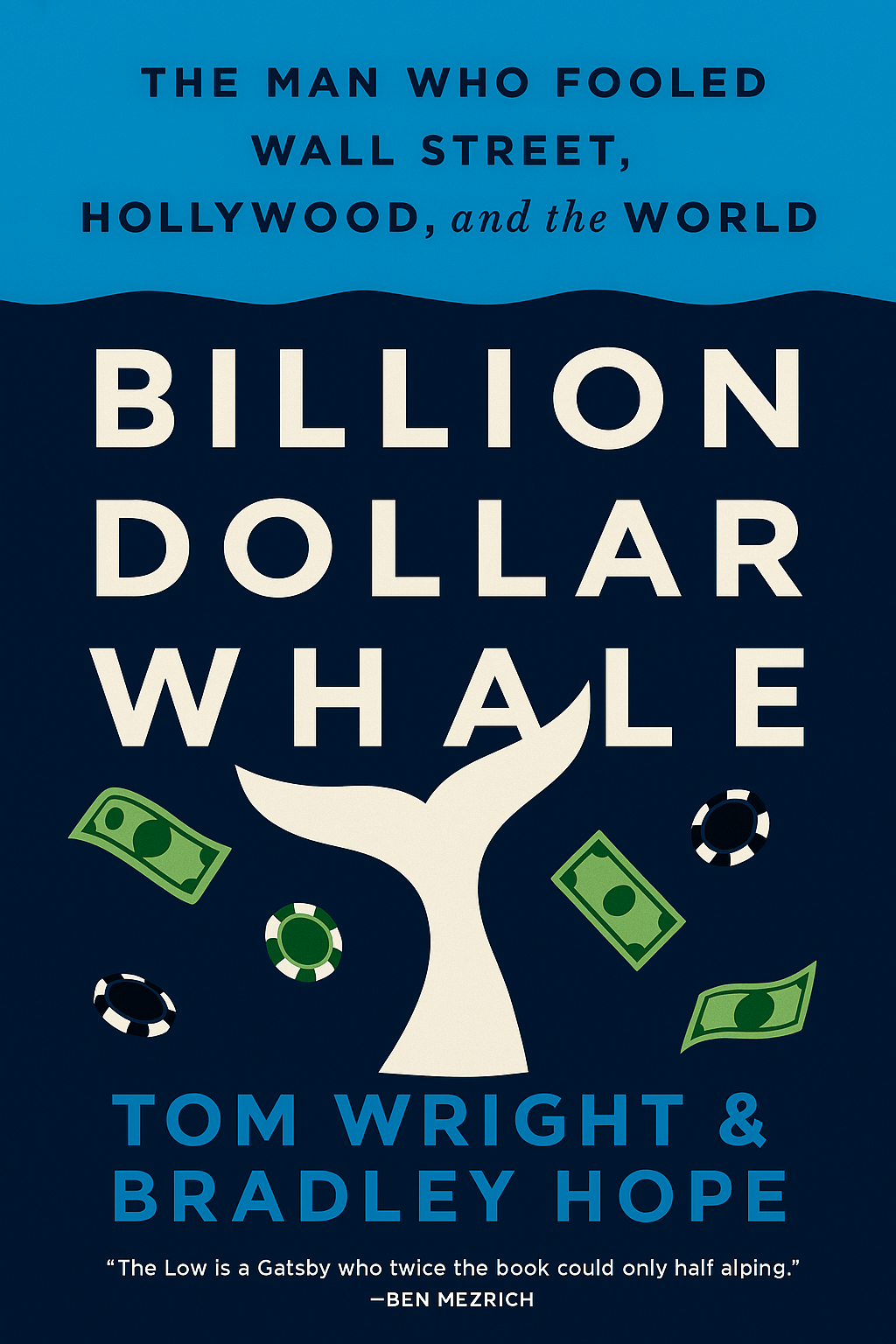
Billion Dollar Whale
The Man Who Fooled Wall Street, Hollywood, and the World
Book Edition Details
Summary
In the glittering corridors of global finance, where power mingles with prestige, emerges a tale of audacity that defies belief. "Billion Dollar Whale" unravels the jaw-dropping saga of Jho Low, a Wharton-educated mastermind who orchestrated a colossal financial deception, leaving the world's elite and watchdogs baffled. Crafted by two master investigative journalists, this gripping narrative plunges readers into the shadowy underbelly where wealth, Hollywood glamour, and political intrigue intersect. As the dust from the 2009 financial crisis settled, Low's cunning manipulation of a national fund set a new benchmark for audacious fraud. This account not only exposes the mechanics of his elaborate scheme but also poses a chilling reflection on modern capitalism's vulnerabilities—a riveting read that will haunt the corridors of power for years to come.
Introduction
What happens when a young man with modest means discovers he can fool the world's most sophisticated financial institutions using nothing more than charm, audacity, and an understanding of human psychology? In our interconnected global economy, where trillions of dollars flow across borders daily and prestige often matters more than substance, one individual managed to orchestrate the largest financial heist in modern history while dining with world leaders and partying with Hollywood celebrities. This extraordinary true story exposes the shocking vulnerabilities in our financial system and reveals how corruption spreads like a virus through the highest levels of government, banking, and entertainment. Through meticulous investigation into leaked documents and insider testimonies, you'll discover the specific tactics used to manipulate prestigious institutions and understand how modern money laundering operates on an unprecedented scale. You'll learn to recognize the warning signs of sophisticated financial fraud and understand why transparency and accountability matter more than ever in our globalized world. Most importantly, you'll see how the pursuit of easy profits can blind even the most experienced professionals to obvious red flags, making vigilance essential for anyone navigating today's complex financial landscape.
The Art of Elite Deception: Building Credibility Through Borrowed Status
In 1999, seventeen-year-old Jho Low carefully removed family photographs from their frames aboard a luxury yacht docked in Penang, Malaysia. He replaced them with pictures of his own modest middle-class family, creating an elaborate fiction for his wealthy Harrow School classmates who were visiting for summer vacation. When his friends arrived, Low presented himself as a "prince of Malaysia," gesturing proudly at what appeared to be his family's opulent yacht and hilltop mansion overlooking the South China Sea. This wasn't mere teenage bragging. Low had borrowed these symbols of wealth from a family friend, a genuine billionaire who had taken pity on the ambitious young man. As his Harrow friends toured the yacht's marble-appointed interior and posed for photos against the backdrop of the sprawling estate, none suspected they were participating in an elaborate deception. Low's performance was so convincing that his classmates returned to school spreading stories about their Malaysian royal friend, establishing a reputation that would follow him to the University of Pennsylvania's Wharton School. The yacht incident reveals the psychological blueprint that would later enable Low to steal billions from Malaysia's sovereign wealth fund. From an early age, he understood that perception creates reality, especially among the wealthy elite who rarely question the credentials of those who appear to belong to their exclusive circles. His willingness to construct elaborate fictions, combined with his keen observation of how power and status actually operate in elite social networks, gave him a crucial advantage over more honest but naive individuals. This early experiment taught Low that wealthy people want to believe in exclusive circles and royal connections. They're often too polite or too impressed to ask probing questions when someone appears to have the right background, education, and access to luxury. By studying their behavior and psychology, Low learned to exploit the very courtesy and assumptions that bind elite social networks together, understanding that borrowed credibility could be just as powerful as the genuine article. The lesson here is profound and unsettling: in a world obsessed with status and connections, the most dangerous fraudsters are often those who understand social dynamics better than their victims understand themselves, making skepticism and verification essential even in the most prestigious circles.
How Prestigious Institutions Enable Massive Fraud for Profit
When Tim Leissner, Goldman Sachs' star Asia banker, first met Jho Low in 2009, he dismissed the young Malaysian as "dodgy" and warned colleagues to be cautious. Yet within three years, Leissner was traveling the world with Low on private jets, helping him orchestrate bond deals that would generate nearly $600 million in profits for Goldman Sachs while draining billions from Malaysia's sovereign wealth fund, 1MDB. The transformation from skepticism to complicity reveals how institutional greed can override professional judgment when enormous profits are at stake. The seduction began when Low convinced Malaysia's new Prime Minister Najib Razak to create 1MDB as a development fund that would attract Middle Eastern investment and transform Malaysia into a regional financial hub. Low positioned himself as the unofficial advisor who could deliver Arab money and international credibility to Malaysia's ambitious plans. When Leissner saw the potential for massive fees from bond issuances worth billions, his ethical concerns evaporated like morning mist. Goldman's internal risk committees raised red flags about Low's undefined role and the unusual structure of the deals, but senior executives like President Gary Cohn overruled them, seduced by the enormous profits. The mechanics were breathtakingly simple yet devastatingly effective. Goldman would buy entire bond issues from 1MDB at steep discounts, then immediately resell them to investors at higher prices, pocketing the difference. Instead of the typical $1 million fee for such work, Goldman charged over $200 million for a single deal. The bank justified these outrageous profits by claiming they were taking on significant risk, but they had already lined up eager buyers before purchasing the bonds, making the transactions virtually risk-free. Meanwhile, Low and his conspirators systematically diverted over $1.4 billion from these bond proceeds into shell companies designed to look like legitimate Abu Dhabi investment funds. The money then flowed through a labyrinth of offshore accounts, financing everything from Low's Hollywood investments to Prime Minister Najib's personal campaign expenses, while Malaysian taxpayers remained responsible for repaying the debt. This case demonstrates how institutional prestige can become a weapon in the hands of sophisticated criminals. When banks prioritize short-term profits over due diligence, they become unwitting accomplices to massive fraud, lending their credibility to schemes that would otherwise collapse under scrutiny.
The Hollywood Connection: Using Celebrity Culture to Launder Billions
Leonardo DiCaprio thought he had found the perfect financiers when he met Jho Low and his associates at Red Granite Pictures in 2012. Here were mysterious Asian investors with seemingly unlimited funds and no creative interference, offering him and director Martin Scorsese complete artistic freedom to make "The Wolf of Wall Street" after Warner Bros. had pulled funding. What DiCaprio didn't know was that his dream project about financial fraud was being financed with money stolen from the Malaysian people, creating an irony so perfect it seemed scripted. The Hollywood seduction began with Low's legendary parties, where he would spend millions in a single night, flying in A-list celebrities on private jets and showering them with expensive gifts. At one memorable Saint-Tropez celebration, Low spent 2 million euros on champagne alone, creating a spectacle that had paparazzi and celebrities talking for months. These weren't just parties but carefully orchestrated networking events designed to build relationships with the entertainment industry's most powerful figures, transforming Low from an unknown Malaysian financier into a globally recognized player. Low understood that Hollywood runs on relationships and access to capital, and he exploited both with surgical precision. By positioning himself as a billionaire party host who could deliver unique experiences and unlimited funding, he gained credibility with stars who were accustomed to being courted by wealthy investors. When Red Granite offered to finance "The Wolf of Wall Street" with a $100 million budget, Scorsese and DiCaprio saw it as a miracle that would allow them to create their vision without studio interference. The film's funding came directly from the 1MDB bonds, laundered through a complex web of shell companies that made the money appear legitimate by the time it reached Hollywood. Low even attended the film's wrap party, celebrating alongside the actors who had unknowingly helped legitimize his stolen fortune. For DiCaprio, the relationship seemed ideal: he got his passion project funded, gained access to Low's exclusive social circle, and received expensive artwork as gifts, including a Picasso worth millions. This reveals how easily the entertainment industry can be manipulated by those with ready cash and few questions asked. When creative professionals are offered unlimited budgets and artistic freedom, they rarely investigate the source of funding, making celebrity culture an ideal vehicle for laundering stolen money and gaining social credibility.
When Governments Become Criminal Enterprises: The Ultimate Betrayal
By 2015, Jho Low's empire was crumbling under the weight of mounting investigations, but he refused to accept reality, responding to exposure with even more audacious displays of wealth. When Malaysian journalist Clare Rewcastle-Brown began publishing leaked documents proving the 1MDB fraud on her Sarawak Report website, Low's reaction was to throw increasingly extravagant parties, as if sheer audacity could overcome mounting evidence. His final birthday celebration in Las Vegas, featuring Britney Spears emerging from a giant cake, cost millions and attracted global media attention—exactly the opposite of what a fugitive fraudster should want. The unraveling began when Xavier Justo, a disgruntled PetroSaudi executive, leaked 140 gigabytes of internal documents that revealed the intricate details of how Low and his conspirators had systematically stolen billions. These emails contained damning conversations where they discussed covering up massive losses and complained about delays caused by Low's excessive partying and shopping sprees. The evidence was so overwhelming that even Malaysia's compliant state media couldn't ignore it, forcing Prime Minister Najib to make increasingly desperate public denials. As investigations launched simultaneously in the United States, Switzerland, and Singapore, Low's behavior became increasingly erratic and self-destructive. Instead of fleeing quietly to a non-extradition country, he continued hosting parties and making public appearances, seemingly convinced that his network of powerful friends would protect him indefinitely. He had spent years cultivating relationships with everyone from Goldman Sachs executives to Hollywood stars to Middle Eastern royalty, believing these connections made him untouchable by law enforcement. The final blow came when the U.S. Department of Justice filed civil forfeiture cases seeking to recover over $1 billion in assets purchased with stolen 1MDB funds. The court filings read like a catalog of Low's excesses: the Time Warner penthouse overlooking Central Park, the Beverly Hills mansion, Monet and Picasso paintings, a superyacht, and even the rights to "The Wolf of Wall Street" itself. Prime Minister Najib, Low's primary protector and co-conspirator, was eventually voted out of office in a stunning electoral upset and arrested on corruption charges. Low's downfall illustrates a crucial truth about large-scale fraud: the very ambition and ego that enable such schemes often ensure their destruction, as the need for recognition and status makes it impossible to remain hidden when survival demands invisibility.
Summary
The greatest financial heists succeed not through sophisticated technology or complex financial instruments, but by exploiting the fundamental weaknesses in human nature and institutional culture that make our global financial system vulnerable to manipulation by those who understand how greed, status, and social dynamics actually operate. Always demand transparency about funding sources, especially when deals seem too good to be true or come with unusual secrecy requirements, and remember that legitimate wealth-building rarely requires offshore shell companies or resistance to regulatory oversight. Recognize that institutional prestige doesn't guarantee ethical behavior, as some of the world's most respected banks and companies can become complicit in fraud when profits are large enough to override professional judgment. Understand that in our interconnected global economy, corruption in one country can quickly spread to others through the international financial system, making vigilance and accountability everyone's responsibility, not just regulators and law enforcement agencies.
Related Books
Download PDF & EPUB
To save this Black List summary for later, download the free PDF and EPUB. You can print it out, or read offline at your convenience.
By Tom Wright
