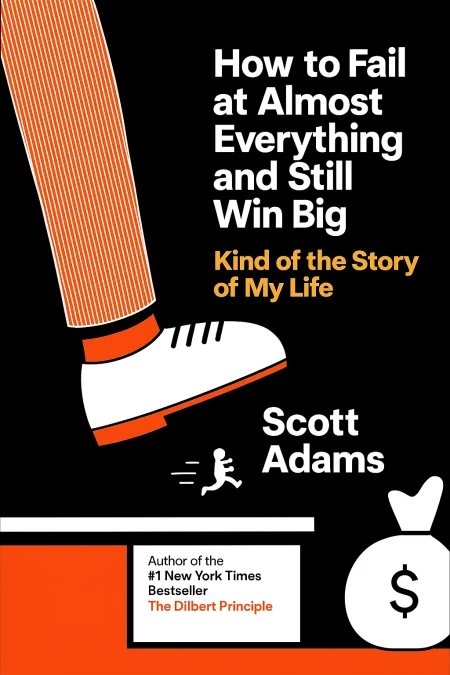
How to Fail at Almost Everything and Still Win Big
Kind of the Story of My Life
Book Edition Details
Summary
In a world where flops become fortune, Scott Adams stands as the unlikely champion of failure's potential. "How to Fail at Almost Everything and Still Win Big" is a masterclass in turning life's missteps into stepping stones for success. As the brilliant mind behind the iconic Dilbert comic strip, Adams shares his unconventional wisdom gleaned from a lifetime of spectacular misfires—from corporate misadventures to entrepreneurial flops. His philosophy is both irreverent and insightful: embrace the chaos, sidestep the illusion of passion, and harness your quirky mix of skills to stack the odds in your favor. With humor as his sidekick, Adams dismantles traditional success narratives, offering readers a candid roadmap to thriving amidst the rubble of defeat. Here, failure isn't the end—it's the beginning of a game-changing strategy.
Introduction
Scott Adams stands as one of the most unconventional success stories of our time, a man who transformed spectacular failures into extraordinary triumph. The creator of Dilbert, one of the world's most popular comic strips, Adams began his journey as a seemingly doomed corporate employee, stumbling through a series of professional disasters that would have crushed lesser spirits. Yet from each setback emerged invaluable lessons that would eventually propel him to remarkable heights of achievement and wealth. What makes Adams particularly compelling is not just his material success, but his refreshingly honest approach to understanding how success actually works. Unlike most motivational speakers who peddle simple formulas, Adams dissects the messy reality of achievement with the precision of a scientist and the humor of a seasoned comedian. His path was neither straight nor predictable, marked by voice problems that nearly silenced him, business ventures that spectacularly imploded, and moments of profound self-doubt. Through Adams' remarkable story, we discover how systematic thinking can triumph over goal-oriented approaches, how managing personal energy becomes the foundation for all other achievements, and how embracing failure as a learning tool transforms setbacks into stepping stones. His journey reveals that success is less about talent or luck than most people imagine, and more about creating the right systems and maintaining the right mindset to capture opportunities when they arise.
From Corporate Failures to Cartooning Dreams
Adams' corporate career reads like a masterclass in professional mediocrity, yet it became the unexpected foundation for his later success. Working first at Crocker National Bank and later at Pacific Bell, he demonstrated a remarkable talent for failing upward, consistently being promoted despite what he freely admits was spectacular incompetence. His inability to handle the details of a bank teller position nearly cost him his first job, yet he managed to talk his way into the management training program through sheer audacity and humor. The corporate world of the 1980s provided Adams with an invaluable education in the absurdities of modern business life. He witnessed firsthand the dysfunction, politics, and pointless bureaucracy that would later become the rich material for Dilbert. His experiences ranged from budget management to computer programming, from lending to project management, each role adding layers to his understanding of how organizations actually function versus how they claim to function. What transformed these failures into future success was Adams' systematic approach to learning. Rather than becoming bitter about his corporate struggles, he treated each experience as data collection for his eventual creative work. He observed the patterns of office behavior, catalogued the ridiculous dynamics between managers and employees, and began to see the universal truths that would make Dilbert resonate with millions of office workers worldwide. The turning point came when Adams realized that his diverse corporate failures had given him something unique: a comprehensive understanding of workplace dynamics from multiple perspectives. This wasn't just career frustration; it was research material for what would become one of the most successful comic strips in history. His corporate failures weren't obstacles to overcome but resources to be mined for creative gold.
Building Systems Over Goals for Success
Adams fundamentally challenges the conventional wisdom about goal setting, arguing instead for what he calls systems thinking. While most people chase specific objectives, Adams discovered that creating reliable systems produces far better long-term results than pursuing individual goals. Goals, he observed, put you in a state of continuous pre-success failure, where you're constantly falling short of your target until that brief moment of achievement, followed quickly by the emptiness of having nothing left to pursue. Systems, by contrast, create ongoing success regardless of specific outcomes. When Adams decided to become a cartoonist, he didn't set a goal to get syndicated by a certain date. Instead, he built a system of drawing every morning before work, continuously improving his craft, and persistently submitting his work. Every day he followed his system was a successful day, regardless of whether he received acceptances or rejections. This systems approach extended throughout his career development. At Pacific Bell, Adams systematically acquired new skills whenever the company would pay for training. He learned public speaking, business writing, technology concepts, and dozens of other capabilities not because he had specific plans for them, but because his system was to become more valuable by constantly expanding his skill set. This approach meant that when opportunities arose, he was prepared to capitalize on them. The power of systems thinking becomes clear when examining Adams' approach to his health crisis with spasmodic dysphonia. Rather than setting a goal to be cured, he created a systematic approach to researching every possible treatment, tracking his symptoms, and maintaining his optimism through structured daily affirmations. The system kept him functional and forward-moving even when individual treatments failed, ultimately leading him to the experimental surgery that restored his voice.
Overcoming Spasmodic Dysphonia Through Determination
Perhaps no challenge tested Adams' systematic approach to life more severely than losing his voice to spasmodic dysphonia, a rare neurological condition that made normal conversation nearly impossible. For almost four years, Adams could barely speak to other humans, though he could still talk to his cat and recite memorized passages. This bizarre limitation turned him into what he described as a ghost in crowded rooms, able to observe life but unable to fully participate in it. The medical establishment offered little hope, with doctors suggesting everything from Botox injections to psychiatric medication. When traditional treatments failed, Adams applied his systematic approach to the problem, creating spreadsheets to track potential triggers, using Google alerts to monitor any mention of his condition worldwide, and maintaining detailed records of his symptoms. He refused to accept the medical consensus that the condition was incurable, instead treating it as a problem to be systematically solved. The breakthrough came through Adams' methodical research system. A Google alert led him to reports of experimental surgery in Japan, which connected him to Dr. Gerald Berke at UCLA, who was pioneering a revolutionary nerve-rerouting procedure. The surgery involved severing the connections between brain and vocal cords, then rebuilding them using nerves from elsewhere in the neck. It was risky, unproven, and required months of recovery during which Adams would be completely unable to speak. Adams' decision to undergo this experimental surgery exemplifies his approach to extreme challenges. Rather than hoping for the best or accepting defeat, he gathered data, assessed probabilities, and made a calculated bet on a long-shot solution. The surgery succeeded spectacularly, not only restoring his ability to speak but actually giving him a stronger, more projectable voice than he had ever possessed. His systematic approach to an "incurable" problem had accomplished what medical experts thought impossible.
Life Lessons on Energy, Luck and Personal Systems
Adams' most profound insight centers on the management of personal energy as the master key to all other achievements. Unlike most success literature that focuses on time management or goal achievement, Adams recognized that energy management underlies everything else. When your energy is optimized through proper diet, exercise, adequate sleep, and engaging work, every other aspect of life becomes easier. Conversely, when energy is depleted, even simple tasks become overwhelming. This energy-first approach revolutionized Adams' daily routine. He learned to match his energy levels to appropriate tasks, doing creative work when his mind was sharpest and handling routine tasks when his energy was lower. He discovered that certain foods energized him while others made him sluggish, that regular exercise was non-negotiable for maintaining mental clarity, and that having control over his schedule was crucial for managing his energy effectively throughout the day. Adams also developed a sophisticated understanding of luck that goes far beyond random chance. While acknowledging that genetics, timing, and circumstances all play crucial roles in success, he learned to position himself where luck was more likely to find him. This involved continuously developing new skills, maintaining a high volume of different projects, and staying in various games long enough for probability to work in his favor. The combination of optimized personal energy and strategic positioning created what Adams calls a "luck magnet" effect. When opportunities arose, he had the energy to pursue them effectively and the diverse skill set to capitalize on them. His systems approach meant he was always ready for unexpected possibilities, turning apparent failures into stepping stones toward eventual success. This methodology transformed a series of mediocre corporate years into the foundation for extraordinary creative and financial achievement, proving that systematic thinking can indeed overcome the apparent randomness of life.
Summary
Scott Adams demonstrates that success is less about exceptional talent or favorable circumstances than about creating effective systems and maintaining the energy to execute them consistently. His journey from failed corporate employee to internationally successful cartoonist illustrates how systematic thinking can transform even spectacular failures into valuable resources for future achievement. The most practical lesson from Adams' experience is the power of treating life challenges as engineering problems to be systematically solved rather than obstacles to overcome through willpower alone. By focusing on energy management, skill acquisition, and creating multiple opportunities for luck to find him, Adams built a sustainable approach to success that could weather failures and capitalize on unexpected opportunities. His story offers a refreshing alternative to conventional achievement wisdom, suggesting that the right systems and sufficient persistence can overcome almost any apparent limitation or setback.
Related Books
Download PDF & EPUB
To save this Black List summary for later, download the free PDF and EPUB. You can print it out, or read offline at your convenience.
By Scott Adams
