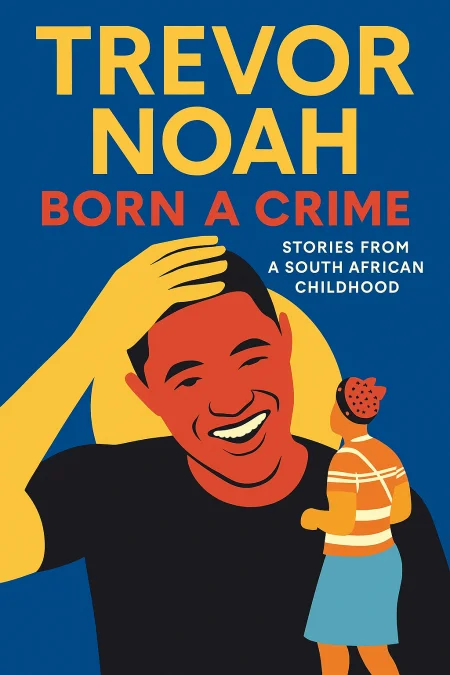
Born a Crime
Stories from a South African Childhood
Book Edition Details
Summary
In the shadow of apartheid's brutal legacy, Trevor Noah's life began with an act considered illicit—his very birth. Born to a white Swiss father and a black Xhosa mother in a divided South Africa, Trevor's existence was a defiance of unjust laws. His mother, a woman of fierce spirit and unyielding faith, shielded him from the regime's oppressive gaze, crafting a childhood of cloaked adventures and hidden truths. As apartheid crumbled, mother and son stepped into the chaotic promise of freedom, navigating a world of newfound possibilities and persistent dangers. "Born a Crime" is a captivating tale of resilience, humor, and the complex dance between a fearless mother and her mischievous son, set against the backdrop of a country in the throes of transformation.
Introduction
In the heart of apartheid South Africa, where racial mixing was not just taboo but criminal, a child was born who would embody the very contradictions of his divided nation. Trevor Noah entered the world in 1984 as living proof of a forbidden relationship—his existence itself a violation of the laws that governed his homeland. His mixed-race heritage made him an outsider in every community: too light for black spaces, too dark for white ones, and perpetually navigating the complex terrain of colored identity in a society built on racial separation. Noah's story unfolds against the backdrop of one of history's most systematized forms of oppression, yet it pulses with humor, resilience, and the unbreakable bond between a determined mother and her son. Through his eyes, we witness the absurdities and tragedies of apartheid, the challenges of growing up between worlds, and the transformative power of education and comedy. His journey reveals how identity is forged not by the categories society imposes, but by the choices we make and the love that surrounds us. Readers will discover the profound ways that language becomes both shield and sword, how humor can be a survival mechanism, and why the courage to remain authentic in the face of systemic oppression becomes its own form of revolution.
Growing Up Mixed in Apartheid South Africa
Trevor Noah's childhood was defined by the fundamental illegality of his existence. Born to a black Xhosa mother and a white Swiss-German father in 1984, he was literally "born a crime" under apartheid's racial classification laws. His parents' relationship was punishable by five years in prison, making every family moment a carefully orchestrated act of resistance. His mother, Patricia, had to navigate an elaborate system of deception just to move through the world with her son—sometimes pretending he belonged to a colored woman walking nearby, other times dropping his hand and denying their relationship when police appeared. The young Trevor learned early that survival meant becoming a chameleon. In Soweto, where he stayed with his grandmother, he had to remain hidden indoors to avoid detection by informants who might report a light-skinned child in a black township. When visiting his father's neighborhood in Hillbrow, he experienced a different kind of invisibility—the privilege of moving freely in white spaces while his mother faced constant scrutiny. These early experiences taught him that identity was not fixed but fluid, something that could be performed and adapted based on circumstances. Language became his most powerful tool for navigation. Growing up trilingual in English, Xhosa, and Afrikaans, with smattering of other African languages, Trevor discovered that speaking someone's language was like holding a key to their world. He could code-switch not just between languages but between identities, finding acceptance in different communities by reflecting their own speech patterns and cultural markers back to them. This linguistic agility would later become central to his comedy career, but in childhood, it was simply a matter of survival. The complexity of his racial identity was matched by the complexity of his family structure. His relationship with his father remained necessarily distant—stolen Sunday afternoons of German food and Formula 1 racing, always constrained by the need for secrecy. Meanwhile, his mother's fierce independence and unwavering faith shaped his worldview, even as she made increasingly dangerous sacrifices to give him opportunities that apartheid had denied to previous generations.
From Alexandra Township to Comedy Stages
Noah's transition from adolescence to young adulthood coincided with South Africa's democratic transformation, but the end of apartheid didn't immediately solve the puzzle of his identity. At Sandringham High School, a diverse post-apartheid institution, he found himself still searching for belonging among the various racial and economic groups that clustered together. His solution was entrepreneurial: he became the school's unofficial food procurement specialist, running between the cafeteria and hungry classmates who were willing to pay him to navigate the lunch lines. This early business venture revealed Noah's innate understanding of market dynamics and social psychology. He wasn't the coolest kid or the most athletic, but he identified a need and filled it efficiently. His success came not from fitting into existing social hierarchies but from creating his own niche that served everyone. This pattern would repeat throughout his young adult years, as he learned to find opportunity in the spaces between established categories. After high school, unable to afford university, Noah found himself drawn to Alexandra Township, where his friend Sizwe lived. In "Alex," he discovered a vibrant informal economy built on hustle and mutual aid. He and his crew sold pirated CDs, provided short-term loans, and facilitated complex barter arrangements that kept the community's underground economy flowing. These weren't traditional criminal enterprises but rather creative responses to economic exclusion—ways for young people with few formal opportunities to create value and support themselves. It was also in Alexandra that Noah began DJ'ing at street parties, using his computer skills to create seamless music mixes that could keep crowds dancing all night. His technical abilities, combined with his understanding of diverse musical tastes across racial lines, made him a sought-after DJ. These gigs taught him how to read audiences, how to build energy, and how to recover when something went wrong—skills that would prove invaluable when he eventually moved from controlling dance floors to commanding comedy stages.
Family Trauma and Finding His Voice
The most harrowing chapter of Noah's story centers on his relationship with his stepfather Abel, a charming mechanic whose alcoholism gradually revealed a capacity for devastating violence. Abel's abuse of Noah's mother Patricia escalated over years, creating a household atmosphere of unpredictable terror punctuated by periods of apparent normalcy. Noah watched helplessly as his mother endured physical violence while maintaining her dignity and protecting her children, all while receiving no meaningful support from police who viewed domestic violence as a "family matter." The culmination came when Noah was in his early twenties and Abel shot Patricia twice—once in the buttocks and once in the head—in front of her young sons. Miraculously, she survived, but the incident crystallized for Noah both the depths of human cruelty and the extraordinary resilience of the human spirit. His mother's recovery was swift and complete, and her ability to find humor even in the aftermath of attempted murder demonstrated the philosophical approach to adversity that she had instilled in her son. This trauma taught Noah profound lessons about powerlessness and agency. Throughout the years of escalating abuse, he had felt helpless to protect his mother, constrained by his youth, his physical limitations compared to Abel, and the broader social systems that failed to intervene. Yet he also witnessed his mother's refusal to be broken by circumstances beyond her control. Her faith, her humor, and her determination to continue building a better future for her children showed him that survival could be an act of defiance. The experience also deepened his understanding of how systemic oppression operates through intimate relationships. Abel's violence wasn't disconnected from the broader social context that had denied him opportunities, destroyed his self-worth, and provided him with models of masculinity based on domination rather than partnership. This recognition would later inform Noah's comedy, which frequently explores how historical trauma manifests in contemporary social dynamics, particularly around race, gender, and power.
Breaking Free and Building a Career
Noah's eventual escape from the cycle of township life required both opportunity and audacity. His technical skills with computers and sound equipment, combined with his multilingual abilities and deep understanding of South African cultural dynamics, positioned him uniquely as the country's media landscape began to diversify in the post-apartheid era. He parlayed his DJ'ing experience into radio work, where his ability to connect with audiences across racial lines made him valuable to stations trying to build truly national audiences. His breakthrough came through persistence and the willingness to take risks that more established entertainers might have avoided. Stand-up comedy in South Africa was a nascent field with few role models, especially for performers who wanted to address racial themes with both honesty and humor. Noah developed a comedic voice that was observational rather than confrontational, finding absurdity in the everyday experiences of navigating post-apartheid society while avoiding the political preaching that might have limited his appeal. The key to his success was his ability to make audiences laugh at shared experiences while gently challenging their assumptions. His mixed-race background, which had been a source of isolation and confusion throughout his childhood, became a comedic asset that allowed him to offer insights into multiple communities without being constrained by any single group's expectations. He could joke about black culture without being accused of self-hatred, and critique white behavior without being dismissed as an outsider. As his career progressed from local radio to national television to international recognition, Noah maintained the survival skills he had learned in childhood: adaptability, linguistic dexterity, and the ability to find humor in difficult circumstances. His success represented not just personal achievement but a vindication of his mother's sacrifice and faith. By transforming his outsider status from liability to asset, he proved that the very characteristics that had made him illegitimate under apartheid could become sources of strength and connection in a more open world.
Summary
Trevor Noah's remarkable journey from "born a crime" to international comedic success illustrates the transformative power of resilience, adaptability, and the refusal to be defined by circumstances beyond one's control. His story demonstrates that identity is not a fixed category imposed by society but a dynamic creation shaped by our responses to challenge and our willingness to find connection across difference. Through humor, language, and an unwavering commitment to authenticity, Noah transformed the very characteristics that made him an outsider under apartheid into the foundation for a career built on bringing people together through shared laughter and recognition of common humanity. His experience offers profound insights for anyone navigating questions of belonging, identity, and purpose. The lesson is not that suffering ennobles or that hardship automatically creates wisdom, but rather that how we choose to respond to difficulty determines whether our experiences become sources of bitterness or connection. Noah's ability to find humor in trauma, to see opportunity in exclusion, and to build bridges across the very divisions that were meant to separate him suggests that our greatest challenges often contain the seeds of our most meaningful contributions. His story speaks especially to those who feel caught between worlds, offering proof that the margins can be places of unique insight and that our perceived weaknesses might actually be our greatest strengths waiting to be discovered.
Related Books
Download PDF & EPUB
To save this Black List summary for later, download the free PDF and EPUB. You can print it out, or read offline at your convenience.
By Trevor Noah
