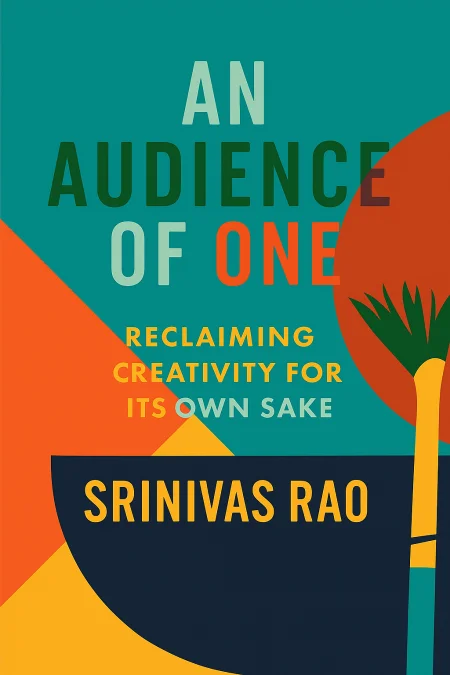
An Audience of One
Reclaiming Creativity for Its Own Sake
Book Edition Details
Summary
In a world saturated with voices clamoring for approval, Srini Rao offers a radical shift: create for yourself, not the masses. "An Audience of One" challenges the status quo by urging creatives to follow their own muse, igniting joy and fostering genuine productivity. Rao draws from his own journey and the fascinating stories of trailblazers like Oprah, who defied conventional wisdom to find unparalleled success. This book is a treasure trove of insights, blending captivating narratives with actionable advice from creativity experts. It dares you to abandon the chase for external validation and embrace the liberating power of personal satisfaction. By prioritizing your own creative fulfillment, Rao promises not only a more joyous creative process but also an unexpected expansion of your audience. Unleash your true creative potential and transform your life from within.
Introduction
Picture this: A young teen duo from France starts making music in their bedrooms. Despite achieving worldwide recognition, you'd never recognize either member of Daft Punk if you saw them on the street. They wear robot masks during performances, deliberately making themselves more anonymous as their popularity grows. When they were paid over $300,000 for a Coachella performance, nearly all the money went back into the spectacle itself. Their philosophy is simple: "You don't need to be on the covers of magazines with your face to make good music." This story captures something profound about the creative process that we've lost in our age of social media metrics and viral fame. We live in a time when every creative pursuit seems to require an audience, validation, and measurable success. Yet the most fulfilling and authentic creative work often emerges when we create solely for ourselves, for an audience of one. The pressure to monetize every hobby, to build a platform around every passion, has transformed creativity from a source of joy into another form of performance anxiety. We've forgotten that the act of creation itself can be its own reward. This exploration invites you to rediscover the pure pleasure of making something beautiful, meaningful, or playful without concerning yourself with likes, shares, or sales. When you create for an audience of one, you free yourself to take risks, to fail beautifully, and to discover what truly matters to your creative spirit.
The Joy of Creating Without Applause
David Bowie once said he didn't strive for success, but rather tried to do something artistically important. This distinction reveals everything about why creating for an audience of one leads to more fulfilling work than chasing external validation. When Bowie felt the pressure of a successful career gaining momentum, he would deliberately shift directions, leaving behind what was working to explore something entirely new. His fearless reinvention kept his work fresh for himself as much as for his audience. The same principle applies to Maria Popova, who founded Brain Pickings as nothing more than a collection of links she emailed to seven friends. Today it reaches millions of readers, but Popova reflects that external motivators like praise and traffic statistics can feel life-affirming in the moment while ultimately distracting from the deeper rewards that make creative work thrilling to wake up to each morning. Consider the paradox many creators face: the moment we begin creating primarily for applause, the quality of our work suffers. A podcaster thinking about download numbers during an interview loses presence and authenticity. An author obsessing over reviews while writing produces forced, inauthentic prose. A musician focused on Grammy potential creates music that feels calculated rather than inspired. When we create for an audience of one, we give ourselves permission to experiment, to fail, and to discover. We experience the pure joy of being so immersed in our work that we lose track of time. This state of flow becomes our reward, making the creative process itself addictive in the most beautiful way. The work becomes a daily source of meaning rather than a vehicle for external achievement.
Finding Your Voice in the Creative Wilderness
Frank Warren had a lucid dream about three postcards while visiting Paris. Following this inspiration, he printed three thousand anonymous stamped postcards with simple instructions: share an artful secret you've never told before. He handed them out randomly on Washington, D.C. streets, not knowing what to expect. This creative experiment grew into PostSecret, which became the most visited advertisement-free site in the world with over 200 million visitors. Warren never monetized it, instead using its success to raise money for suicide prevention. Warren's story illustrates how authentic creative voices emerge when we follow our genuine curiosity rather than calculated strategies for success. His willingness to act on a strange dream, to create something with no clear purpose or profit motive, led to profound impact precisely because it came from an authentic place within himself. Finding your voice requires questioning what others have told you about your creative capacity. Too often we accept limiting beliefs about our abilities, seeing our creativity as fixed rather than fluid. When we start questioning these assumptions, our creative potential becomes boundless. We begin to trust our instincts and listen to our own creative impulses rather than seeking constant external validation. The courage to create what you want to see exist in the world, regardless of how others might respond, becomes the foundation of unmistakable work. Your values, not market trends or popular opinion, guide your creative choices. When work aligns with your deepest values, it feels less like obligation and more like privilege. This alignment creates the conditions for your most resonant and impactful creative expression to emerge naturally.
Designing Environments That Nurture Authentic Expression
Marie Kondo's simple question "Does this spark joy?" becomes a powerful filter for creating spaces that support rather than drain our creative energy. Everything in our environment either adds to or subtracts from our capacity for focused, inspired work. A cluttered, chaotic space creates mental static that competes with our creative voice. A clean, intentionally designed environment allows that voice to sing clearly. The impact of environment extends far beyond physical space to include the information we consume, the people we associate with, and even the sounds that surround us. Research shows that moderate levels of ambient noise can actually enhance creativity by providing just enough distraction to prevent overthinking. The gentle buzz of a coffee shop or the sound of rain can create ideal conditions for breakthrough thinking. Technology presents a particular challenge for creative environments. The same tools that enable us to create and share our work can become sources of constant distraction. Social media platforms are deliberately designed to be habit-forming, triggering dopamine releases that fragment our attention and undermine our capacity for sustained creative focus. Learning to use technology as a tool rather than allowing it to use us becomes essential for protecting our creative space. The most supportive creative environments are those we design with intention rather than accept by default. This might mean working in a specific chair at a specific time each day, surrounding yourself with visual reminders of what inspires you, or establishing rituals that signal to your brain that it's time to create. Small changes in environment can produce dramatic shifts in creative output and satisfaction.
Learning from Others While Staying True to Yourself
The myth of the lone creator obscures a fundamental truth: every great creative work contains traces of other creators who came before. As one writer noted, every good book has the thumbprints of other writers all over it. Learning from others becomes essential for creative growth, but this learning must be balanced with maintaining your authentic voice. Creative partnerships often produce extraordinary results precisely because they combine different strengths and perspectives. Matt Damon and Ben Affleck's friendship began in high school, where they would critique movies together and dream about making better ones. Their collaborative approach to writing Good Will Hunting, combined with their mutual support and lack of envy toward each other's success, created something neither could have achieved alone. The key to learning from others without losing yourself lies in deliberate consumption rather than random browsing. Just as athletes follow specific nutritional plans to optimize performance, creators must be intentional about what they feed their minds. You won't create masterful work by consuming mindless entertainment, just as you won't develop physical strength by eating only junk food. Communities of fellow creators provide essential support, accountability, and inspiration throughout the creative journey. Whether through formal groups, informal gatherings, or online connections, surrounding yourself with others who understand the creative process helps sustain motivation during difficult periods. The isolation that often accompanies creative work becomes manageable when balanced with meaningful connections to others walking similar paths.
Summary
The path back to authentic creativity begins with a simple but radical shift: creating primarily to satisfy yourself rather than to impress others. When we remove the pressure of external validation, we rediscover the pure joy that drew us to creative expression in the first place. This joy becomes sustainable fuel for lifelong creative practice, unlike the fleeting satisfaction of likes, sales, or recognition. Creating for an audience of one doesn't mean isolation or selfishness. Rather, it means trusting that work created with authenticity and care will naturally resonate with others who need exactly what you have to offer. The most beloved creative works throughout history emerged from artists who remained faithful to their inner vision while developing the craft to express it skillfully. Your creative voice is already within you, waiting to be heard above the noise of others' expectations and your own fears. By designing supportive environments, learning from masters while maintaining your unique perspective, and committing to regular practice regardless of results, you create space for this voice to grow stronger each day. The world needs what only you can create, but first you must give yourself permission to create it purely for the joy of creation itself.
Related Books
Download PDF & EPUB
To save this Black List summary for later, download the free PDF and EPUB. You can print it out, or read offline at your convenience.
By Srinivas Rao
