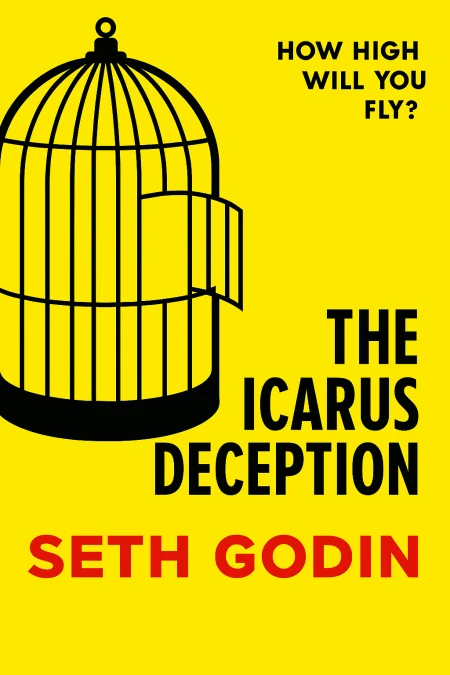
The Icarus Deception
How High Will You Fly?
Book Edition Details
Summary
In Seth Godin's daring manifesto, "The Icarus Deception," the traditional tale of Icarus's fall takes on new meaning. For generations, the warning to avoid the sun's scorching embrace has served as a metaphor for restraint and compliance. But Godin flips the script, shedding light on the forgotten admonition: don't fly too low. In today's shifting landscape, the supposed safety of conformity is a mirage. The industrial age's promise of security through obedience crumbles as creativity emerges as the new currency. Godin beckons readers to embrace their inner artist, not as a matter of innate talent but as a bold choice to innovate, connect, and navigate uncharted territory. Whether you're a teacher, engineer, or manager, Godin challenges you to reject mediocrity and soar with audacity. In a world where predictable paths falter, it's the daring innovators who redefine success.
Introduction
Industrial society has sold us a dangerous myth disguised as wisdom. For generations, we've been told that the original Icarus story warns against flying too close to the sun—against taking risks, standing out, or daring to soar beyond prescribed limits. This interpretation has become a tool of control, keeping individuals safely within the confines of factory-like compliance and predictable mediocrity. The forgotten half of the myth reveals something far more urgent: Daedalus also warned his son not to fly too low, as the sea spray would weigh down his wings and cause him to crash. The deception lies in our collective amnesia about this second warning. We've been conditioned to fear the heights while ignoring the far greater danger of flying too close to the waves. In today's connection economy, the old safety zone of industrial conformity has vanished entirely. The supposed security of following instructions, keeping your head down, and waiting to be picked has become the most dangerous path of all. Meanwhile, the creative act of making art—of doing work that matters, connecting authentically with others, and taking responsibility for meaningful contribution—has emerged as the new safety zone. This transformation demands a fundamental shift in how we understand risk, creativity, and human potential. The argument unfolds through careful examination of how industrial propaganda shaped our fears, why the connection economy rewards artistic courage, and how we can distinguish between genuine myths that inspire human greatness and manipulative propaganda that enforces compliance.
The False Myth: How Industrial Propaganda Taught Us to Fear Our Potential
The Icarus story we inherited is not an ancient wisdom tradition but a modern fabrication designed to serve industrial interests. For over a century, factory owners, school administrators, and corporate managers have weaponized a distorted version of this myth to discourage independent thinking and creative risk-taking. The complete story reveals a balanced warning: avoid both the hubris of flying too high and the timidity of flying too low. Yet only half this message survived in popular culture. This selective amnesia serves a specific purpose. Industrial systems require predictable, replaceable workers who follow instructions without question. Creativity, initiative, and artistic expression disrupt efficiency and challenge hierarchical control. By emphasizing only the dangers of flying high, industrial propaganda creates what could be called the "tall poppy syndrome"—a cultural reflex that cuts down anyone who dares to stand out, speak up, or pursue their unique vision. The result is a profound misalignment between our comfort zone and our actual safety zone. Generations have been trained to find comfort in compliance, believing that obedience leads to security. This might have been true during the peak industrial era, when factory jobs offered genuine stability in exchange for conformity. But economic reality has shifted dramatically. The old comfort zone of following orders has become a trap, while the apparent danger zone of creative risk-taking has become the only reliable path to meaningful security. The false myth perpetuates itself through social conditioning mechanisms that begin in childhood and continue throughout adult life. Schools reward compliance over creativity, corporations promote managers over innovators, and social systems shame those who dare to be different. This creates a self-reinforcing cycle where individuals police themselves and others, maintaining industrial-era thinking long after industrial-era economics have collapsed.
The Connection Economy Revolution: Why Art and Vulnerability Are Now Essential
The economic foundation supporting industrial conformity has fundamentally transformed. Where the industrial economy valued standardization, efficiency, and mass production, the connection economy rewards originality, authenticity, and meaningful relationships. This shift isn't merely technological—it represents a complete reversal in what creates value and generates security. Connection creates exponential rather than linear value. Unlike physical goods, which become scarce when shared, ideas and relationships multiply when spread. When someone shares genuine artistic work—whether that's a innovative business solution, a community-building initiative, or a creative project that moves people—the value increases for all participants. This abundance dynamic means that scarcity-based industrial thinking becomes not just obsolete but actively harmful. The connection economy operates on trust rather than authority. Traditional gatekeepers—record labels, publishers, corporate hierarchies—have lost their monopoly on determining who gets heard. Instead, audiences choose whom to follow based on the quality of connection and the value of ideas. This democratization creates unprecedented opportunities for individuals to build their own platforms and communities, but only if they're willing to be vulnerable and authentic. Vulnerability becomes a strategic advantage in this new paradigm. Industrial workers were trained to hide their personalities, follow scripts, and avoid personal investment in their work. Connection economy participants must do the opposite: share their genuine perspectives, take personal responsibility for outcomes, and create work that reflects their individual vision and values. This requires emotional labor rather than just physical or intellectual effort. The transformation demands what could be called "kamiwaza"—a Japanese concept meaning godlike performance that combines technical skill with complete authenticity. This isn't about perfection or invulnerability; it's about the courage to perform at full capacity without holding back, knowing that failure and criticism are inevitable parts of the artistic process.
Myths vs Propaganda: Reclaiming Our Right to Create and Lead
Understanding the difference between genuine myth and manipulative propaganda becomes crucial for anyone seeking to reclaim their creative potential. True myths inspire humans to embody their highest capabilities—they present gods and heroes as idealized versions of human possibility, suggesting that ordinary people can achieve extraordinary things through courage, wisdom, and persistence. Propaganda operates through opposite mechanisms. Instead of inspiring greatness, propaganda encourages limitation. Instead of suggesting human potential, propaganda emphasizes human inadequacy. The industrial version of the Icarus story functions as propaganda because it tells people they have no right to soar, that ambition leads to destruction, and that safety lies in accepting prescribed boundaries. Real myths throughout history celebrate the hero's journey—the individual who leaves familiar territory, faces challenges, and returns with gifts for the community. These stories acknowledge risk and failure while ultimately affirming human agency and creative power. They suggest that everyone has the potential to be heroic within their own context and circumstances. The distinction matters because it determines how we relate to our own capabilities. When we accept propagandistic myths, we internalize limitations and police our own behavior to stay within imposed boundaries. When we embrace genuine mythological thinking, we recognize ourselves as capable of godlike achievements within human constraints. Modern artistic work requires mythological rather than propagandistic thinking. Every creative act—from starting a business to organizing a community project to developing a new approach to familiar problems—involves stepping into unknown territory without guarantees. This mirrors the classic hero's journey structure, where protagonists must leave safety to discover their true capabilities. The key insight is that we don't need permission to embark on heroic journeys. The connection economy provides tools and opportunities that previous generations couldn't imagine. The question isn't whether we're qualified to make art or lead change—it's whether we're willing to embrace the responsibility and uncertainty that come with creative action.
Overcoming Resistance: The Artist's Path Through Fear to Authentic Connection
Every genuine creative endeavor encounters what can be termed "the resistance"—an internal voice that generates doubt, fear, and elaborate reasons to avoid doing meaningful work. This resistance isn't a character flaw or personal weakness; it's a normal psychological response to situations that involve vulnerability and uncertain outcomes. Understanding how to work with resistance rather than against it becomes essential for sustained creative practice. The resistance manifests through various strategies designed to prevent authentic expression. It might create perfectionist paralysis, where nothing feels good enough to share. It might generate busy work that feels productive but avoids real creative challenges. It might amplify criticism from others while minimizing encouragement and support. Most insidiously, it might convince us that we're not "real artists" because we lack certain credentials, talents, or circumstances. Working with resistance requires recognizing it as a signal rather than a roadblock. When resistance appears, it indicates proximity to work that matters. The stronger the resistance, the more important the potential creative breakthrough. This reframing transforms resistance from an enemy into a compass pointing toward meaningful action. Authentic connection emerges when creators share their work despite resistance rather than waiting for resistance to disappear. The audience responds not to perfection but to genuine human effort and vulnerability. This creates a paradox: the work becomes more powerful when creators stop trying to control outcomes and focus instead on the quality of their creative process and the authenticity of their expression. The path forward involves developing what could be called "comfortable with uncomfortable"—the ability to function effectively while experiencing fear, uncertainty, and potential criticism. This isn't about eliminating these feelings but about continuing to create and connect despite their presence. Like physical fitness, emotional resilience develops through practice rather than theory.
Summary
The central revelation emerges clearly: we live in a moment of unprecedented creative opportunity disguised as unprecedented danger. The old safety zone of industrial compliance has vanished forever, replaced by a connection economy that rewards precisely the qualities industrial propaganda taught us to suppress—originality, vulnerability, and authentic human expression. The choice is not between safety and risk, but between the real risk of flying too low and the apparent risk of flying toward our actual potential. Those brave enough to abandon industrial mythology and embrace their role as artists will discover that the greatest danger was never flying too close to the sun, but remaining forever trapped by the waves below.
Related Books
Download PDF & EPUB
To save this Black List summary for later, download the free PDF and EPUB. You can print it out, or read offline at your convenience.
By Seth Godin
