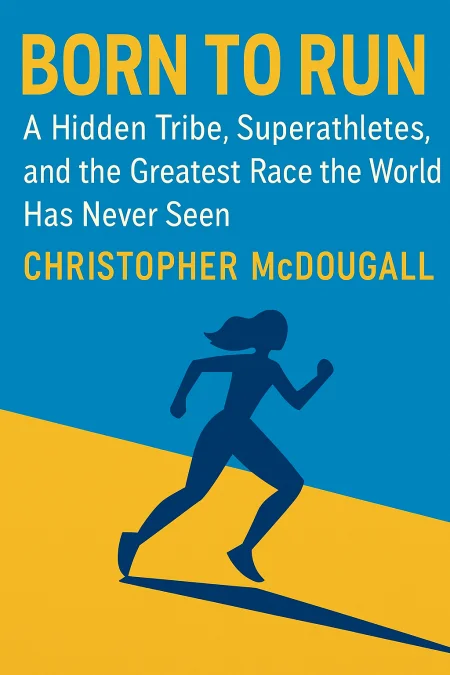
Born to Run
A Hidden Tribe, Superathletes and the Greatest Race the World Has Never Seen
Book Edition Details
Summary
At the heart of a question as simple as "Why does my foot hurt?" lies a narrative that redefines the limits of human endurance. In "Born to Run," Christopher McDougall embarks on an odyssey through Mexico's Copper Canyons, home to the legendary Tarahumara Indians—a tribe whose running prowess defies modern comprehension. With the enigmatic Caballo Blanco as his guide, McDougall uncovers secrets that challenge everything we've accepted about running, health, and joy. This story seamlessly intertwines cutting-edge science, high-stakes adventure, and the thrill of a fifty-mile race that pits the Tarahumara against a motley crew of extraordinary Americans. With every step, McDougall invites readers to explore the potential within, revealing a world where happiness is as close as the ground beneath our feet. Here, the true spirit of running emerges—not just as sport, but as a path to unparalleled freedom and vitality.
Introduction
In the remote canyons of Mexico, a mysterious tribe runs hundreds of miles without injury, their feet barely touching the ground as they glide through landscapes that would challenge modern athletes. Meanwhile, in our technologically advanced world, runners suffer injuries at unprecedented rates despite wearing the most sophisticated footwear ever created. This paradox opens a window into one of humanity's most fundamental questions: what does it truly mean to be human? The story that unfolds reveals how our species evolved not through brute strength or superior intelligence alone, but through an extraordinary capacity for endurance running that shaped our bodies, minds, and social structures. From the evolutionary pressures that forged our unique physiology to the cultural forces that nearly erased our natural abilities, we discover how running became both our greatest survival tool and our forgotten birthright. This exploration will resonate with anyone curious about human potential, whether you're a weekend jogger puzzled by persistent injuries, an athlete seeking peak performance, or simply someone fascinated by the remarkable journey that transformed our ancestors from tree-dwelling primates into the planet's most successful endurance predators. The answers lie not in laboratories or training manuals, but in the dust-covered trails where our deepest nature still whispers its ancient secrets.
Ancient Wisdom: The Tarahumara's Preserved Running Heritage
Deep in Mexico's Copper Canyons, where civilization's reach grows thin and ancient ways persist, lives a people who have preserved humanity's original relationship with running. The Tarahumara, or Rarámuri as they call themselves, inhabit one of the world's most challenging terrains, where survival depends not on technology but on the simple act of putting one foot in front of the other. For centuries, they have maintained traditions that reveal running not as punishment or recreation, but as a fundamental expression of human nature. Their extraordinary abilities first captured global attention when a small group ventured beyond their mountain stronghold to compete in ultramarathons. Wearing simple sandals carved from tire treads and flowing traditional robes, they didn't just participate in these grueling races—they dominated them, often stopping to chat with spectators or share food before disappearing into the distance. Their success challenged every assumption about proper training, nutrition, and equipment that modern sports science had carefully constructed. What makes the Tarahumara remarkable isn't just their speed or endurance, but their relationship with running itself. For them, running is woven into the fabric of daily life, from childhood games that can last for days to ceremonial races that strengthen community bonds. They run not to escape their bodies but to inhabit them fully, not to conquer distance but to dance with it. Their approach reveals running as a form of moving meditation, a practice that integrates physical effort with spiritual purpose. The contrast with modern running culture couldn't be starker. While contemporary athletes obsess over split times and suffer through injury after injury, the Tarahumara run with joy, their faces lit with the same expression children wear at play. They have preserved something we have lost: the understanding that humans are not just capable of running great distances, but that we are fundamentally designed for it. Their example suggests that our modern struggles with running may not reflect human limitations, but rather our disconnection from our own nature.
The Great Transformation: Technology's Promise and Betrayal (1970s-2000s)
The transformation of human running from natural movement to technological dependence represents one of the most dramatic shifts in our species' relationship with its own body. The 1970s marked the beginning of America's first great running boom, a grassroots movement that emerged from the counterculture and produced extraordinary athletes like Steve Prefontaine and Frank Shorter. These runners trained with primitive equipment, wearing thin-soled shoes that were essentially racing flats, yet they dominated international competition and inspired millions to discover the joy of running. The modern running shoe, introduced during this era, promised to improve upon millions of years of evolution through cushioning and motion control. Corporate forces seized upon the growing popularity of running, marketing increasingly complex footwear as essential for safety and performance. Yet this technological intervention coincided with an explosion of running injuries that had been virtually unknown to previous generations. The very features marketed as protective—thick heels, arch support, and motion control systems—began altering the natural running gait that had served humanity so well. Scientific research revealed the cruel irony at the heart of this transformation: the more expensive and technologically advanced the shoe, the higher the injury rate among its wearers. Studies comparing runners in cheap, minimal footwear to those in premium athletic shoes consistently showed that the barefoot-style runners suffered fewer injuries and demonstrated more efficient biomechanics. The foot, it turned out, was not a flawed design requiring correction but a masterpiece of engineering that performed best when allowed to function as intended. As the decades progressed, running became increasingly medicalized and commercialized, losing much of its spiritual and communal significance. The simple joy of movement was replaced by complex training programs, expensive equipment, and scientific analysis that often obscured rather than illuminated fundamental truths about human endurance. This technological approach, while well-intentioned, created barriers where none existed before, making running seem more difficult and dangerous than it actually was when approached with wisdom and respect for our natural design.
The Reckoning: When Modern Athletes Met Ancient Masters
The convergence of ancient wisdom and modern athleticism reached its dramatic climax in a remote Mexican village where the world's greatest ultrarunner agreed to test his abilities against the Tarahumara masters on their home terrain. This wasn't merely a race but a collision of philosophies—one representing the pinnacle of scientific training and technological optimization, the other embodying thousands of years of natural human movement refined to its purest expression. Scott Jurek arrived in the Copper Canyons carrying the weight of unprecedented achievements: seven consecutive victories at the Western States 100, a course record at the Badwater Ultramarathon, and a reputation as perhaps the greatest ultrarunner in history. Yet facing him were runners like Arnulfo Quimare, whose abilities seemed to transcend normal human limitations, gliding over treacherous terrain with an ease that suggested a fundamentally different relationship with the act of running itself. The race that unfolded revealed truths that extended far beyond athletic competition. As runners from vastly different worlds found themselves sharing the same trails, breathing the same thin mountain air, and pushing against the same physical limits, artificial boundaries began to dissolve. The Tarahumara's generosity in sharing water and encouragement, Jurek's respectful acknowledgment of his opponents' mastery, and the spontaneous celebration that erupted among all participants demonstrated that running at its deepest level is not about defeating others but about discovering what humans can accomplish together. The outcome proved less important than the process of getting there. In preparing for this ultimate test, both sides had to examine their fundamental assumptions about human potential, training methods, and the purpose of athletic endeavor. The race became a laboratory for exploring questions that extend far beyond sport: How much of human capability remains untapped? What happens when we strip away the artificial barriers between cultures and compete on the level ground of shared humanity? The answers emerged not from the finish line but from every step of the journey that led there.
Renaissance: Rediscovering Our Natural Running Heritage
The early 2000s witnessed the emergence of a revolutionary movement that challenged every assumption about modern running. Led by maverick coaches, barefoot runners, and researchers willing to question conventional wisdom, this renaissance sought to reconnect with the fundamental principles that had made the Tarahumara and other indigenous peoples such extraordinary athletes. The movement gained momentum as more people recognized that the high-tech solutions of the previous decades had failed to deliver on their promises. Central to this revolution was the rediscovery of natural running form and minimal footwear. Pioneering athletes like Barefoot Ted McDonald and coaches like Eric Orton began experimenting with running techniques that emphasized midfoot striking, shorter strides, and increased cadence. These methods, which closely resembled the natural gait patterns observed in indigenous runners, produced remarkable results in terms of both performance and injury prevention. Runners who adopted these techniques often found that chronic problems that had plagued them for years simply disappeared. The scientific community began to take notice as researchers like Dr. Daniel Lieberman at Harvard University conducted groundbreaking studies on human locomotion. Their work revealed that humans are uniquely adapted for long-distance running, with anatomical features specifically evolved for endurance rather than speed. This research provided the theoretical foundation for what traditional cultures had always known intuitively: that humans are born to run, and that our bodies possess remarkable capabilities when allowed to function as nature intended. Perhaps most importantly, this movement emphasized the restoration of joy and community to running. Following the example of the Tarahumara, modern practitioners began to view running not as a form of punishment or obligation, but as a celebration of human potential. Trail running experienced explosive growth as people sought more natural environments and varied terrain. Ultra-marathons became laboratories for exploring the outer limits of human endurance, often with a spirit of adventure and camaraderie that recalled the sport's golden age. This return to origins represented not just a change in technique, but a fundamental shift in philosophy toward a more holistic and sustainable approach to human movement.
Summary
The story of human running reveals a profound truth about our species: we are not merely capable of extraordinary endurance, but we evolved specifically because of it. Our ancestors' ability to run down prey across vast distances provided the high-quality nutrition that fueled the growth of our oversized brains, while the cognitive demands of persistence hunting developed the complex reasoning abilities that distinguish us from other animals. Running didn't just help humans survive—it made us human. Yet modern life has created an unprecedented disconnect from this fundamental aspect of our nature. We have transformed from the world's premier endurance athletes into a sedentary species plagued by the very diseases that were virtually unknown to our running ancestors. The epidemic of heart disease, diabetes, and depression that characterizes contemporary society represents not just individual health failures but a collective forgetting of who we are designed to be. The path forward requires neither complex technology nor revolutionary training methods, but rather a return to the simple wisdom encoded in our own bodies. By rediscovering the joy of natural movement, learning from cultures that have preserved these ancient skills, and approaching running not as punishment but as celebration, we can reclaim our birthright as creatures born to run. The choice is ours: continue down the path of technological dependence and physical decline, or take the first step toward rediscovering the extraordinary capabilities that lie dormant within every human being.
Related Books
Download PDF & EPUB
To save this Black List summary for later, download the free PDF and EPUB. You can print it out, or read offline at your convenience.
By Christopher McDougall
