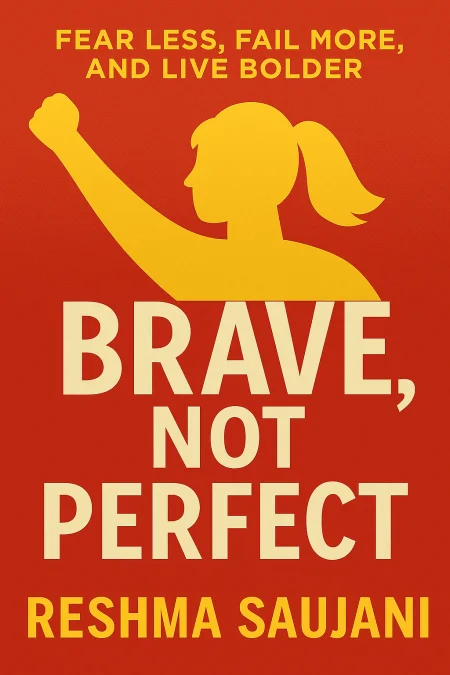
Brave, Not Perfect
Fear Less, Fail More, and Live Bolder
Book Edition Details
Summary
What if you stopped chasing perfection and embraced the fearless spirit within? Reshma Saujani, celebrated for her TED talk and bestselling books, invites you to do just that. In "Brave, Not Perfect," Saujani dismantles the myth that women must be flawless to succeed, advocating instead for a life driven by audacity and authenticity. From the stifling pressures of social media to the haunting echoes of childhood expectations, she examines how the pursuit of perfection cages women in a life not of their choosing. Her compelling narrative offers a bold alternative: a journey where bravery becomes the compass, guiding you toward your true potential. Saujani's book is a clarion call to all who feel stifled by fear, encouraging you to step boldly into a future shaped by your own daring choices.
Introduction
Modern society presents women with a peculiar paradox: while celebrating female empowerment and capability, it simultaneously reinforces deeply ingrained patterns of perfectionist behavior that ultimately limit women's potential. This fundamental contradiction shapes how women navigate professional ambitions, personal relationships, and self-perception from childhood through adulthood. The cultural messaging surrounding female achievement creates a complex web where success becomes synonymous with flawlessness, leading to risk-averse behaviors that paradoxically prevent genuine success and fulfillment. The examination of this phenomenon reveals how perfectionist conditioning operates as both a personal limitation and a systemic barrier. Rather than serving as a pathway to excellence, the pursuit of perfection often becomes a cage that constrains authentic expression and bold action. The analysis presented here challenges conventional wisdom about female achievement by distinguishing between healthy standards and destructive perfectionism, while proposing an alternative framework centered on courage and resilience. Through careful examination of societal expectations, developmental patterns, and practical strategies, readers will encounter a systematic deconstruction of perfectionist thinking and its replacement with what might be called a "bravery mindset." This approach transforms failure from a source of shame into a tool for growth, and reframes risk-taking as an essential component of meaningful achievement rather than a threat to carefully constructed self-image.
The Perfect Girl Programming: How Society Conditions Women for Perfection
From earliest childhood, girls receive countless subtle and overt messages that shape their understanding of acceptable behavior and achievement standards. This programming operates through multiple channels simultaneously: family dynamics, educational institutions, peer interactions, and media representations all contribute to a comprehensive conditioning system that prioritizes compliance, appearance, and flawless performance over exploration, risk-taking, and authentic self-expression. The conditioning process begins with fundamental differences in how society responds to male and female children's behavior. Girls receive praise for being "good," which typically translates to being quiet, helpful, and accommodating. Their physical exploration is often limited through protective interventions, while their academic and social achievements are celebrated primarily when they demonstrate perfection rather than effort or improvement. This creates a feedback loop where girls learn that their value depends on meeting external standards rather than pursuing internal curiosity or passion. Educational environments reinforce these patterns through both explicit instruction and implicit expectations. Teachers, despite good intentions, often provide different types of feedback to girls and boys, offering more detailed criticism to male students while softening corrective guidance for female students. This protective approach, while well-meaning, deprives girls of the resilience-building experiences that come from receiving direct feedback and learning to recover from mistakes. The result is a generation of women who have been systematically trained to prioritize others' approval over their own goals, to avoid challenges that might result in visible failure, and to maintain a carefully constructed exterior that conceals any hint of struggle or imperfection. This programming becomes so deeply embedded that it operates unconsciously, influencing major life decisions and daily interactions long into adulthood.
The Cost of Perfectionism: Why Perfect Girls Become Paralyzed Women
The transition from childhood to adulthood reveals the hidden costs of perfectionist conditioning as women encounter situations where flawless performance is neither possible nor desirable. Professional environments, romantic relationships, and parenting responsibilities all require adaptability, risk-taking, and resilience in the face of uncertainty—qualities that perfectionist training systematically undermines. In professional settings, perfectionist conditioning manifests as reluctance to pursue opportunities without guaranteed success, excessive preparation that delays action, and difficulty recovering from criticism or setbacks. Women consistently apply for positions only when they meet 100% of qualifications, while their male counterparts apply with 60% qualification rates. This disparity reflects not just confidence differences, but fundamental differences in how failure and imperfection are perceived and processed. The emotional toll of maintaining perfectionist standards creates chronic stress, anxiety, and exhaustion. Women report spending disproportionate mental energy on managing their appearance, behavior, and achievements to meet impossible standards. This constant self-monitoring depletes the psychological resources needed for creative thinking, bold decision-making, and authentic relationship building. The pursuit of perfection becomes a full-time job that leaves little energy for pursuing meaningful goals or experiencing genuine satisfaction. Perhaps most significantly, perfectionism creates a false sense of safety while actually increasing vulnerability. The belief that flawless performance will protect against criticism or failure proves consistently false, while the avoidance of challenging situations prevents the development of genuine confidence and resilience. Women find themselves trapped in comfortable but limiting circumstances, watching opportunities pass by while waiting for conditions to become "perfect" enough to warrant action.
Redefining Bravery: Building a New Framework for Female Courage
Traditional concepts of bravery often emphasize dramatic, physical acts of courage that may not resonate with or reflect women's experiences and strengths. A more inclusive understanding of bravery encompasses intellectual courage, emotional vulnerability, social risk-taking, and the willingness to pursue authentic goals despite uncertainty about outcomes. This redefined framework recognizes that bravery manifests differently across contexts and individuals. For some women, bravery might mean speaking up in meetings or negotiating salaries. For others, it could involve ending unsatisfying relationships, pursuing creative endeavors, or setting boundaries with family members. The common thread is the willingness to act in alignment with personal values and goals despite the possibility of failure, criticism, or discomfort. The new framework also acknowledges that women may face different types of risks and consequences than men when displaying assertive or ambitious behavior. Rather than encouraging women to simply adopt male models of behavior, this approach celebrates distinctly feminine forms of courage while building tolerance for the inevitable backlash that accompanies boundary-breaking actions. Central to this redefinition is the concept of "failing forward"—viewing mistakes and setbacks as information rather than indictments. This perspective transforms failure from something to be avoided at all costs into a natural and valuable part of the learning process. Women learn to distinguish between harmful shame and useful feedback, developing the emotional regulation skills necessary to persist through difficulty while maintaining their core sense of worth and capability.
From Perfect to Brave: Practical Strategies for Embracing Imperfection
The transition from perfectionist thinking to brave action requires specific, practical strategies that address both mindset shifts and behavioral changes. These strategies work by gradually building tolerance for discomfort and uncertainty while strengthening confidence in one's ability to handle whatever outcomes arise. Fundamental to this transformation is the practice of deliberately choosing imperfection in low-stakes situations. This might involve sending emails without extensive revision, wearing slightly wrinkled clothing, or expressing opinions without comprehensive research. These small acts of imperfection serve as inoculation against the fear of making mistakes, proving repeatedly that minor flaws rarely produce the catastrophic consequences that perfectionist thinking predicts. Building physical and emotional resilience forms another crucial component of brave behavior. Regular exercise, adequate sleep, and stress management practices provide the energy and stability necessary for taking risks. Women learn to recognize the difference between genuine intuition and anxiety-driven avoidance, developing the capacity to act despite feeling nervous or uncertain. The cultivation of supportive relationships becomes essential for sustaining brave behavior over time. This involves both seeking mentors and allies who encourage risk-taking and authenticity, and learning to be vulnerable enough to ask for help when needed. Women practice sharing their struggles and failures openly, discovering that authenticity actually deepens rather than weakens their connections with others. Perhaps most importantly, women learn to reframe their relationship with success and failure entirely. Instead of viewing life as a pass/fail examination where anything less than perfection equals failure, they adopt a growth mindset that sees every experience as providing valuable information for future decisions. This fundamental shift in perspective makes it possible to pursue ambitious goals without the paralyzing fear that has historically limited their choices and achievements.
Summary
The journey from perfectionist paralysis to courageous action requires both understanding the deep cultural conditioning that shapes women's behavior and implementing practical strategies for building tolerance to imperfection and failure. The central insight emerging from this analysis is that bravery, rather than perfection, serves as the true pathway to meaningful achievement and authentic fulfillment. This framework offers women permission to pursue their genuine goals without waiting for ideal conditions or guaranteed outcomes, while building the resilience necessary to persist through the inevitable challenges that accompany any worthwhile endeavor. The transformation benefits not only individual women but creates ripple effects that challenge limiting social expectations and create space for future generations to embrace their full potential from the beginning.
Related Books
Download PDF & EPUB
To save this Black List summary for later, download the free PDF and EPUB. You can print it out, or read offline at your convenience.
By Reshma Saujani
