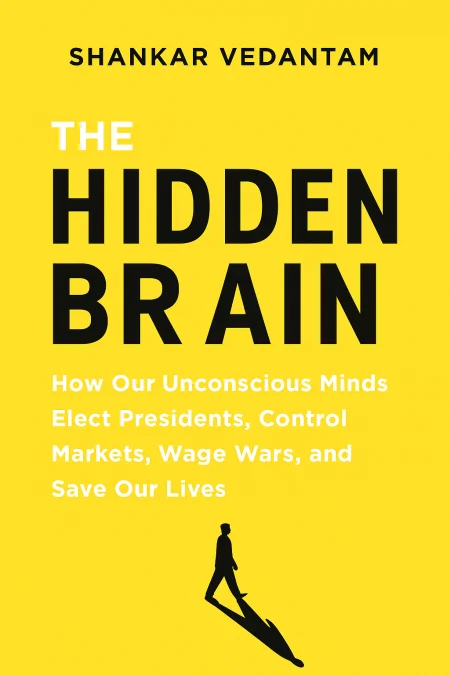
The Hidden Brain
How Our Unconscious Minds Elect Presidents, Control Markets, Wage Wars, and Save Our Lives
Book Edition Details
Summary
What if the mind’s most crucial decisions are made in the shadows, out of sight? Shankar Vedantam peels back the layers of our subconscious in "The Hidden Brain," revealing the invisible forces that steer our choices and beliefs without us even realizing. This riveting narrative uncovers the silent puppeteer within us all, influencing everything from whom we love to the verdicts we deliver in courtrooms. With a blend of gripping storytelling and cutting-edge science, Vedantam traverses from the high-stakes corridors of political campaigns to the heart-wrenching extremes of terrorism indoctrination. He paints a vivid picture of how these unseen biases can be manipulated, challenging us to confront our hidden selves and the profound impact they wield on society. This book isn’t just an exploration—it’s a call to awareness in an era where understanding our inner mechanisms is more vital than ever.
Introduction
Beneath the surface of our conscious thoughts lies a powerful force that shapes nearly every aspect of human behavior, from the mundane decisions of daily life to the most consequential choices that determine the fate of individuals and societies. This force operates without our awareness, influencing how we perceive others, make judgments, and navigate social relationships. While we believe ourselves to be rational actors making deliberate choices based on careful consideration, the reality is far more complex and unsettling. The exploration that follows reveals how unconscious mental processes systematically distort our perceptions and decisions in ways that contradict our conscious beliefs and intentions. Through rigorous scientific evidence and compelling real-world examples, we discover that the gap between what we think we know about ourselves and what actually drives our behavior is vast and consequential. This investigation employs a multidisciplinary approach, drawing from psychology, neuroscience, sociology, and behavioral economics to construct a comprehensive understanding of how hidden cognitive mechanisms operate across different domains of human experience. The journey ahead challenges fundamental assumptions about human nature, personal responsibility, and the workings of social institutions. By examining these unconscious influences through the lens of empirical research rather than speculation, we can begin to understand why well-intentioned people often perpetuate the very problems they seek to solve, and how awareness of these hidden processes might lead to more effective solutions to persistent social challenges.
The Unconscious Mind's Pervasive Influence on Daily Decisions
The human brain operates on two distinct levels: the conscious mind that we experience directly and an unconscious system that processes information and makes decisions without our awareness. This hidden system handles the vast majority of our mental activity, from recognizing faces to forming first impressions, yet we remain largely oblivious to its influence. When we encounter someone new, meet a job candidate, or evaluate a political figure, we believe our judgments stem from careful rational analysis. In reality, unconscious associations and mental shortcuts drive these assessments before our conscious mind has time to engage. These unconscious processes evolved to help our ancestors make rapid survival decisions in dangerous environments. The same mechanisms that once helped humans quickly identify threats and allies now operate in modern contexts where such snap judgments may be inappropriate or harmful. A hiring manager may unconsciously favor candidates whose names are easier to pronounce, investors may be drawn to companies with simple ticker symbols, and voters may support politicians based on nothing more than how "presidential" they appear. The ubiquity of these hidden influences becomes apparent when we examine everyday situations where people's actions contradict their stated intentions. Well-meaning individuals who genuinely believe in equality may nonetheless harbor unconscious biases that affect their behavior toward people from different backgrounds. The gap between conscious intention and unconscious action creates a fundamental challenge for understanding human behavior and designing fair social systems. Scientific research has developed sophisticated methods to detect and measure these unconscious biases, revealing their presence even among people who consciously reject prejudice and discrimination. The implications extend far beyond individual decision-making to affect institutions, policies, and social outcomes on a massive scale. Recognizing the existence and power of unconscious mental processes is the first step toward understanding how they shape our world.
Bias in Critical Domains: Justice, Politics, and Disasters
Unconscious bias demonstrates its most profound impact in high-stakes situations where rational decision-making should theoretically prevail. In criminal justice settings, research reveals systematic disparities in how defendants are treated based on factors that should be legally irrelevant. Studies of death penalty cases show that defendants with more stereotypically African features receive harsher sentences than those with less pronounced features, even when controlling for the severity of their crimes and other relevant factors. These disparities occur not because judges and juries are consciously racist, but because unconscious associations between appearance and criminality influence judgments in subtle yet measurable ways. Political behavior similarly reflects the operation of hidden mental processes that voters themselves may not recognize. Analyses of electoral patterns reveal correlations between unconscious racial attitudes and voting preferences that persist even when accounting for conscious political beliefs and stated issue positions. Candidates may benefit or suffer based on how well their appearance and presentation align with voters' unconscious expectations about leadership, competence, and trustworthiness. These effects operate independently of and sometimes contrary to voters' conscious policy preferences and stated values. During disasters and emergencies, unconscious group dynamics can override individual decision-making in ways that prove fatal. When faced with ambiguous threats, people unconsciously look to others for cues about appropriate responses, creating dangerous delays in evacuation situations. The tendency to seek consensus and follow the crowd, while adaptive in many social contexts, can trap groups in buildings during fires or prevent individuals from taking necessary action when seconds count. Understanding these patterns reveals why traditional emergency preparedness focused solely on clear exit signs and evacuation routes often fails. The consistency of these effects across different domains suggests that unconscious bias is not an aberration but a fundamental feature of human cognition. Recognizing this reality is essential for developing more effective approaches to promoting fairness in justice, improving democratic decision-making, and saving lives during emergencies.
The Evolutionary Origins and Mechanisms of Hidden Bias
The unconscious mind's tendency toward bias emerges from cognitive mechanisms that served crucial survival functions throughout human evolutionary history. Early humans who could quickly categorize others as friend or foe, identify potential threats, and make rapid decisions in dangerous situations were more likely to survive and reproduce. These same mental shortcuts that once helped our ancestors navigate life-or-death situations now operate in modern environments where such rapid categorization may be inappropriate or counterproductive. The brain's pattern recognition systems excel at detecting associations and generalizations from limited information. When we repeatedly encounter certain combinations of features or characteristics, our unconscious mind creates mental shortcuts that automatically activate these associations in future encounters. This process occurs without conscious awareness and can persist even when we consciously know that the associations are inaccurate or unfair. The efficiency of this system comes at the cost of accuracy and nuance. Social groups provided essential survival advantages for early humans, leading to the evolution of psychological mechanisms that promote in-group loyalty and out-group wariness. These mechanisms manifest in modern contexts as unconscious preferences for people who resemble us in appearance, background, or other characteristics, while simultaneously creating subtle biases against those perceived as different. The strength of these unconscious preferences often surprises people when they discover them through psychological testing. Memory and attention systems also contribute to biased perception by selectively encoding and retrieving information that confirms existing expectations. When members of minority groups engage in negative behavior, these incidents may be more memorable and seem more representative than statistically equivalent negative behavior by majority group members. This creates illusory correlations that reinforce stereotypes even in the absence of any real differences in behavior between groups. Understanding these mechanisms reveals why bias can persist and even strengthen despite conscious efforts to promote equality and fairness.
Confronting Unconscious Bias Through Reason and Awareness
The discovery of pervasive unconscious bias raises urgent questions about personal responsibility and social change. If our judgments and decisions are influenced by mental processes operating below the threshold of awareness, how can we be held accountable for biased behavior? The answer lies in recognizing that while we cannot directly control unconscious processes, we can take conscious steps to minimize their harmful effects and create systems that reduce opportunities for bias to influence important decisions. Awareness alone is insufficient to eliminate unconscious bias, but it represents a crucial first step. When people learn about their own hidden biases through scientific assessment, they often express surprise and dismay at discovering attitudes that contradict their conscious beliefs. This emotional reaction, while uncomfortable, provides motivation for implementing strategies to counteract biased thinking. Research shows that people who are aware of their potential for bias can take deliberate steps to make fairer decisions, though this requires ongoing effort and vigilance. Institutional reforms offer more systematic approaches to reducing the impact of unconscious bias. Structured decision-making processes, diverse evaluation committees, and objective criteria can help minimize the influence of hidden mental shortcuts. In hiring decisions, for example, blind resume reviews and standardized interview questions can reduce the impact of unconscious preferences. In medical settings, checklists and protocols can prevent biased assumptions from affecting patient care. These structural changes work by reducing reliance on intuitive judgments where bias is most likely to intrude. The most effective approaches combine individual awareness with systemic changes that acknowledge the reality of unconscious bias rather than hoping it can be wished away. This requires abandoning the comforting fiction that good intentions guarantee fair outcomes and instead building safeguards that account for the predictable ways human psychology can lead well-meaning people astray. The goal is not to eliminate the unconscious mind, which plays vital roles in human cognition, but to understand its limitations and design systems that harness its strengths while minimizing its potential for harm.
Summary
Human behavior is profoundly shaped by unconscious mental processes that operate beneath the threshold of awareness, influencing decisions and judgments in ways that often contradict our conscious intentions and values. Through rigorous scientific investigation across multiple domains, from individual psychology to institutional behavior, we discover that the gap between what we believe drives our actions and what actually influences them is both vast and consequential. This understanding reveals why persistent social problems resist solution despite widespread good intentions and why institutional reforms must account for the predictable ways unconscious bias affects human judgment. The path forward requires not the impossible task of eliminating unconscious mental processes, but rather the development of systems and practices that acknowledge these hidden influences while creating structures to promote fairer and more rational decision-making in the domains that matter most.
Related Books
Download PDF & EPUB
To save this Black List summary for later, download the free PDF and EPUB. You can print it out, or read offline at your convenience.
By Shankar Vedantam
