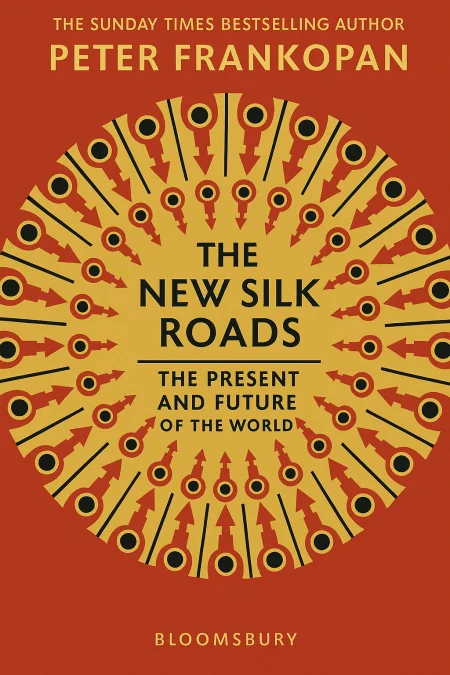
The New Silk Roads
The Present and Future of the World
Book Edition Details
Summary
In the shifting sands of modern geopolitics, Peter Frankopan’s "The New Silk Roads" is a beacon illuminating the East’s rising influence. As the West grapples with divisions, Frankopan's narrative sweeps us across continents—from the bustling bazaars of the Middle East to China’s dynamic metropolises—revealing a tapestry of newfound alliances and shared aspirations. This isn't just a history lesson; it's a riveting exploration of a world in flux, where ancient trade routes are reborn as conduits of power and progress. The book dares readers to question entrenched perspectives, offering a vivid portrait of global interdependence and the vibrant, interconnected future that lies ahead.
Introduction
In the early 1990s, as the Soviet Union crumbled and the Berlin Wall fell, few could have predicted that within a generation, the world's economic center of gravity would begin shifting dramatically eastward. Today, we witness an extraordinary transformation as ancient trade routes between Europe and Asia experience a renaissance that rivals their historical golden age. This transformation represents more than mere economic statistics; it embodies a fundamental rebalancing of global power that touches everything from property prices in London to the availability of airline pilots worldwide. The story unfolding across the vast expanse from the Eastern Mediterranean to the Pacific Ocean reveals how nations once considered peripheral to global affairs have become central to our collective future. China's Belt and Road Initiative alone promises nearly one trillion dollars in infrastructure investment, while countries like India, Turkey, and Kazakhstan are emerging as crucial players in a multipolar world order. This is not simply a tale of rising GDP figures, but a complex narrative of how technological innovation, resource competition, and shifting demographics are reshaping international relations in ways that will define the twenty-first century. Understanding these changes becomes essential for anyone seeking to comprehend our rapidly evolving world. Whether you are a business leader navigating global markets, a policy maker grappling with international challenges, or simply a curious observer trying to make sense of today's headlines, the patterns emerging along these new Silk Roads offer crucial insights into where our interconnected world is heading.
The Rise of Asia: Economic Transformation Since 2015
The transformation of Asia since 2015 has been nothing short of breathtaking in both scope and speed. In 1993, when President Clinton spoke hopefully of Russia's democratic potential and South Korea was still emerging from poverty, few could have imagined that within a quarter-century, Asian economies would be fundamentally reshaping global trade patterns. China's GDP has grown from 39 percent of America's in 2001 to surpassing it by 2016 when measured in purchasing power parity terms, while more than 800 million Chinese have been lifted above the poverty line since the 1980s. This economic miracle extends far beyond China's borders. South Korea, once one of the world's poorest nations with no natural resources, has transformed into a technological powerhouse with companies like Samsung becoming global leaders. India's middle class has exploded from 2 million households with disposable incomes above $10,000 in 1990 to 50 million by 2014, with consumer spending projected to triple by 2025. Even smaller nations have experienced remarkable growth, as Qatar Airways expanded from a modest regional carrier in 1993 to a global airline with over 200 aircraft serving 150 destinations. The ripple effects of Asian prosperity reach every corner of the globe in unexpected ways. Chinese demand for French wine has driven exports to nearly 220 million liters annually, while the shortage of airline pilots worldwide stems largely from rapidly expanding Asian carriers offering salaries up to $750,000 per year. Property prices in London, Vancouver, and San Francisco have been pushed higher by waves of Asian investment capital. Even seemingly unrelated phenomena like the global shortage of donkeys traces back to Chinese demand for traditional medicines, forcing African nations to ban exports to protect their agricultural economies. Perhaps most significantly, this transformation represents more than just wealth creation; it signals a fundamental shift in global influence and cultural reach. Asian nations are no longer content to be mere manufacturing centers for Western consumption. They are becoming centers of innovation, cultural production, and financial power that will shape the world's future trajectory for decades to come.
China's Belt and Road Initiative: Global Infrastructure Revolution
On September 7, 2013, President Xi Jinping stood before students at Nazarbayev University in Kazakhstan and articulated a vision that would reshape global commerce: the creation of an "economic belt along the Silk Road." This moment marked the birth of what would become the Belt and Road Initiative, arguably the most ambitious infrastructure program in human history. Drawing inspiration from ancient trade routes that connected East and West for millennia, Xi proposed rebuilding these connections for the modern age through massive investments in roads, railways, ports, and energy projects. The scale of China's commitment has proven extraordinary. By 2015, the China Development Bank had reserved $890 billion for some 900 projects, while the Export-Import Bank of China began financing over 1,000 projects across 49 countries. Today, more than 80 countries participate in the initiative, representing 4.4 billion people and $21 trillion in combined GDP. This network spans from the ancient Silk Road cities of Central Asia to the ports of Africa, from the factories of Southeast Asia to the capitals of Europe. The initiative's flagship projects demonstrate China's engineering capabilities and financial resources. The China-Pakistan Economic Corridor alone involves $60 billion in investments, including the development of Gwadar port and high-speed rail connections that could transform Pakistan's economy. In Malaysia, the East Coast Rail Link will connect the peninsula's coasts at a cost of $13 billion, while new railways through Laos promise to turn this landlocked nation into what officials call "land-linked." The scope extends to Africa, where Chinese loans have funded $20 billion in roads and railways, and to Latin America, where over $220 billion in loans have been distributed over the past fifteen years. Yet the Belt and Road Initiative represents more than infrastructure development; it embodies China's vision of global leadership based on mutual benefit and shared prosperity. By positioning itself as the provider of financing, technology, and expertise that other nations desperately need, China has created a network of economic relationships that extend its influence across continents. This approach contrasts sharply with traditional Western development models, offering an alternative vision of international cooperation that many developing nations find increasingly attractive as they seek partners for their own growth ambitions.
US-China Rivalry: Trade Wars and Strategic Competition
The election of Donald Trump in 2016 marked a dramatic shift in America's approach to China, transforming what had been managed strategic competition into open economic warfare. Trump's campaign rhetoric painted China as America's greatest threat, claiming that Chinese trade practices represented "the greatest theft in the history of our country." This zero-sum worldview translated into concrete policy actions, beginning with tariffs on over 1,000 Chinese products affecting $50-60 billion in imports, described by Trump as merely "the first of many" such measures. The escalation revealed deeper American anxieties about China's rise and the relative decline of Western influence. U.S. intelligence officials began describing China as seeking "Indo-Pacific regional hegemony in the near-term" with the ultimate goal of "displacement of the United States to achieve global pre-eminence in the future." This perception drove not only trade measures but also broader efforts to counter Chinese technological advancement, including restrictions on Chinese access to American semiconductors and attempts to limit Chinese investment in strategic industries. China's response has been measured but firm, implementing retaliatory tariffs targeting American agricultural products from states that voted for Trump, while positioning itself as a defender of multilateral trade and international cooperation. Chinese officials consistently frame their country's actions as defensive rather than aggressive, emphasizing mutual benefit and win-win cooperation. This messaging resonates globally as America's unilateral actions in withdrawing from international agreements and imposing sanctions have strained relationships with traditional allies. The competition extends far beyond trade into technological, military, and diplomatic spheres. America's attempts to maintain technological supremacy face China's massive investments in artificial intelligence, renewable energy, and advanced manufacturing. While the United States struggles with domestic divisions and international isolation, China has successfully positioned itself as a reliable partner for development and growth. This rivalry is reshaping global alliances and forcing nations worldwide to choose sides in what many observers see as the defining geopolitical competition of the twenty-first century.
The Future Multipolar World: Challenges and Opportunities
As we look toward the future, the emergence of a multipolar world order presents both unprecedented opportunities and significant risks. The traditional Western-dominated international system is giving way to a more complex arrangement where multiple centers of power compete for influence and resources. China's Belt and Road Initiative continues to expand despite challenges, creating new economic networks that bypass traditional Western institutions. Meanwhile, America's "America First" policies have accelerated its isolation from global affairs, leaving space for other powers to assume leadership roles. The technological dimension of this transformation cannot be overstated. China's investments in artificial intelligence, quantum computing, and advanced manufacturing are beginning to yield results that challenge American technological supremacy. The development of autonomous weapons systems, space capabilities, and digital infrastructure represents a new kind of arms race that will determine which nations lead in the coming decades. European nations find themselves caught between American pressure and Chinese opportunities, struggling to maintain relevance in a world increasingly shaped by Asian dynamics. Perhaps most significantly, the COVID-19 pandemic and climate change have highlighted the need for global cooperation at precisely the moment when international institutions appear weakest. The challenges facing humanity require coordinated responses that transcend national boundaries, yet the current trajectory suggests increasing fragmentation rather than collaboration. Trade wars, sanctions, and geopolitical competition are undermining the very cooperation necessary to address these existential challenges. Yet within this uncertainty lie tremendous opportunities for those nations and leaders wise enough to adapt to changing circumstances. The countries of the Silk Roads are already demonstrating how cooperation can create prosperity and stability. As one ancient Chinese ruler noted, "A talent for following the ways of yesterday is not sufficient to improve the world of today." The future belongs to those who can build bridges rather than walls, who choose collaboration over competition, and who recognize that in an interconnected world, mutual prosperity remains the only sustainable path forward. The new Silk Roads are rising, and they will continue to shape our collective future whether we choose to participate or not.
Summary
The transformation unfolding across Asia represents more than a shift in economic statistics; it embodies a fundamental rebalancing of global power that will define the twenty-first century. The central theme running through this historical moment is the tension between two competing visions of international order: one based on unilateral dominance and zero-sum competition, the other founded on multilateral cooperation and mutual benefit. While Western nations increasingly turn inward and erect barriers, Asian countries are building connections, investing in infrastructure, and creating networks of collaboration that span continents. The lessons from this transformation offer crucial insights for navigating our interconnected future. First, sustainable prosperity requires cooperation rather than competition, as demonstrated by the success of initiatives that bring nations together around shared economic interests. Second, technological advancement and infrastructure development remain the foundations of national power and international influence, making investment in education, innovation, and connectivity essential for any nation's future success. Finally, the ability to adapt to changing circumstances while maintaining long-term strategic vision separates successful nations from those that cling to outdated approaches. As we stand at this historical crossroads, the choice facing leaders and citizens worldwide is clear: embrace the collaborative spirit that has always driven human progress, or risk being left behind by the forces of change. The new Silk Roads are not merely trade routes; they represent pathways toward a more prosperous and interconnected future. Those who understand and engage with this transformation will help shape the world our children inherit, while those who resist may find themselves increasingly isolated in a rapidly evolving global landscape.
Related Books
Download PDF & EPUB
To save this Black List summary for later, download the free PDF and EPUB. You can print it out, or read offline at your convenience.
By Peter Frankopan
