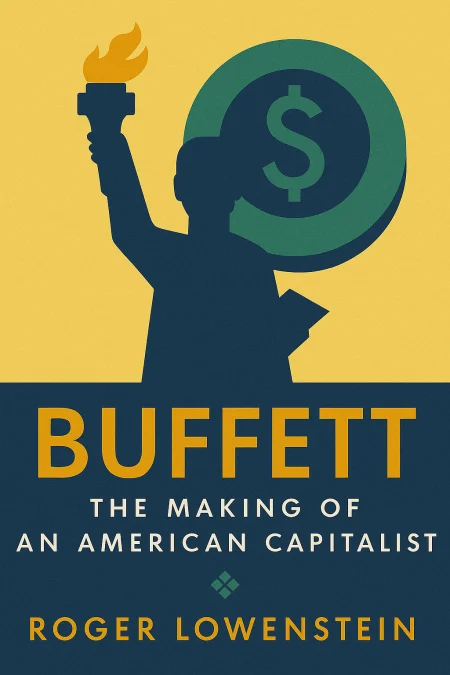
Buffett
The Making of an American Capitalist
Book Edition Details
Summary
In the heart of American capitalism, one man stands as a paradox: Warren Buffett, the unassuming oracle of Omaha. Roger Lowenstein’s riveting biography delves beyond the figures and fortune, revealing a man whose wisdom is as profound as his bank account. Raised from humble beginnings, Buffett's journey from a paperboy to a titan of industry is marked by a steadfast commitment to a singular investment ethos: seek undervalued gems and nurture them to their full potential. Yet, it’s his lifestyle—simple, grounded, and frugal—that adds layers to his enigma. Through intimate access to those closest to Buffett, Lowenstein captures the essence of a billionaire whose greatest wealth lies in his principles and philanthropy. This is not just the story of wealth amassed, but values embodied, a narrative that challenges the very essence of success and legacy.
Introduction
In the pantheon of American capitalism, few figures command as much respect and fascination as Warren Buffett. Known worldwide as the "Oracle of Omaha," this unassuming Midwesterner transformed a failing textile company into one of the most valuable corporations on earth, all while maintaining the folksy charm of a small-town neighbor. Born during the Great Depression to a stockbroker father and raised in Nebraska's heartland, Buffett discovered his calling early, purchasing his first stock at age eleven and never looking back. What sets him apart isn't just his extraordinary wealth—estimated at over $100 billion—but his unique approach to business and life that defies conventional wisdom. Buffett's story reveals three profound dimensions of success. First, his relentless pursuit of knowledge and rational thinking, demonstrated through his voracious reading habits and ability to distill complex business concepts into simple truths. Second, his unwavering commitment to long-term value creation over short-term gains, a philosophy that guided him through decades of market volatility while others chased fleeting trends. Finally, his remarkable consistency in applying timeless principles of integrity, patience, and humility, proving that character matters as much as intellect in achieving lasting success. Through his journey from a paperboy in Omaha to one of history's greatest investors, we witness how ordinary virtues, when applied with extraordinary discipline, can yield extraordinary results.
Early Years and the Making of an Investor
Warren Edward Buffett entered the world on August 30, 1930, in Omaha, Nebraska, during one of America's darkest economic periods. His father, Howard Buffett, worked as a stockbroker and would later serve in Congress, while his mother, Leila, came from humble beginnings in rural Nebraska. The family's early years were marked by financial uncertainty when Howard's bank failed in 1931, leaving them with little more than hope and determination. Yet these challenging circumstances would prove formative, instilling in young Warren both a deep respect for money and an understanding of its fragility. From his earliest days, Warren displayed an unusual fascination with numbers and business. While other children played with toys, he would sit for hours calculating the life spans of composers or memorizing the populations of cities. At age six, he began his first entrepreneurial venture, selling Chiclets door-to-door and setting up lemonade stands in high-traffic areas. His childhood friend Bob Russell recalled how Warren would spend afternoons recording license plate numbers and counting bottle caps at gas stations, treating these activities as primitive market research rather than mere games. The boy's precocious business sense became legendary in the neighborhood. He delivered newspapers with the efficiency of a seasoned executive, eventually managing five different routes and earning substantial income for a teenager. Warren's approach was methodical and strategic—he would study his customers' habits, track subscription renewals, and even befriend elevator operators to gain intelligence about potential movers. By age thirteen, he was filing tax returns and had accumulated enough savings to purchase forty acres of Nebraska farmland. Perhaps most remarkably, Warren's ambitions were never modest. He would tell friends with quiet certainty that he would be rich before age thirty-five, not as a boast but as a simple statement of fact. This wasn't mere childhood fantasy—it reflected a deep understanding of how money worked and grew over time. When hospitalized with appendicitis at age seven and feared near death, Warren filled a page with numbers representing his future wealth, telling his nurse he would someday have his picture in the paper. Even in his youth, Warren Buffett possessed the rare combination of mathematical brilliance, entrepreneurial instinct, and unshakeable confidence that would define his extraordinary career.
From Partnership to Berkshire: Building an Empire
After graduating from Columbia Business School, where he studied under the legendary Benjamin Graham, Buffett returned to Omaha in 1956 with $9,800 in savings and a revolutionary idea. Rather than seeking employment on Wall Street, he convinced seven family members and friends to invest $105,000 in his new venture, Buffett Associates Ltd. The young man who had been rejected by Harvard Business School was now running his own investment partnership from his bedroom, charging no management fees and taking profits only when his investors made money. This alignment of interests would become a hallmark of his approach throughout his career. The partnership years from 1956 to 1969 established Buffett's reputation as an investment genius. Working from a modest office in Kiewit Plaza, he methodically searched for undervalued securities using Graham's principles of value investing. His annual letters to partners became masterpieces of financial education, written with wit and wisdom that made complex concepts accessible to ordinary investors. Buffett's results were nothing short of spectacular—the partnership achieved a compound annual return of 29.5 percent compared to 7.4 percent for the Dow Jones Industrial Average. An investor who put $10,000 into the partnership in 1957 would have seen it grow to $150,270 by 1969. As the Go-Go years of the 1960s reached their frenzied peak, Buffett made a decision that stunned Wall Street: he liquidated the partnership and returned money to investors. While others chased hot stocks and speculative ventures, Buffett recognized that the market had become dangerously overvalued and that his conservative approach was out of step with the times. Rather than compromise his principles or risk his investors' capital, he chose to step away at the height of his success. This act of intellectual honesty and fiduciary responsibility demonstrated the character that would define his entire career. The liquidation of the partnership led Buffett to focus his attention on Berkshire Hathaway, a struggling New England textile company he had acquired for his partnership. What began as a typical Graham-style value investment—buying a company for less than its working capital—evolved into something far more significant. Buffett gradually transformed Berkshire from a dying textile manufacturer into a diversified holding company, using the cash flows from insurance operations to fund investments in stocks and wholly-owned businesses. This transformation marked Buffett's evolution from a stock picker to a business owner, setting the stage for the creation of one of America's most valuable and admired corporations.
The Philosophy and Psychology of Value Investing
At the heart of Warren Buffett's extraordinary success lies a deceptively simple investment philosophy rooted in the teachings of Benjamin Graham but refined through decades of practical experience. Buffett's approach centers on the concept of intrinsic value—the true worth of a business based on its ability to generate cash flows over time. Unlike Wall Street's obsession with quarterly earnings and stock price movements, Buffett focuses on understanding businesses so thoroughly that he can estimate their long-term earning power with reasonable confidence. This fundamental analysis allows him to identify opportunities when market prices diverge significantly from underlying business values. Buffett's famous metaphor of "Mr. Market" illustrates his psychological approach to investing. He views the stock market as a manic-depressive partner who offers to buy or sell shares at different prices each day, sometimes rationally, often irrationally. Rather than trying to predict Mr. Market's mood swings, Buffett uses them to his advantage, buying when prices are depressed and selling when they become excessive. This contrarian mindset requires enormous emotional discipline, as it often means acting opposite to popular sentiment. During the 1973-74 bear market, while others panicked, Buffett famously declared he felt "like an oversexed guy in a whorehouse," eagerly purchasing quality businesses at bargain prices. The evolution of Buffett's investment criteria reflects his growing sophistication as a business analyst. While Graham focused primarily on quantitative measures like book value and earnings ratios, Buffett learned to appreciate qualitative factors such as brand strength, competitive advantages, and management quality. His investment in American Express during the salad oil scandal demonstrated this shift—he recognized that the company's franchise value remained intact despite temporary difficulties. Similarly, his purchase of Coca-Cola stock showed his appreciation for businesses with enduring competitive moats and the ability to raise prices over time. Perhaps most importantly, Buffett understood that successful investing requires the right temperament more than superior intellect. He often emphasized that investors need patience, discipline, and the ability to think independently. His approach of concentrating investments in his best ideas, rather than diversifying broadly, reflected his confidence in his analytical abilities and his willingness to accept responsibility for his decisions. This psychological framework—combining rational analysis with emotional discipline—enabled Buffett to compound wealth at extraordinary rates while maintaining his sanity and integrity in an often-chaotic financial world.
Legacy and Impact on Modern Finance
Warren Buffett's influence extends far beyond his personal investment returns, fundamentally reshaping how both professional and individual investors approach financial markets. Through his annual letters to Berkshire Hathaway shareholders, Buffett created a new form of business communication that combined financial education with folksy wisdom, making complex investment concepts accessible to millions of readers worldwide. These letters became required reading in business schools and investment firms, spreading his philosophy of long-term value creation and rational decision-making throughout the financial community. His annual meetings in Omaha transformed from small gatherings into "Woodstock for Capitalists," drawing tens of thousands of pilgrims eager to learn from the master. The "Buffett Way" challenged many prevailing orthodoxies in modern finance theory. While academics promoted efficient market hypothesis and complex mathematical models, Buffett demonstrated that markets could be systematically beaten through careful analysis and patient execution. His success invalidated the notion that diversification was always beneficial, showing instead that concentration in thoroughly understood businesses could reduce risk while enhancing returns. His emphasis on business fundamentals over stock price movements helped redirect attention from short-term speculation to long-term value creation, influencing a generation of investors to adopt more thoughtful approaches to capital allocation. Beyond investment strategy, Buffett's commitment to ethical business practices and shareholder-friendly policies set new standards for corporate governance. His refusal to split Berkshire's stock, his minimal compensation as CEO, and his transparent communication with shareholders demonstrated that management could serve investors' interests without sacrificing their own. His pledge to give away 99 percent of his wealth through the Giving Pledge initiative inspired other billionaires to commit to philanthropy, showing that great wealth carries great responsibility. His partnership with Bill and Melinda Gates in promoting charitable giving has redirected hundreds of billions of dollars toward solving global problems. Perhaps most significantly, Buffett proved that success in business need not come at the expense of personal integrity or social responsibility. His down-to-earth lifestyle, self-deprecating humor, and commitment to treating all stakeholders fairly created a new model of the American capitalist—one who could accumulate vast wealth while maintaining the trust and admiration of the general public. His influence on corporate culture, investment practices, and philanthropic giving ensures that the Oracle of Omaha's legacy will endure long after his final annual letter is written.
Summary
Warren Buffett's remarkable journey from a Depression-era paperboy to one of history's greatest investors demonstrates that extraordinary success flows not from complex strategies or insider advantages, but from the disciplined application of timeless principles. His life teaches us that true wealth creation requires patience over instant gratification, rational analysis over emotional reactions, and long-term thinking over short-term opportunism. Most profoundly, Buffett showed that character matters as much as intellect in achieving lasting success—his integrity, humility, and commitment to serving others created trust that became his greatest competitive advantage. For anyone seeking to improve their financial future or business acumen, Buffett's example offers two essential lessons: first, invest in developing your knowledge and analytical skills, reading voraciously and thinking independently rather than following the crowd; second, focus on creating genuine value for others, whether as an investor, entrepreneur, or employee, understanding that sustainable success comes from serving stakeholders rather than exploiting them. This biography will particularly resonate with aspiring investors, business leaders, and anyone fascinated by how ordinary virtues, when applied with extraordinary consistency, can yield remarkable results in both financial markets and life itself.
Related Books
Download PDF & EPUB
To save this Black List summary for later, download the free PDF and EPUB. You can print it out, or read offline at your convenience.
By Roger Lowenstein
